Update2026.11.16 (월)

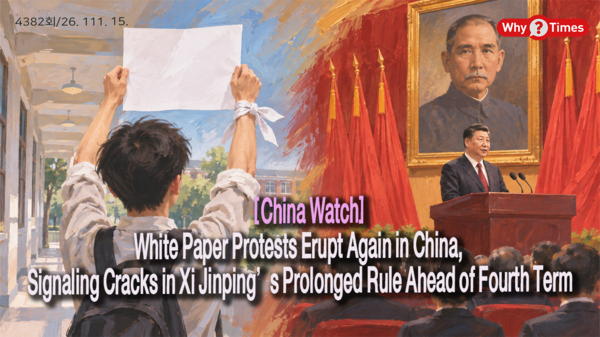
[White Paper Appears at Campus Gate of University Directly Under the United Front Work Department]
Shockwaves are rippling following reports that students staged a silent protest at Huaqiao University in Fujian Province, an institution directly administered by the Central Committee’s United Front Work Department (UFWD) of the Chinese Communist Party (CCP). Holding blank white sheets of paper and white towels, the students demanded the restoration of presidential term limits and opposed lifelong rule. The incident occurred just two weeks after the conclusion of the Fifth Plenary Session of the 20th Central Committee (Fifth Plenum) and around the 160th anniversary of Sun Yat-sen’s birth, which the CCP commemorated on a grand scale. The students reportedly called on university students nationwide to reignite the 2022 "White Paper Movement." This marks a resurgence of the same demands that surfaced in an "Open Letter from University Students" posted online on the opening day of the Fifth Plenum. Xi Jinping is eyeing a fourth consecutive term at the 21st Party Congress in 2027. As the alienation of the younger generation resurfaces against his regime and symbols of resistance revive amidst a dense surveillance network, the political burden Beijing faces is far from light.
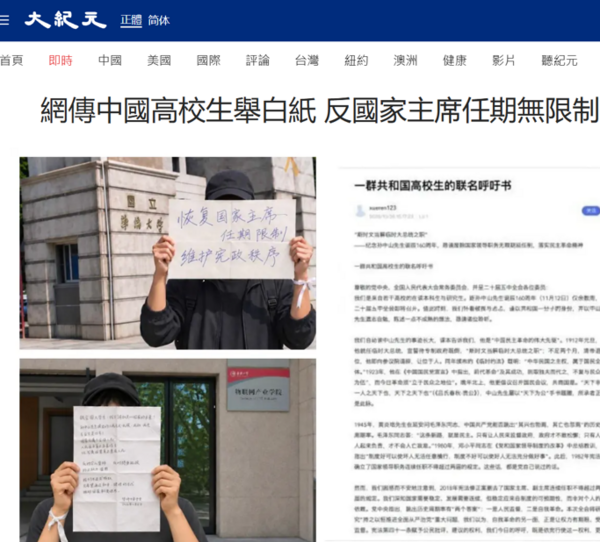
On November 14, the overseas Chinese-language outlet The Epoch Times reported that "photos circulated on overseas social media the previous day showing individuals introduced as Huaqiao University students holding handwritten white sheets of paper in front of the school gate," adding that "the papers contained demands to restore presidential term limits and uphold constitutional order, alongside an appeal for students at other universities to take action against the personality cult." With campuses in Quanzhou and Xiamen, Fujian Province, Huaqiao University explicitly states on its official website that it is directly affiliated with the CCP Central Committee’s United Front Work Department.
The photos were first made public on November 12. Overseas dissident Han Yunxiao uploaded several photos of Huaqiao University students to social media that day, and they spread rapidly across international platforms starting the next day. In the images, students with white cloth wrapped around their wrists hold handwritten sheets of paper against the backdrop of the campus gate. One photo, taken in front of the main gate bearing the plaque "Huaqiao University College of Engineering," features the signature "Huaqiao University Student" and the date November 8, 2026, written at the bottom of the sheet.
According to the overseas Chinese media outlet Vision Times, the placard read: "To university students nationwide: We have the right to be concerned about the future of our country! Oppose the personality cult, oppose lifelong rule, and prevent the abuse of power. We do not seek privilege. We merely hope that our national system advances in a peaceful and rational manner."
Posting the photos, Han Yunxiao wrote: "A single sheet of white paper, a few handwritten lines. Nothing grand, yet enough to make certain people nervous." He urged overseas supporters to "hold up white paper and tie on white towels to cheer on the students who bravely spoke out."
After allegations surfaced online that the photos were fabricated, Australia-based democracy activist Li Shangkai provided a rebuttal testimony to The Epoch Times on November 14. According to Li, several students took advantage of an empty campus during a holiday to stage the protest, holding up the handwritten demands with both hands bound by white towels. Li stated he is in contact with a participating student using the pseudonym Zhang Jun and showed chat logs to reporters.
["In Response to Peking University’s Appeal"… Carried Out Under Authorities' Pressure]
According to Zhang Jun, the catalyst was a joint appeal letter allegedly posted on an online forum by Peking University students. Once the post became a hot topic at Huaqiao University, government officials entered the campus to monitor student movements, placing the students under immense pressure. Zhang said, "In response to this initiative from Peking University, we want to spark the White Paper Movement once again. I hope university students across the country will step forward together, write our demands on white paper, tie white towels around their hands, and take photos."
Indeed, on October 26—the opening day of the Fifth Plenum—a post claiming to be a joint letter from students at 14 universities, including Peking University, Renmin University, and Tongji University, appeared on a site called "Siyuan Lake BBS." According to Radio Free Asia (RFA), the letter demanded the restoration of presidential term limits, discussions on democratic constitutional reform, and guaranteed space for debating state affairs, quoting Sun Yat-sen’s 1912 inaugural oath as Provisional President. However, it lacked individual signatures or verification of co-signers. The site’s registration country was listed as South Korea and its postal address in Singapore, leaving its origins unclear. Whether the appeal Zhang referred to was this specific letter, or if actual inter-university organization took place, remains unconfirmed.
The timing was also deliberate. November 12 marks the 160th anniversary of Sun Yat-sen’s birth. According to China's state-run Xinhua News Agency, Xi Jinping declared at a commemorative rally at the Great Hall of the People in Beijing that day that China must inherit Sun Yat-sen’s legacy to achieve the rejuvenation of the Chinese nation. Zhang targeted the very same day: "On this anniversary of Sun Yat-sen, I hope the Chinese people awaken. What we want is democracy, not a dictatorial government." Onto the stage where Beijing spoke of national rejuvenation, the students superimposed the question of how far power should be permitted to extend.
[The Symbolism of a University Directly Under the UFWD]
What gives this protest particular weight is its location. Founded in 1960 with campuses in Quanzhou and Xiamen, Fujian Province, Huaqiao University is directly overseen by the Party Central Committee’s UFWD. While it has long admitted ethnic Chinese students from Taiwan, Hong Kong, Macao, and Southeast Asia, the vast majority of its student body hails from the mainland. In effect, anti-regime criticism has emerged from an educational stronghold of United Front operations designed to embrace overseas Chinese and cultivate pro-regime forces.
U.S.-based exiled democracy activist Jie Lijian highlighted this significance. He told The Epoch Times, "Huaqiao University is an institution under the UFWD with a strong ideological tint that conducts specialized education," adding that "within such an educational system, speaking out—whether by holding a placard or writing a statement—requires taking enormous risks." He continued, "They chose to do so fully aware of what lies ahead for them." Regarding the choice of Sun Yat-sen’s birthday, Jie interpreted it as a wish that "the Three Principles of the People continue to spread in China so that the specter of dictatorial communism collapses as soon as possible."
[Memories of the 2018 Constitutional Amendment and the 2022 'A4 Revolution']
The institutional change targeted by the students is the March 2018 constitutional amendment. At that time, the National People's Congress (NPC) abolished the clause limiting the president and vice president to two consecutive terms. While the five-year term limit remained intact, the cap on consecutive terms was removed, enabling Xi Jinping to begin his third term as president in March 2023. Because he also serves concurrently as General Secretary of the CCP and Chairman of the Central Military Commission, the ramifications of demanding the restoration of term limits extend far beyond a single constitutional article. Meanwhile, on October 29, the Fifth Plenum adopted a decision on "comprehensive and strict governance over the Party," ratified the expulsion of 33 members from the Party, and scheduled the 21st Party Congress for the second half of 2027. Agence France-Presse (AFP) reported that due to ongoing purges, attendance at this plenum was the lowest since 1976, and projected a high likelihood of Xi securing a fourth consecutive term.
White paper first became a symbol of protest in November 2022. As vigils for victims of the Urumqi apartment fire escalated into demonstrations against COVID-19 lockdowns, citizens and students held up blank sheets of paper on streets and campuses, with calls for Xi Jinping to step down even emerging in Shanghai. Whereas the starting point in 2022 was lockdowns, this time the rules governing the supreme leader’s tenure are the central issue from the outset. Recording individual demands on paper and sharing photos without mass gatherings is a method that can easily spread to other campuses—though whether it has actually carried over to other universities has yet to be verified.
[Why Times Insight]
The Huaqiao University incident is read as a political warning because photos have surfaced presenting the restoration of the term limit cap—abolished by the 2018 constitutional amendment—as a demand from university students in 2026. If testimonies that students publicly questioned at their campus gate an issue the NPC had settled via constitutional revision are true, it demonstrates that dissent over the limits of power can still be openly expressed even after Xi’s third term. The setting—a university governed by the Party Central Committee’s United Front Work Department—adds substantial political weight to that question.
The benchmark for judging future repercussions will be whether identical demands are independently verified outside Huaqiao University. If verifiable evidence with confirmed dates and locations emerges from different campuses, and the shared demand to restore term limits repeats, there will be grounds to assess this as a broader political movement among university students. What stands out in current reports is that white paper, the symbol of the 2022 lockdown protests, is now being used to question the rules of the supreme leader's tenure. The question inscribed on that paper is specific: "How many consecutive terms should China's supreme leader be allowed to serve?"
Of course, this protest is unlikely to escalate immediately into a regime crisis. The number of participants appears small, and the authorities' identification and crackdown will be swift. However, as the record-low attendance at the Fifth Plenum illustrates, the Party is already shaken internally by purges. If signals of fractures from below continue to recur leading up to the 2027 Party Congress, anti-Xi sentiment could evolve from sporadic incidents into an accumulated consciousness of resistance. That is precisely why Beijing fears a single sheet of white paper.

-중국 푸단대학교 한국연구원 객좌교수
-전 EDUIN News 대표
-전 OUR NEWS 대표
-제17대 대통령직인수위원회 정책기획팀장
-전 대통령실 홍보기획비서관
-사단법인 한국가정상담연구소 이사장
-저서: 북한급변사태와 한반도통일, 2012 다시우파다, 선거마케팅, 한국의 정치광고, 국회의원 선거매뉴얼 등 50여권