
Update2026.10.24 (토)

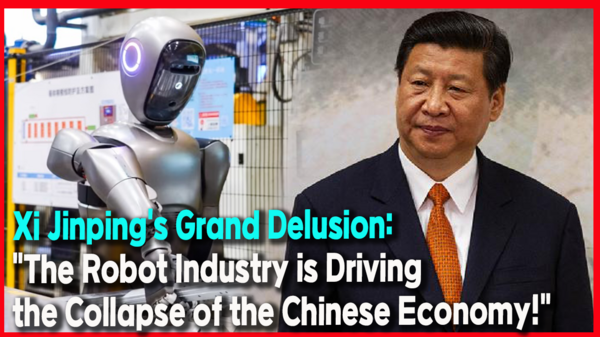
[Robots Multiply, but Consumers Close Their Wallets]
China is transforming into one of the world's most powerful AI and robotics powerhouses. Robots run factories, artificial intelligence boosts productivity, and electric vehicles alongside advanced manufacturing sweep global markets. Yet, the reality of the Chinese economy is the exact opposite. Sales of automobiles and home appliances are plummeting, the real estate market is collapsing, and consumers are tightly closing their wallets. Amidst this bizarre phenomenon where production expands while demand vanishes, President Xi Jinping's strategy of 'Tech Supremacy (Technology Rise)' faces a critical test.
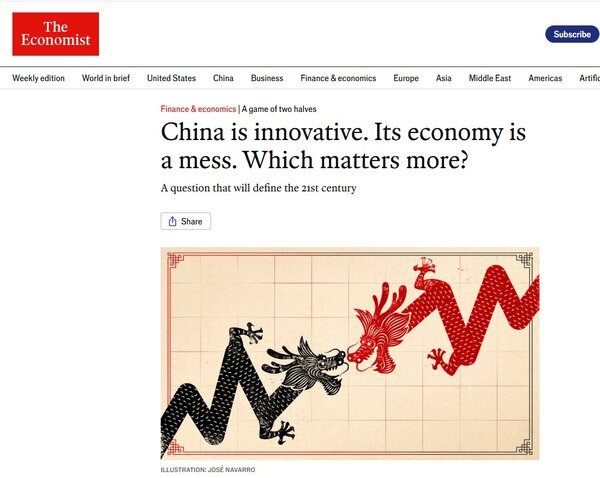
The Economist, the world’s highly authoritative global current affairs and economics weekly founded in 1843, recently analyzed the Chinese economy and posed a "question that will define the 21st century": Why is the overall economy failing to revive despite China's dazzling achievements in AI, robotics, and advanced manufacturing?
The Economist cited the high-tech industrial park in Yingtan, Jiangxi Province, south of Beijing, as a case study. Here, AI and robotics technologies are advancing rapidly, and China has already secured world-class competitiveness in new energy and advanced manufacturing. However, within the same country, the collapse of the real estate market, a local government debt crisis, sluggish consumption, and anxiety about the future are spreading simultaneously.
The publication pointed out that "the dazzling development of the high-tech sector is failing to save the national economy as a whole," noting that "this is precisely the most crucial economic question China faces today."
[Obsessed with Tech Supremacy, China Lost Its Consumption]
The core of the problem highlighted by The Economist is not robots or AI themselves. The issue lies in the Chinese government's excessive focus on nurturing high-tech industries at the expense of overall economic balance. The Economist noted, "Over the past several years, Chinese local governments have poured massive subsidies into semiconductors, electric vehicles, new energy, and AI industries in line with the central government's policy stance," adding, "As a result, China has reached world-class levels in terms of patent numbers and production scale."
However, side effects have snowballed. The Economist observed, "As overinvestment accumulated, supply skyrocketed while demand failed to keep pace, forcing companies into fierce price wars," and added, "Private enterprises found it difficult to compete with state-owned enterprises and strategic industries backed by government support. While capital was concentrated on expanding production, boosting consumption and strengthening the social safety net were pushed to the back burner."
The figures on the industrial front mirror this reality. The Economist pointed out, "As of April, the proportion of industrial enterprises recording losses reached approximately 32%, marking an all-time high," and emphasized, "This is not only significantly higher than the 10% recorded in 2011 but also surpasses the record set during the 1998 Asian Financial Crisis."
Interestingly, announcements from China's National Bureau of Statistics (NBS) during the same period indicated the exact opposite. The NBS announced last May that "total profits of industrial enterprises from January to April increased by 18.2% year-on-year." On the surface, businesses appear to be enjoying a massive boom.
Yet, this disparity exposes a fundamental issue surrounding Chinese economic statistics. Profits in non-ferrous metal smelting jumped by 120%, and computer and telecommunications equipment manufacturing increased by 110%. Conversely, profits in non-metallic mineral products manufacturing dropped by 50.7%, steelmaking fell by 51.5%, and auto manufacturing profits also decreased by 16.8%. In short, a few high-tech and resource-related sectors are propping up the overall average, while a vast majority of manufacturing and domestic demand-driven industries are already suffering from deteriorating profitability.
[Consumers are No Longer Buying!]
An even more severe problem is consumption, not production. The Economist pointed out, "While robots are multiplying exponentially in industrial parks, consumer sentiment remains depressed."
In fact, economic indicators from May directly confirmed these concerns. According to Reuters, "China's retail sales in May decreased by 0.6% month-on-month, turning negative again from a 0.2% increase in April." This marks the first monthly decline since December 2022.
The issue lies deeper than just the scale of the decline; it lies in the details. According to the Chinese economic media outlet Caixin, "Auto sales fell by 16.1%, home appliance sales dropped by 15.6%, and building material sales decreased by 13.6%."
Automobiles and appliances are the very items consumers purchase first when they feel optimistic about their future income. A simultaneous, sharp drop in sales for these items signifies not just a simple economic slowdown, but a severe contraction in consumer confidence itself.
Even the Labor Day holiday provided no relief. Reuters evaluated, "Despite the five-day Labor Day holiday, consumption failed to revive as expected," adding, "The effectiveness of the government's subsidy policy for consumer goods replacement is also gradually waning."
Households are also locking up their wallets. The Economist reported, "The balance of household bank loans recorded a decline for the first time in history." This implies that rather than taking out new loans to buy homes or increase spending, people are choosing to pay down debt and hoard cash.
[Xi Jinping's Gamble: Can It Succeed?]
Professor Yuen Yuen Ang of Johns Hopkins University assesses that "China is currently conducting an unprecedented experiment." She pointed out, "It is difficult to find a precedent in modern history where a country has fully mobilized its national capacity into high-tech industries while simultaneously experiencing an economic slowdown and a local government debt crisis."
President Xi Jinping's vision is clear: "To let high-tech industries like AI, robotics, EVs, and semiconductors replace the old growth model centered on real estate and construction."
The problem is speed. The legacy growth engines are collapsing before the new growth engines can grow large enough. Compounded by the US-China tech war, global supply chain restructuring, and overcapacity issues, China's high-tech industries are also facing profitability pressures. The Economist described this as a "high-stakes gamble."
Furthermore, The Economist analyzed that "the obsession with tech competition with the United States has distorted the priorities of the Chinese leadership." The goal of catching up with the US succeeded in nurturing advanced industries, but it failed to direct sufficient attention toward curing chronic economic ailments such as sluggish consumption, the real estate crisis, and local government debt.
[The Real Crisis of the Chinese Economy is a Lack of Demand, Not Production]
The true problem facing the Chinese economy is not a lack of production capacity. Rather, it is producing far too much. As AI and robots boost productivity and automate factories, more goods pour into the market. However, households whose assets have shrunk due to falling property prices, young people anxious about future income, and the middle class burdened by debt are no longer consuming as they used to. Factories are humming, but consumers are vanishing.
Ultimately, the new growth model envisioned by Xi Jinping focuses on "making more," but what the Chinese economy desperately needs right now is "consuming more."
Households, not factories, must be revitalized. Yet, Beijing's policy direction remains heavily tilted toward production over consumption, industry over welfare, and national competitiveness over household well-being.
As a result, the Chinese economy is morphing into a distinct 'K-shaped economy.' Advanced manufacturing and export industries continue to grow, while domestic demand, real estate, and consumer sectors keep shrinking.
Robots are on the rise. Consumers are on the decline. And the question that will determine the future of the Chinese economy is becoming clear: Can AI and robots really replace a broken property market and vanished consumption? If the answer is no, Xi Jinping's tech supremacy may turn out to be the starting point of another crisis, rather than the solution to save the Chinese economy.


-중국 푸단대학교 한국연구원 객좌교수
-전 EDUIN News 대표
-전 OUR NEWS 대표
-제17대 대통령직인수위원회 정책기획팀장
-전 대통령실 홍보기획비서관
-사단법인 한국가정상담연구소 이사장
-저서: 북한급변사태와 한반도통일, 2012 다시우파다, 선거마케팅, 한국의 정치광고, 국회의원 선거매뉴얼 등 50여권