
Update2026.10.24 (토)

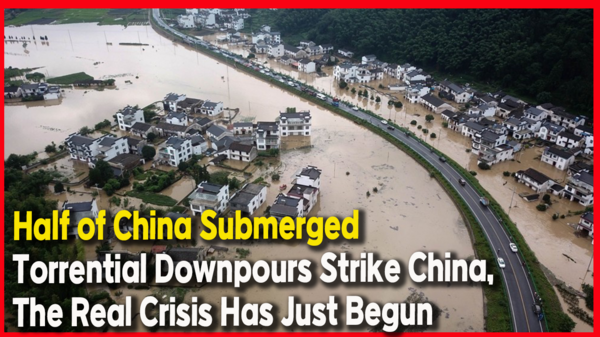
[A Deluge Unleashed Just Two Days Into the Meiyu Season]
China is entering its first major flood phase of this summer. In Anhui Province, the nation's highest and second-highest rainfall records were documented simultaneously within a mere five hours, and up to 500 mm of torrential rain is forecasted for some areas over the coming week. The issue is that this downpour is not a one-off anomalous weather event. Concerns are mounting among Chinese authorities over the risk of large-scale flooding this summer, as the Meiyu (plum rain) season—which began four days earlier than average—shows signs of stalling over the Yangtze and Huai River basins for an extended period.
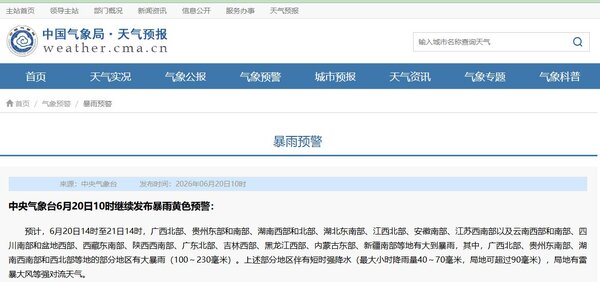
The China Meteorological Administration (CMA) announced on June 20, "Anhui Province entered the Meiyu season on June 18," adding, "The onset of the Meiyu season in the Jianghuai region arrived four days earlier than in typical years." The Meiyu season is a phenomenon where a monsoon rain belt, formed under the influence of the East Asian summer monsoon, stalls for prolonged periods, triggering concentrated heavy downpours. In particular, the Yangtze and Huai River basins are traditionally ground zero for China's annual flood damage.
Meteorological experts are paying closer attention to the timing of its onset rather than the Meiyu season itself. This is because an earlier start increases the likelihood of a prolonged rainy period, which in turn can significantly boost cumulative rainfall. This explains the growing anxiety that central and eastern regions of China could face a much longer flood season this year compared to historical averages.
[Anhui Province Devastated... Securing the Nation's Top Two Rainfall Records in Just 5 Hours]
The epicenter of this torrential rain was Anhui Province. China National Radio (CNR) reported, "From 5:00 AM to 10:00 AM on June 19, among the 2,418 national-level meteorological stations across the country, Dingyuan County in Anhui Province recorded the nation's highest rainfall at 137.9 mm, while Mingguang City ranked second with 102.1 mm." In essence, nearly a month's worth of rain was dumped on these two regions in just five hours.
The Anhui Meteorological Observatory immediately issued a yellow alert for heavy rain. Some parts of Huangshan City were expected to receive massive downpours ranging from 150 to 180 mm, with maximum hourly precipitation projected to reach 60 to 80 mm.
The state-run media outlet Guangming Daily reported, "The Anhui Provincial Department of Natural Resources and the Emergency Management Department issued a red alert for landslides across Huangshan City." The probability of landslides occurring in certain areas was assessed to be extremely high.
A presenter on "Xinwenxia," an online channel operated by the local Anhui media outlet Anhui Business Daily, described the current situation in a single sentence during a broadcast: "This isn't rain; it's as if the floodgates of heaven have been thrown open."
Indeed, widespread concerns over damage are mounting across Anhui Province, to the extent that ten prefecture-level cities—including Lu'an, Hefei, Chuzhou, Anqing, Chizhou, Tongling, Wuhu, Ma'anshan, Xuancheng, and Huangshan—have simultaneously been placed under intensive management.
[Even Railways Ground to a Halt... Rainstorms Shake China's Arteries]
The severe weather has moved beyond mere localized flooding and has begun to disrupt the transportation network.
The Paper (Pengpai News) reported that train services on several railway lines had been suspended due to the heavy rain and convective weather affecting central and southern Anhui.
Train services operating between Hefei Station and Yeji Station were cancelled one after another, and long-distance routes passing through Wuhu Station were also halted. Some trains remained suspended for two consecutive days. This is not merely a matter of daily inconvenience.
Anhui Province is a critical logistics hub connecting the Yangtze River basin with eastern China's manufacturing belt. If rail disruptions become prolonged, it could impact not only passenger travel but also supply chain logistics. This is precisely why Chinese authorities are keeping a watchful eye on the rainfall situation.
[Not Just an Anhui Problem... Half of China Under the Umbrella of Heavy Rain]
A bigger issue is that the heavy rain is not confined to Anhui Province. According to the China Meteorological Administration, from June 19 to 20, severe convective weather struck a vast area encompassing four autonomous regions—Inner Mongolia, Gansu, Ningxia, and Guangxi—as well as Beijing, Tianjin, and the provinces of Hebei, Shandong, Henan, Jiangsu, Hubei, Hunan, Jiangxi, and Guangdong. Some regions were battered by torrential rain exceeding 90 mm per hour, accompanied by hail and gale-force winds.
Xinhua News Agency also projected that a massive and intense rain band would persist over the Northeast, North China, the middle and lower reaches of the Yangtze River, and South China over the next few days. Effectively, most of central and eastern China has fallen into the high-risk zone for severe storms.
[The Real Trouble Lies in the Coming Week... Up to 500mm of Heavy Rain Forecasted]
However, the genuine crisis is that these unimaginable downpours are only just beginning. What worries Chinese meteorological authorities most at this stage is the projected volume of upcoming rainfall.
Sina.com, citing forecasts from China Weather Net, reported, "From June 19 to 24, cumulative rainfall in the middle and lower reaches of the Yangtze River and the Jiangnan region will generally exceed 200 mm, with some areas seeing 300 to 400 mm, and localized areas potentially exceeding 500 mm." A figure of 500 mm is by no means minor. According to data from the China Meteorological Administration, the average historical Meiyu rainfall for the Jianghuai basin hovers around 300 mm.
This means that within less than a week from the start of the Meiyu season, certain areas could be hit by an entire season's worth of rain all at once. What is even more alarming is that the rain belt is stationary and shows no signs of moving anytime soon.
In relation to this, the Hong Kong-based South China Morning Post (SCMP) analyzed, "The rain belt is currently stalled over the Yangtze and Huai River basins," adding, "If the front fails to push northward, there is a high probability that heavy precipitation will repeatedly concentrate over the exact same regions."
SCMP further noted, "However, what sets this year's rainfall apart from previous years is its premature onset," pointing out that "The fact that the Jianghuai basin entered the Meiyu season four days earlier than average leads to concerns that cumulative rainfall across the middle and lower reaches of the Yangtze River could accumulate longer and in greater volumes than in previous years."
[Memories of the 1998 Great Flood... Why China Is on High Alert]
The reason China is reacting so sensitively to this rainstorm stems from historic trauma. The Yangtze and Huai River basins are symbolic regions when it comes to flood damage in China.
SCMP noted, "The 1998 Great Yangtze River Flood is recorded as one of the worst natural disasters in modern Chinese history," recalling that "At the time, thousands lost their lives and tens of millions were displaced." Following that disaster, the Chinese government pushed forward with large-scale levee construction and water conservancy projects, but the inherent risk of flooding was never entirely eradicated.
SCMP added, "In 2020, massive flooding hit the Yangtze River basin again, causing water levels at the Three Gorges Dam to rise to dangerous levels and putting the entire Chinese society on edge," concluding, "While it is premature to conclude that the current Anhui downpours will immediately escalate into a disaster on par with 1998 or 2020, the fact that record-breaking rainfall is being observed right at the start of the Meiyu season is a signal that cannot be taken lightly."
The Paper also pointed out, "The suspension of train services must be viewed in the same context," adding, "The simultaneous halting of multiple lines at major railway hubs within Anhui—such as Wuhu, Hefei, and Yeji—indicates that the heavy rain has gone beyond causing simple everyday inconveniences and is now threatening the transit and logistical arteries traversing the province."
[The First Alarm Has Sounded... China's Flood Response Capabilities Put to the Test]
The core of this crisis does not lie merely in the large volume of rain that has fallen. The real problem is the simultaneous convergence of multiple factors: a Meiyu season starting earlier than average, a forecast of up to 500 mm in cumulative rainfall over a week, and a monsoon front stalled over the Yangtze and Huai River basins. The top two national rainfall records set in Anhui within five hours might just be the opening act.
In recent years, Chinese authorities have repeatedly pledged to build cities capable of withstanding "once-in-a-century rainstorms." However, the 2021 Zhengzhou subway disaster and the 2023 Great Beijing Flood demonstrated that China's drainage infrastructure and disaster management capabilities remain vulnerable.
Ultimately, the key factor going forward is not the amount of rainfall itself, but rather how well China's cities, rivers, reservoirs, and drainage systems can cope with this deluge.
The first alarm sounding from Anhui Province is more than just a piece of local disaster news. It may well be the signal heralding the beginning of a much harsher and larger flood season that China will have to confront this summer.


-중국 푸단대학교 한국연구원 객좌교수
-전 EDUIN News 대표
-전 OUR NEWS 대표
-제17대 대통령직인수위원회 정책기획팀장
-전 대통령실 홍보기획비서관
-사단법인 한국가정상담연구소 이사장
-저서: 북한급변사태와 한반도통일, 2012 다시우파다, 선거마케팅, 한국의 정치광고, 국회의원 선거매뉴얼 등 50여권