
Update2026.10.24 (토)

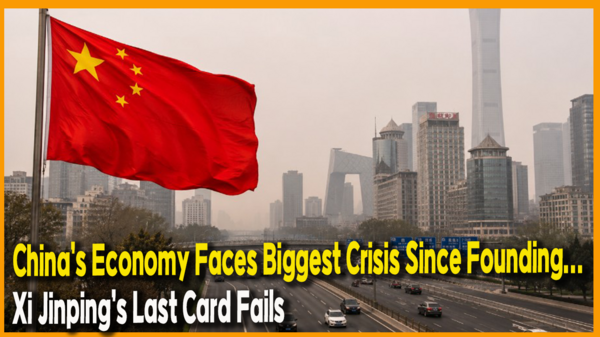
[Property, Local Government Finance, and Employment Shake Simultaneously: The Chinese Growth Model Hits Its Limits]
China is plunging into the midst of a complex economic meltdown unlike anything it has experienced since its founding. As real estate, local government finance, employment, and consumption sink simultaneously, all stimulus cards deployed by Beijing have been exhausted one by one. International experts are now formalizing diagnoses that there is no way out, warning that China’s problems have transcended a short-term slowdown and entered a structural crisis.
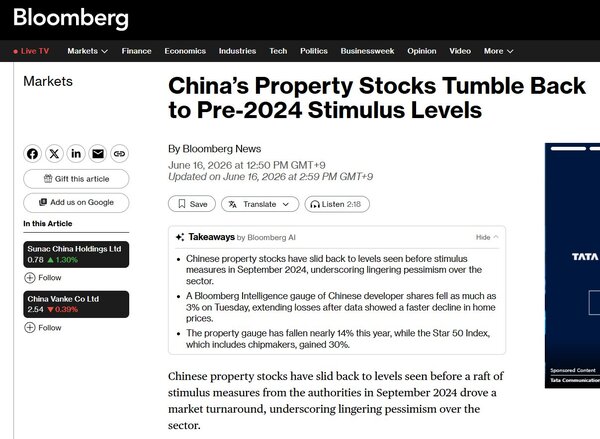
Bloomberg reported on June 17, 2026, "Chinese property stocks have completely collapsed below the levels prompted by authorities' massive stimulus package in September 2024 that briefly led a market rebound, reaffirming deep-seated market pessimism toward the sector." According to the report, a developer stock index compiled by Bloomberg Intelligence plummeted by as much as 2.1% during intraday trading on June 16.
Bloomberg further noted, "In September 2024, Beijing unleashed an all-out stimulus package ranging from interest rate cuts to the massive purchase of unsold homes, driving a stock surge, but the market is now saying 'this time is different.' Just four months after convincing investors that Beijing would do whatever it takes to revive the economy, the stock rebound began to falter, disappointment blanketed the entire market, and now stock prices have returned precisely to their starting points." The last card pulled by Beijing has vanished without leaving a trace.
[Actual Growth Rate is Half of Official Announcement — The Truth Hidden Behind Statistics]
How critical China’s crisis has become is most clearly revealed by the gap between the statistics Beijing presents and the reality on the ground. Regarding this, the US-based think tank Rhodium Group pointed out, "Historically, no economy has ever recorded a 5% real GDP growth rate while simultaneously suffering through 10 consecutive quarters of deflation." Rhodium estimated that China’s real GDP growth rate in 2025 stood at a mere 2.5% to 3.0%, roughly half of the official figure announced by the National Bureau of Statistics.
Nippon.com, an outlet known for providing precise and in-depth information featuring top sector experts and journalists, noted, "In 2025, the Chinese government's total revenue decreased by 1.7% year-on-year." It emphasized that "this marks the first decline in five years since 2020, when the shock of COVID-19 was at its peak. With the state coffers shrinking, no one believes Beijing's 5% growth statistics anymore."
Camille Boullenois, an economist at the Rhodium Group, warned, "Without structural reforms, Beijing is running out of ways to escape producer price deflation," adding that "major policy tools are already near a state of practical exhaustion."
Logan Wright, a partner leading China markets research at Rhodium Group, stated definitively, "The deflation problem is structural. It is not something that can be easily resolved by short-term data anomalies or specific policy stimulus." Even more serious is housing prices. Bloomberg pointed out, "Chinese home prices have been falling for four and a half years, representing a destruction of household wealth comparable to the 2008 financial crisis in the US," noting that "unlike the US, however, China's decline is still accelerating."
[A 170-Trillion-Yuan Void: Property Collapse is Swallowing the Entire Economy]
The foreign affairs magazine The Diplomat stated, "In reality, real estate was not just a single industry, but the central pillar of the Chinese economy that ran through steel, cement, construction, finance, local government revenue, and overall household consumption." It added, "The real estate sector, which once accounted for a third of GDP, has now plummeted to 11.4%, and China currently has no alternative to fill that void." The Diplomat further pointed out, "According to Rhodium Group estimates, the total volume of China's real estate sector evaporated by $800 billion in just two years, shrinking from $2.9 trillion in 2023 to $2.15 trillion in 2025. During the same period, real estate-linked infrastructure spending also contracted from $760 billion to $650 billion, resulting in a combined GDP loss of approximately $900 billion."
The Diplomat continued, "From 2020 to 2024, losses in the Chinese real estate market had already exceeded 120 trillion yuan (approx. $18 trillion), and now they are highly likely to have surpassed 170 trillion yuan. This is a scale that surpasses the 2008 financial crisis in the US or the collapse of Japan’s asset bubble." In China, where 70% of household wealth is tied up in real estate, such losses lead directly to a collapse in consumption. A deflationary spiral is already at work: when consumption drops, companies cut production; when companies cut production, wages are slashed; and when wages are slashed, consumption drops even further.
Bloomberg analyzed that "major commodity markets also reflect this shock." It noted, "The price of polysilicon, a key material for solar cells, has plummeted to less than one-fifth of its 2022 peak, and the price of rebar, essential for construction sites, has crashed to an eight-year low. An analysis of over 6,000 listed companies revealed that the proportion of Chinese listed firms recording losses in the first half of 2025 exceeded 25%, reaching its highest level in at least a quarter-century."
[The Collapse of Vanke: The Fall of a Giant That State Support Cannot Prevent]
Bloomberg noted, "The trajectory of China's largest property developer, Vanke, encapsulates the essence of this crisis. Vanke recorded a historic annual net loss of 88.2 billion yuan (approx. $12.8 billion) for 2025, with combined losses across two fiscal years surpassing 130 trillion yuan. In the first quarter of 2026, it posted another net loss of 5.95 billion yuan, while revenue for the same quarter plummeted 23.86% year-on-year."
Bloomberg added, "This astronomical loss clearly demonstrates that whether Vanke avoids default now hinges entirely on the willingness of its state-owned shareholders to provide support. However, the moment even the state closes its wallet, fear of a chain-reaction collapse will inevitably spread through the market. Premature declarations that 'the worst is over' have been repeated several times, but all proved wrong. In November last year, even UBS quietly withdrew its outlook for an early recovery."
[Total Meltdown of Local Finances: Every Province Fails to Stand Alone]
In the first quarter of 2026, the fiscal self-sufficiency rate of all 28 provincial-level administrative regions that disclosed data fell below 100%. For the first time in Chinese history, even the wealthiest economic powerhouse provinces have become incapable of covering their own budgets with their own revenues.
Rhodium Group noted, "The scale of this fiscal vacuum is beyond imagination." It pointed out, "While total assets in the Chinese banking sector reach $70 trillion, the growth rate of new loans has plummeted to a record low of 6.1%. Compared to an average of 18.1% from 2007 to 2016 and 9% from 2017 to 2024, the financial system’s engine that supplies blood to the economy has effectively run dry." Rhodium criticized that "the fact that 58% of loans are executed below the benchmark interest rate means banks have already abandoned profitability and entered 'zombie finance' to keep a insolvent system on life support."
As local governments struggle with financial distress, salary cuts and delays for civil servants, teachers, and police officers are spreading nationwide. China's "iron rice bowl (鐵飯碗)" is shattering simultaneously across the country.
[The Industrial Heartlands are Withered: FAW’s Crisis and Mass Automotive Closures]
The crisis has bypassed financial markets to pierce the very heart of China’s industrial apparatus. State-owned FAW (First Automotive Works Group), founded in 1953 and producer of China's very first automobile, is seeing its massive empire centered on its Changchun headquarters shake as it faces a simultaneous onslaught from a failed transition to the electric vehicle (EV) era and sluggish internal combustion engine joint ventures. The crisis of this state-owned giant, once dubbed the "cradle of the Chinese automotive industry," is also politically fatal to the authorities.
From January to April this year, Chinese auto sales plunged by 20.6% year-on-year. The world's largest automotive market has degenerated into a structure that abandons domestic demand and survives solely on exports—a direct consequence of large-scale cuts to vehicle purchase subsidies following the bankruptcy of local government finances. Within the EV market, approximately 50 cash-strapped firms are projected to downsize or completely shut down within 2026. China’s ambition to leap from the "factory of the world" to the world's dominant EV superpower is stumbling, caught off guard by the ambush of collapsing domestic demand.
[Youth in Despair: An Employment Collapse Official Statistics Cannot Hide]
While the official youth unemployment rate stands at 16.9%, analysis suggests the actual figure is closer to 40%. In 2026, 12.6 million college graduates will enter the job market, breaking records yet again.
As Beijing's AI strategy forces corporations to optimize workforce efficiency, "quiet layoffs" are rapidly spreading among large Chinese enterprises. To evade government pressure regarding employment stability, corporations are reducing headcount without making official announcements. Consequently, the number of "invisible unemployed" who do not show up in official labor statistics is exploding. These individuals drift between delivery platforms and short-term gig work, joining the ranks of a "platform worker" army that numbers 320 million people.
[The Chinese Communist Party’s Last Card: Brainwashing Campaigns]
As economic solutions run dry, what the Communist Party has pulled out is ideological control. At the National People's Congress in March 2026, the Xi Jinping leadership lowered its GDP growth target below 5% for the first time since 1991, setting it at 4.5% to 5%. In doing so, the Communist Party has tacitly admitted that fewer and fewer people believe in the economic myth.
Authorities are launching propaganda campaigns that label the youth phenomenon of "lying flat (躺平·Tangping)" as ideological laziness, and even claiming it is orchestrated by foreign forces. However, rather than resolving the issue, this rhetoric only deepens the anger and cynicism of the youth.
Eurasia Group warned, "Ahead of the 21st Party Congress in 2027, Xi Jinping will prioritize political control and technological hegemony over consumption stimulus and structural reform," adding that "while Beijing possesses the tools to manage the crisis itself, the public's standard of living will continue to deteriorate in the process, and the repercussions will ripple across the globe."
Foreign Policy defined the crisis facing the Communist Party as a "managed decline," noting that "it is a framework that maintains political dominance while increasingly failing to deliver on promises of growth, opportunity, and institutional trust." This is not an outright collapse, but something far more volatile—an unstable equilibrium that persists for a long time until, at a sudden moment, it can no longer hold.
The primary issue confronting the Chinese economy is not the growth rate itself. It is that Beijing continues to prioritize control over market reform amidst a structural crisis where real estate, local finance, employment, and consumption are failing simultaneously. In the past, whenever a crisis struck, China could buy time with massive stimulus packages. Now, however, the world has begun to ask: Does the Xi Jinping regime retain any capability left to revive the economy, or has it entered the stage of merely managing its decline?


-중국 푸단대학교 한국연구원 객좌교수
-전 EDUIN News 대표
-전 OUR NEWS 대표
-제17대 대통령직인수위원회 정책기획팀장
-전 대통령실 홍보기획비서관
-사단법인 한국가정상담연구소 이사장
-저서: 북한급변사태와 한반도통일, 2012 다시우파다, 선거마케팅, 한국의 정치광고, 국회의원 선거매뉴얼 등 50여권