
Update2026.10.24 (토)


[“The Collapse of Chinese Investment Has Created Ghost Districts in London”]
The Liberty Times (自由時報), a prominent daily newspaper in Taiwan, has directly spotlighted the failure of Chinese capital in overseas real estate investments. As Chinese funds that aggressively flooded into London roughly 18 years ago recede like a low tide—driven by China's domestic property crisis and intensifying geopolitical friction—they are leaving behind "ghost districts" right in the heart of the British capital. This phenomenon is not merely an isolated failure of foreign investment. It stands as vivid evidence that the ghost town crisis plaguing mainland China, birthed by the Xi Jinping administration's botched property policies and local governments' reckless overdevelopment, is spilling across borders and spreading globally.
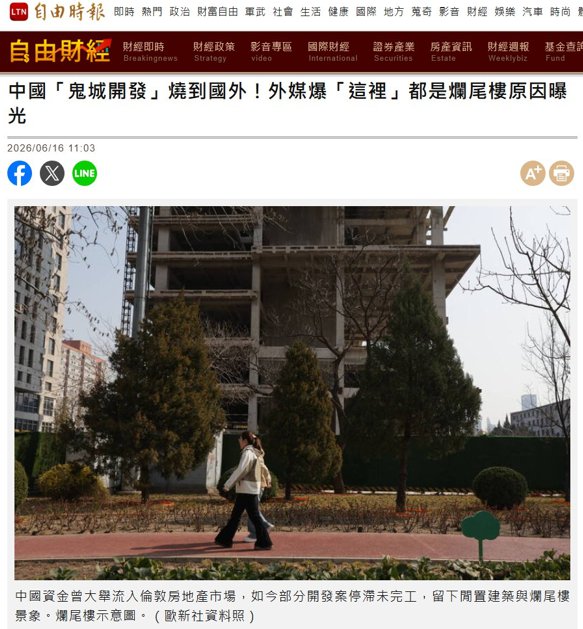
On June 16, under the direct headline "How the Collapse of Chinese Investment Created Ghost Towns in London," the Liberty Times cited an analysis by the British media outlet The London Standard, drawing keen attention by reporting that "Chinese capital has left indelible traces of 'ghost neighbourhoods' across London."
The Liberty Times pointed to the Royal Mint Court fiasco near Tower Bridge as a prime example. The paper noted, "Between 2008 and 2016, during the so-called 'Golden Era' when UK-China relations were at their peak, Chinese capital poured into London. When the 2008 financial crisis drove London's commercial property prices down to attractively low levels, large Chinese developers and state-owned banks jumped in en masse, as Beijing actively encouraged the external investment of domestic capital that could not be absorbed at home."
The report introduced a recollection from a Chinese real estate broker active at the time: "The Chinese bought anything. Absolutely anything." During that period, massive projects kicked off in rapid succession around Nine Elms, Canary Wharf, and the East London Docklands, with state-owned banks and mega-developers aggressively competing for a piece of the pie.
However, the tide has turned. The urban regeneration and job creation promised by Chinese capital have ended up as empty slogans. Out of 391 development projects currently active in London, eight mega-sites managed by five major Chinese developers remain completely stalled or left half-built and abandoned.
The Royal Mint Court dispute has become the ultimate symbol of this friction. China purchased the site in 2018 for £255 million (approximately 440 billion KRW) and unveiled plans to construct a 600,000-square-foot "mega-embassy." However, espionage anxieties exploded when it was revealed that an intricate underground network of 208 secret rooms lay beneath the site, with one chamber sitting just one meter away from the UK's most sensitive telecommunications cables. Local planning authorities rejected the embassy proposal twice, in 2022 and 2024. Although UK Housing Secretary Steve Reed finally approved the plan in January 2026, just ahead of Prime Minister Keir Starmer's state visit to China, appeal proceedings remain active, and construction has yet to break ground.
[The Global Shockwaves of China's Real Estate Withdrawal]
London is not alone. Similar wounds remain wherever Chinese capital made landfall. "Forest City," built on artificial islands in Malaysia's Johor Strait, now sits virtually abandoned. Littered with empty streets, shuttered storefronts, and vacant high-rises, the city mirrors the deep financial distress of its embattled Chinese developer, Country Garden.
British media outlets cited by the Liberty Times are unsparing in their assessment: China, once warmly welcomed as a "deep-pocketed city builder," has morphed into an "authoritarian threat" in less than a decade. The retreat of Chinese capital from London is not a routine divestment; it is the byproduct of a complex systemic collapse driven by interlocking geopolitical tensions and China's domestic real estate implosion.
[The Mainland Catastrophe: 50 Ghost Cities, Up to 80 Million Vacant Homes]
The true disaster, however, lies within mainland China. London's ghost districts are merely the tip of the iceberg. Newsweek reported that "the number of vacant homes across China ranges between 65 million and 80 million units," quoting He Keng, former deputy head of the National Bureau of Statistics, who stated: "The most extreme estimates suggest that the current number of vacant properties is enough to accommodate 3 billion people."
To put this figure into perspective, one only needs to look at the total population of Germany (approximately 84 million). Even the conservative estimate of 65 million vacant units is enough to house nearly the entire German population.
Commenting on this, the U.S.-based anti-communist media outlet Vision Times cited market experts to deliver a sharp critique: "The era of 'build it and they will come' is over. China is currently managing the painful liquidation process of the largest asset bubble in human history."
The same grim reality applies to the Xiong'an New Area, Xi Jinping's signature vanity project. Launched in 2017 as a "thousand-year plan" to build a utopian metropolis that would relieve pressure on Beijing, the project remains eerily deserted nine years later. It is nowhere near its residential target of 5 million people, and the few who do live there are mostly employees of state-run schools and enterprises forced to relocate by the government.
A university administrator living there remarked, "The city is clean and basic amenities are present, but it lacks the vitality of life." While foreign media and independent observers routinely describe Xiong'an as a "ghost town" or the "ghost city of the century," Xi Jinping visited the site in March 2026 and adamantly claimed that the project was "a completely correct decision."
[The Time Bomb Planted in 1994: The Self-Destruction of Land Finance]
This catastrophe did not materialize out of thin air. Its roots trace back to the 1994 tax reform. When Beijing centralized tax revenues, cash-starved local governments turned to land leasing as a primary survival mechanism. By the early 2000s, land leases accounted for 60% to 80% of local government revenues. Because local officials’ promotions were tied strictly to GDP growth rates, and constructing buildings boosted GDP, development continued unhindered by actual market demand.
Faced with restrictions on borrowing directly from the central government, local authorities established special purpose vehicles called "Local Government Financing Vehicles" (LGFVs) to raise trillions of yuan by using land as collateral. Because these liabilities were kept strictly on the books of the corporate entities, the official balance sheets of local governments appeared clean. As of 2026, the total hidden debt of these LGFVs is estimated to have surpassed 60 trillion RMB (approximately $8.5 trillion USD).
The Atlantic Council observed: "LGFVs historically relied on land lease revenues to service their loans, but that revenue stream evaporated when the property bubble burst in 2021. A substantial portion of them are now morphing into 'zombie enterprises' that rely on new borrowing or government subsidies just to tread water."
[From the Collapse of Evergrande to 47 Consecutive Months of Decline]
The Chinese real estate market has now logged 47 consecutive months of decline. This is not a standard cyclical downturn; it is a fundamental dismantling of the land finance and fiscal myths that the Chinese Communist Party has relied on for survival over the last 30 years.
When the Evergrande Group collapsed in 2021 under a crushing debt load of $300 billion USD, construction on hundreds of thousands of pre-sold homes ground to a halt simultaneously. Eighteen months later, Country Garden—then China's largest private developer—flashed its own crisis signals. In May 2024, Beijing acknowledged that the real estate crisis had reached economic emergency levels, rolling out a $42 billion USD bailout package. However, market experts argue that the actual cost to fundamentally resolve the crisis ranges from $500 billion to $1 trillion USD, making the current state interventions completely insufficient.
[Desolate Streets, Empty Malls, and Silent Factories: "Where Are the People?"]
The ghost town phenomenon is no longer confined to speculative development zones. Chinese economic commentator Zhang Ping recently noted: "Even during major holidays, there are no people on the streets or in the shopping districts. You can stand around for ten minutes and only see a handful of people pass by. In a superpower of 1.4 billion people, where has everyone gone?" This is a question foreign media outlets are echoed in asking.
Vision Times reported: "In early 2026, stepping just a few blocks off Shanghai’s core avenues reveals rows of vacant storefronts plastered with 'For Rent' signs, empty shopping malls, and desolate commercial blocks. In Shenzhen, roughly 1,000 restaurants closed their doors in the second half of 2025 alone, and hotels that have been open for less than five years are filing for bankruptcy."
While Zhang Ping attributes the emptiness to structural shifts like changes in consumption habits, factory automation, and rural depopulation, foreign analysts focus on a deeper systemic truth. A structural cash crunch—characterized by deflation, severe demand contraction, and a lack of liquidity—is cementing itself as a permanent fixture of the economy. The ghost town blight is spreading nationwide, and even Shanghai’s premier office market is facing unprecedented vacancy pressures.
The Rhodium Group, a think tank focused on China’s economy and politics, noted: "According to global real estate services firm Cushman & Wakefield, as of the second quarter of 2025, the average vacancy rate for prime commercial real estate across 15 major Chinese cities reached 11.1%. Compounding this is a shrinking population; China's births plummeted to 7.92 million in 2025—less than half the figure recorded a decade ago. It is estimated that China will lose nearly 60 million people over the next ten years."
[Outlook and Commentary: a Shadow Globalized]
The ghost districts in London captured by the Liberty Times are not merely a British urban planning issue. They represent the physical scars left abroad by the Chinese growth model, serving as a stark warning that China's real estate-driven economic engine can no longer function in the old way. The ghost towns that began in Ordos and Xiong'an have now metastasized to London and Johor. China's real estate crisis is no longer a domestic affair. Because the Chinese economy became globalized, its shadows have become globalized too.


-중국 푸단대학교 한국연구원 객좌교수
-전 EDUIN News 대표
-전 OUR NEWS 대표
-제17대 대통령직인수위원회 정책기획팀장
-전 대통령실 홍보기획비서관
-사단법인 한국가정상담연구소 이사장
-저서: 북한급변사태와 한반도통일, 2012 다시우파다, 선거마케팅, 한국의 정치광고, 국회의원 선거매뉴얼 등 50여권