
Update2026.10.24 (토)


[The Fuse Ignited by a China-Linked South Korean Telecom Company]
As the United States enforces unprecedented export controls on cutting-edge AI models, South Korean companies have taken a direct hit. Washington has begun defining AI models themselves as strategic assets—on par with advanced semiconductors—and is reacting with extreme sensitivity to any potential links to China. This measure is not merely a technical regulation; it serves as a new testing ground, forcing South Korea to choose its stance amid the intense tech hegemony race between the U.S. and China.
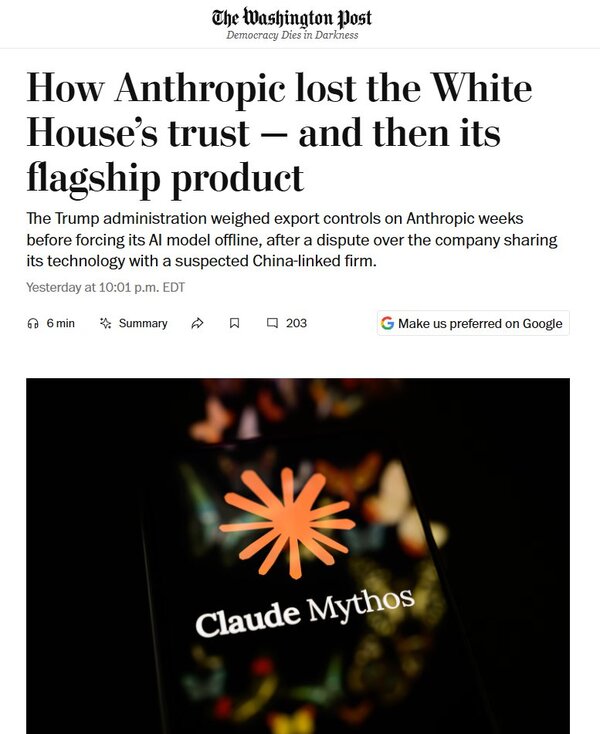
The Washington Post (WP) reported on June 16 (local time) that "the Trump administration's decision to impose export controls on Anthropic was triggered by a dispute arising from Anthropic sharing its technology with a company suspected of having ties to China." According to government officials cited by WP, the company in question was a South Korean telecommunications firm included in the "Mythos early access list" that Anthropic had submitted to the U.S. government. WP did not specify the name of the firm.
On June 1, the Department of Commerce issued a letter signed by Secretary Howard Lutnick to Anthropic CEO Dario Amodei. The directive mandated that any export, re-export, or domestic transfer of Mythos 5, Mythos Preview, and Fable 5 to any non-U.S. citizen must obtain prior government approval. Anthropic officially announced its compliance on June 13, and this restriction applies equally to foreign nationals residing within the United States.
Semafor, a U.S. media outlet specializing in international affairs, reported that "the White House imposed the export controls based on allegations that a China-linked group had accessed Mythos. The Trump administration instructed that access to Mythos and its publicly available version, Fable 5, be restricted strictly to U.S. citizens." As a result, even foreign-national employees working within Anthropic are now barred from using their own company's models.
What underscores the severity of this issue is the sheer speed of the execution. The Department of Commerce activated the export control on June 13, forcing Anthropic to cut off worldwide access to Mythos and Fable 5. U.S. authorities raised concerns that China-linked entities could access Mythos and replicate the model using a technique known as "distillation." Citing the technical impossibility of verifying a user's nationality in real-time on an API session basis, Anthropic chose to completely withdraw the models from the market.
[The Collapse of 'Project Glasswing'… All South Korean Partners Blocked]
The core background of this crisis traces back to 'Project Glasswing,' a security consortium Anthropic had been operating since April. Spurred by concerns that Mythos could be weaponized by malicious hackers, Anthropic had restricted model access to a vetted group of companies and institutions exclusively for defensive cybersecurity vulnerability detection. Through this project, roughly 12 major corporate partners and over 40 additional institutions were granted access.
Project Glasswing initially launched in April with around 50 U.S. partners and expanded by early June to encompass over 150 institutions across more than 15 countries. The roster included critical infrastructure operators in power, water, healthcare, and telecommunications, alongside financial infrastructure giants like SWIFT, Euroclear, the Intercontinental Exchange, NATO, and the EU Agency for Cybersecurity (ENISA).
SK Telecom officially announced its participation in Project Glasswing and its securing of early access to Mythos on June 4, boasting that it was the first mobile carrier in Asia to do so. However, less than 10 days after the announcement, all participating South Korean institutions—including SK Telecom—had their access rights abruptly revoked. Due to this sweeping measure, South Korean Glasswing members including the Korea Internet & Security Agency (KISA), SK Telecom, and Samsung Electronics suffered immediate access cutoffs. European Glasswing partners like NATO and ENISA were similarly blocked without prior notice.
[Why Do South Korean Companies Hold Hands with China?]
This situation begs a fundamental question: Why do certain South Korean companies fail to sever ties with China, even when their access to cutting-edge U.S. technology hangs in the balance?
The answer is structural. The Korea Economic Institute of America (KEI) pointed out that "the relationship between South Korea and China is a complex structure woven from economic interdependence, strategic competition, and regional security concerns. Managing this balance has been a core challenge for every successive South Korean president." KEI added that "South Korea's relations with Beijing have remained strained for about nine years following the deployment of the THAAD missile defense system, during which China retaliated economically by restricting tourism and Hallyu (Korean Wave) cultural exports."
Furthermore, the Chinese market remains a massive revenue source for South Korean businesses. The Center for Strategic and International Studies (CSIS) assessed that "South Korean companies maintain a high export dependency on China in sectors like semiconductors, displays, and chemical materials. Completely severing joint ventures or technical cooperation with China would entail devastating short-term financial losses." CSIS also noted that "U.S. allies are struggling to keep pace with the velocity of Washington's export controls against China." In fact, while South Korea has used its own Act on Prevention of Divulgence and Protection of Industrial Technology to partially block technology transfers to China, it has yet to establish the comprehensive, sweeping export control framework demanded by the United States.
However, this incident signals that the geopolitical math has fundamentally changed. South Korea serves as a vital hardware provider for the U.S. AI infrastructure through the High Bandwidth Memory (HBM) chips manufactured by SK Hynix and Samsung Electronics. Yet, the country now finds itself in a position where it cannot even access the highest-performing versions of the AI models that run on top of those very chips. The paradox of supplying the hardware while being barred from using the AI "brain" has become a stark reality.
[AI: The New Weaponized Strategic Asset Following Semiconductors]
This crisis is highly significant because it establishes a powerful precedent. The fact that an AI software model itself has been subjected to the same level of export control as hardware or military hardware is an explicit declaration that the global technological order is shifting fundamentally.
Commenting on the situation, Bloomingbit—a digital asset media platform launched by the Korea Economic Daily Media Group—stated: "Experts evaluate that this Anthropic measure effectively elevates advanced AI models to the status of strategic assets subject to government export controls." The report added, "Experts believe this decision sets a precedent for regulating AI models as strategic assets equivalent to advanced semiconductors, which will have widespread ripple effects on the valuation and deployment strategies of global AI firms."
The sheer capability of Mythos 5 reinforces this regulatory stance. Mythos is capable of detecting thousands of high-risk zero-day vulnerabilities across major operating systems and web browsers, boasting an 83.1% exploit reproduction accuracy on the CyberGym benchmark. It reportedly discovered a remote crash vulnerability in OpenBSD that had gone undetected for 27 years and demonstrated the capability to chain multiple Linux kernel exploits to achieve full privilege escalation. This underscores that Mythos 5 possesses unprecedented, dual-use capabilities.
Past actions by Chinese AI institutions also shed light on why Washington moved so aggressively. In October 2024, Anthropic’s safety team discovered that three Chinese AI research labs—DeepSeek, Moonshot AI, and MiniMax—had created over 24,000 fake accounts to conduct mass "distillation" extractions of the Claude model. The total volume of dialogue these three entities conducted with Claude via fake accounts exceeded 16 million queries. With that precedent established, Washington's immediate, hardline reaction to suspicions of China-linked access to Mythos was an expected course of action.
[A Warning Cleared for the South Korean Government]
This U.S. intervention carries profound implications for the current Lee Jae-myung administration. The East Asia Forum, a platform analyzing politics, economics, and public policy in the Asia-Pacific, noted: "The Lee Jae-myung administration has pursued an ambitious goal to leapfrog South Korea into the world's top three AI superpowers under its 'AI for All Citizens' policy initiative." However, experts cited by the forum pointed out that "as this sovereign AI strategy materializes, maintaining a strategic balance between Washington and Beijing is escalating into an increasingly urgent and treacherous task."
The East Asia Forum further noted that "since taking office, the Lee administration has restored high-level strategic dialogues between South Korea and China, culminating in the South Korean president's state visit to China in January 2026—the first such visit since 2019. This was a diplomatic effort to thaw a bilateral relationship frozen for nine years by the THAAD dispute."
Concurrently, over the past year, the Lee administration has aggressively pushed its AI policy drive, securing 260,000 GPUs and expanding the national AI budget to 9.9 trillion KRW (for 2026), a more than three-fold increase compared to the previous year. In April, the Stanford Institute for Human-Centered AI (HAI) highlighted eight AI models developed by South Korean institutions as notable models, and the AI benchmarking firm Artificial Analysis explicitly categorized South Korea as the "world's No. 3 AI nation."
The critical flaw, from Washington’s perspective, is that the Lee administration’s conciliatory diplomatic stance toward China directly clashes with its ambitions to be an AI superpower. Now that the U.S. treats top-tier AI models as strategic national security assets and restricts their export, it will become virtually impossible for South Korea to maintain technical and economic entanglements with China while expecting unhindered access to cutting-edge American AI.
In the wake of this crisis, the importance of securing independent AI capabilities—so-called "Sovereign AI"—is gaining renewed urgency within South Korea. Ha Jung-woo, former Senior Secretary to the President for AI Future Planning, previously emphasized: "This is precisely what happens when a country relies entirely on foreign AI technology in an era where AI capability dictates national competitiveness. While we must pursue global cooperation, we absolutely must possess our own domestic capabilities for emergency scenarios."
[Outlook and Commentary: This is an Advance Notice, Not a Mere Warning]
The blocking of Mythos access is not a one-off incident. This situation is far deeper than a simple technical glitch or an isolated regulatory hurdle; it is a formal proclamation that the United States officially treats advanced AI as a vital national security asset. By dragging software models into the same export control matrix as semiconductors, Washington has made it clear that even core allies are not exempt from strict enforcement.
South Korea now finds itself in a deeply ironic structural bind: it acts as a critical supplier of the semiconductors underpinning American AI infrastructure, yet it is simultaneously barred from using the premier AI models built upon that very hardware.
There is only one realistic resolution to this structural contradiction. The era of "strategic ambiguity" between the U.S. and China is no longer viable in the AI age. Unless South Korea clearly cleans up and untangles its technical and capital ties with China, it will inevitably find itself placed even deeper into Washington’s next wave of export control target lists.
This is precisely where the Achilles' heel of the Lee Jae-myung administration's "AI for All Citizens" strategy lies. To leverage cutting-edge American AI, South Korea must cut its tech ties with China; to maintain its deep economic relationship with China, it must accept exclusion from America's frontier technologies. Choosing a path through this high-stakes dilemma is an absolute, immediate mandate that can no longer be deflected with vague diplomatic rhetoric.
For further context on how the global AI industry and international policy makers are reacting to this unprecedented export control shift, you can check out this comprehensive broadcast layout:
Anthropic AI's Foreigner Block and the Amazon Report Case
This video report tracks the swift 24-hour escalation that led the White House to issue the emergency directive to Anthropic, highlighting how safety guardrails, tech investments, and geopolitical concerns intersect to shape these sudden access blocks for foreign nationals and overseas entities.
-중국 푸단대학교 한국연구원 객좌교수
-전 EDUIN News 대표
-전 OUR NEWS 대표
-제17대 대통령직인수위원회 정책기획팀장
-전 대통령실 홍보기획비서관
-사단법인 한국가정상담연구소 이사장
-저서: 북한급변사태와 한반도통일, 2012 다시우파다, 선거마케팅, 한국의 정치광고, 국회의원 선거매뉴얼 등 50여권