
Update2026.10.24 (토)


[Simultaneous Warnings from Bloomberg & USCC — Consumption Contraction and Capital Flight Have Begun]
Warnings are mounting that the Chinese economy has finally reached a critical tipping point. According to data compiled by Bloomberg, projections show that China’s retail sales for May could experience negative growth (-0.2%) for the first time since the post-pandemic recovery. With consumption, real estate, investment, and capital flows shaking simultaneously, the U.S. Congressional USCC warned that "short-term shocks and structural vulnerabilities are colliding." Analysis is gaining traction that the growth model of the world’s second-largest economy has hit a fundamental wall.
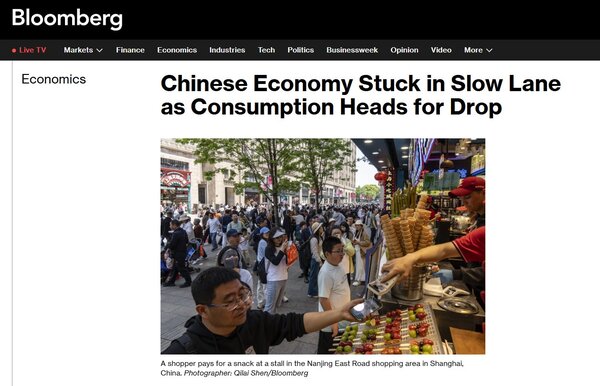
On June 15, Bloomberg caught widespread attention by reporting, "Chinese consumer spending may contract for the first time since the post-pandemic recovery." The report noted that "the median forecast from a Bloomberg survey of economists projects May retail sales to hit -0.2% year-on-year." If confirmed, this would mark the first time Chinese consumption has turned negative since the lifting of COVID-19 lockdowns.
Bloomberg analyzed that "following a surprise rebound at the beginning of the year, the world’s second-largest economy is rapidly cooling down. Investment has shifted back into a decline, and consumption is being weighed down by a weak job market and accelerating inflation."
Commenting on the trend, Raymond Yeung, an economist at the Australia and New Zealand Banking Group (ANZ), warned Bloomberg: "The underlying consumption momentum is weak. As the household deleveraging cycle continues, reliance on fiscal policy will rise as the primary tool to stabilize the economy." Evidence of this lies in the fact that "throughout May, households continued to repay both short- and long-term loans simultaneously, leading to a consecutive two-month decline in bank loans to households."
[USCC Urgent Report: "A Collision of Short-Term Shocks and Long-Term Structural Vulnerabilities"]
On June 9, five days prior to the Bloomberg report, the U.S. U.S.-China Economic and Security Review Commission (USCC) issued a core warning in its latest China briefing, stating: "Economic indicators are deteriorating. Short-term supply shocks are colliding head-on with long-term structural vulnerabilities."
The USCC continued, "Weak industrial production and manufacturing investment data from April indicate that the conflict in Iran is exerting a negative impact on the Chinese economy. If current trends persist, China may fail to achieve its annual growth target of 4.5% to 5%, leading to a scenario that demands difficult decisions at the July Politburo meeting." The commission further noted that "explicitly designating the 'July Politburo meeting' as a watershed moment implies that the current economic slide has already entered a stage where it forces political choices."
Cracks in the economic structure are also vividly exposed through capital movements. On June 7, Reuters reported, "Mainland Chinese investors are flocking to Hong Kong after Beijing abruptly announced a crackdown on 'illegal' cross-border securities trading in late May."
Reuters added, "According to estimates by Kaiyuan Securities, the volume of assets at risk reaches $54 billion." The outlet quoted a Shanghai-based investor who stated, "I liquidated all assets held across two brokers over the past two weeks and am currently seeking alternative investment routes, such as establishing an offshore entity." This tightening of capital controls aligns with a separate Bloomberg report on May 25 regarding stricter regulations on overseas stock trading. Private capital, having lost trust in the domestic economy, is searching for an exit, while the state moves to choke off that very escape route.
[The April Shock: Simultaneous Fall of Retail, Investment, and Real Estate]
This June crisis was already foreshadowed in April. On May 18, CNBC reported, "April retail sales grew by a mere 0.2% year-on-year, marking a 40-month low since December 2022. This figure fell completely short of economists' forecasts of 2.0%."
CNBC pointed out that "the durable goods market collapsed across the board, with car sales plunging by -15.3%, home appliances by -15.1%, building materials by -13.8%, and furniture by -10.4%."
Investment indicators were even more grim. Reuters reported, "Fixed-asset investment for the January–April period contracted by -1.6% year-on-year, a sharp reversal from the +1.7% growth seen in the January–March period." Real estate development investment as of April plummeted by -13.7% year-on-year, widening its drop from March’s -11.2%. This is an accelerated plunge, not a recovery.
[The Stagnation Behind Q1's 5% Growth: Three Cracks Hidden in the Data]
Where, then, did the official first-quarter growth rate of 5.0% come from? The USCC May briefing addressed this by pointing out, "Three headwinds are operating simultaneously: persistent weakness in domestic consumption, inconsistencies in statistical methodology, and inflationary pressures stemming from the war in Iran." The briefing highlighted that "the high growth figure is partly attributable to the downward revision of 2025 figures. On the consumer level, retail sales briefly rebounded after hitting a bottom in December 2025 (0.9%), but were already slowing down again by March (1.7%)."
Nikkei Asia also reported that "this growth was sustained in a manner where exports offset weak domestic demand, and analysts are warning about the sustainability of this structure." In short, the announced 5% growth in the first quarter was an illusion.
[$1.2 Trillion Trade Surplus: A Strength, or an Exit for Collapsing Domestic Demand?]
According to a February analysis by the USCC, "China's trade surplus in 2025 surpassed $1.2 trillion for the first time in history, but this is merely a 'direct result of domestic imbalances—namely overproduction and weak domestic demand—which caused low-priced Chinese goods to flood the global market.'" The analysis concluded that factories, having lost domestic demand, slashed prices and pushed their output onto the global stage.
Regarding this mechanism, Eurasia Group, a leading global political risk research and consulting firm, characterized it as "involution" (neijuan). In other words, "too many companies are competing for too little demand, cutting prices down to the bone. This feeds into a vicious cycle: collapsing margins → wage and job cuts → shrinking consumption → further weakening of demand." Eurasia Group pointed out that "the burden of debt grows heavier with each rotation of this cycle."
The USCC 2025 Annual Report also defined this as a "two-speed economy," explaining that "while advanced manufacturing enjoys abundant policy support and access to capital, broader economic growth is under significant pressure. Consumption remains tepid amid stagnant wages, unemployment, high household debt, and a weak social safety net."
[Nakamae's Diagnosis: Both Fiscal and Monetary Tools Exhausted]
Policy tools to break through this structural trap have already run dry. Tadashi Nakamae, president of Nakamae International Economic Research in Japan, asserted bluntly in an op-ed titled "Is the Chinese Economy Okay?" published in the Nikkei on June 12: "All fiscal and monetary policy options have already been exhausted, making a restoration of balance impossible." He added that "China’s M2 money supply exceeds $51 trillion, more than double that of the United States ($23 trillion), yet this liquidity fails to translate into consumption and investment."
Grant Feng, senior economist at Vanguard, diagnosed: "The Chinese economy is best described as a two-speed economy where tech-driven strength and a persistent housing drag coexist. Without a decisive shift toward consumption-led growth, domestic demand will continue to anchor the economy." Eurasia Group finds the root cause in politics: "Heading into the 2027 Party Congress, Xi Jinping will prioritize political control and technological supremacy over consumption stimulus and structural reform. Beijing possesses the means to stave off a crisis, but chooses not to use them."
[Conclusion: The July Politburo Meeting and Xi's Choice as the Watershed]
The direction pointed to simultaneously by Bloomberg’s June 14 report, the USCC’s June 9 warning, and Reuters’ June 7 capital flight coverage is singular: the Chinese economy is approaching a critical threshold. The first post-pandemic negative growth in May consumption, the shift of fixed-asset investment into negative territory, the widening drop in real estate investment, and the unceasing capital flight despite tightened controls—all these red flags have lit up at once. As the USCC explicitly stated, the July Politburo meeting is the watershed. However, as Eurasia Group diagnosed, if Xi Jinping prioritizes political control over structural reform ahead of the 2027 Party Congress, this "slow-moving fire" will burn longer and deeper.
In conclusion, the Chinese economy is currently facing a barrier that goes beyond a simple cyclical slowdown, confronting the limits of its growth model itself. Manufacturing exports stepped in where real estate collapsed, but the result has been overproduction and the spread of trade conflicts. Boosting consumption requires transferring wealth to households, but this clashes with the state-centric control model. Ultimately, the July Politburo meeting is highly likely to serve as a litmus test showing whether the Xi leadership chooses growth or control, rather than merely being a venue for announcing stimulus packages. If political control continues to take precedence, the "slow economic collapse" of China may become the New Normal rather than a temporary recession.

-중국 푸단대학교 한국연구원 객좌교수
-전 EDUIN News 대표
-전 OUR NEWS 대표
-제17대 대통령직인수위원회 정책기획팀장
-전 대통령실 홍보기획비서관
-사단법인 한국가정상담연구소 이사장
-저서: 북한급변사태와 한반도통일, 2012 다시우파다, 선거마케팅, 한국의 정치광고, 국회의원 선거매뉴얼 등 50여권