Update2026.11.05 (목)


[U.S. Auto Industry Presses for Permanent Legislative Blockade on Chinese Vehicles]
The U.S. auto industry has stepped up pressure on Congress to permanently lock out Chinese automobiles by law. The Alliance for Automotive Innovation (AAI), which represents automakers including General Motors (GM), Toyota, and Volkswagen, demanded that lawmakers pass a bill permanently barring Chinese vehicles during the brief lame-duck session convening immediately after the November 2 midterm elections. The goal is to anchor barriers currently enforced via executive branch regulations into statutory law so that no future administration can dismantle them. Around the same time in Norway, a Chinese rental vehicle deployed in military exercises was discovered to have recorded troop movement routes and access codes to military facilities. Conditions inside China are even bleaker. Retail sales of passenger vehicles in China this year are projected to drop around 22% to roughly 18.5 million units, whereas domestic production capacity is more than triple that figure. Excess inventory is pushed abroad, but Europe has established import caps and consumers are turning their backs amid shoddy after-sales support. Caught between national security barriers, collapsing domestic demand, and an escalating trust crisis, Beijing’s electric vehicle ambitions are facing a defining test.
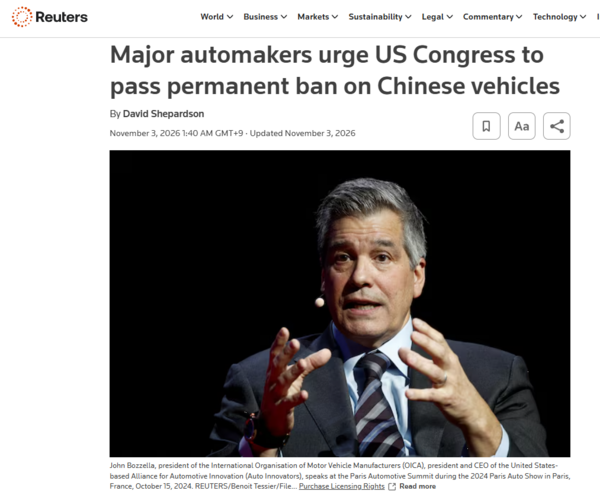
Reuters reported on the 3rd (local time) that "the Alliance for Automotive Innovation (AAI) urged lawmakers on that day to pass legislation permanently banning Chinese connected vehicles when they return to session next week," noting that "AAI President and CEO John Bozzella stated, 'We must safeguard the American market from a flood of Chinese vehicle imports carrying surveillance risks,' adding that 'such imports put long-standing manufacturers who have invested across generations in the United States at an unfair disadvantage.'" The move essentially binds data security and industrial protection into a singular rationale. This marks the second public push by the AAI since it sent a letter conveying the same demand to congressional leadership on September 3.
The United States has already restricted the sale of vehicles tied to China and Russia under the Department of Commerce’s connected vehicle regulations finalized in January 2025. In June, Swedish brand Polestar, in which China's Geely Group holds a majority stake, failed to secure approval under these rules, barring it from selling new cars in the U.S. starting from the 2027 model year. Even for vehicles built at American assembly plants, corporate ownership structures have become the determining metric.
The automotive sector is attempting to codify these executive restrictions into statutory law via the 'Connected Vehicle Security Act (S.4429)', co-sponsored by Senators Bernie Moreno and Elissa Slotkin. However, the bill has yet to clear its final vote, and some congressional aides caution that shifts in the balance of congressional power could make passage before the close of the December session difficult.
The purview of national security reviews is expanding far beyond automobiles. In July, the Federal Communications Commission (FCC) added advanced foreign robotic devices to its covered list, and iRobot—acquired by a Chinese enterprise in January—has struggled to obtain U.S. sales certification for its new robotic vacuum cleaners.
[Access Codes Recorded in Norwegian Military Rental Vehicle]
Evidence demonstrating that security concerns are not hypothetical abstractions emerged from Europe. The Norwegian financial daily Dagens Næringsliv (DN) reported on October 8 that "soldiers discovered vehicle camera footage on the display screen of a rental car during Home Guard exercises held around Oslo Airport in September." According to DN, at least two of the vehicles in question were Deepal models manufactured by China's state-owned Changan Automobile. First Lieutenant Fredrik Blanck, who participated in the exercise, remarked, "You can see who gets in and out, where they go, and how long they stay at each location." Access codes used to open the gates of military installations were even captured on video. Lacking substitute vehicles, soldiers continued to drive the cars until the end of the exercise, deleting the footage only afterward.
The vehicle supplier was a company operating the Hertz franchise in Norway, whose ultimate corporate ownership traces back to China's Geely Group. This enterprise is the primary contractor holding a rental fleet agreement with the Norwegian Armed Forces worth up to 350 million kroner running through 2028. In essence, the vehicles were manufactured by a Chinese state-owned enterprise, and the entity leasing them to the armed forces also carried ties to Chinese capital. While the recordings were stored on a dashcam unit that soldiers had failed to power down and no evidence has yet surfaced showing data was transmitted to China, the incident vividly demonstrated that connected vehicles can function as covert collection hubs for sensitive military intelligence without requiring active cyber penetration. The fundamental concern is that users have no control over who ultimately accesses the stored data.
[63 Million Units in Capacity vs. 18.5 Million in Demand]
A more fundamental crisis is brewing inside China. A report by The Wall Street Journal (WSJ) on October 27 underscored the deepening distress in domestic demand. Skyworth Auto stated that its flagship plant possesses an annual production capacity of 100,000 units, yet its domestic sales in China between January and September totaled a mere 660 units. While production capacity is calculated on an annual basis and sales reflect nine months of domestic figures—meaning this cannot be directly translated into plant utilization rates—the yawning chasm between supply capacity and actual domestic absorption is unmistakable.
The WSJ reported that "passenger car purchases by Chinese consumers between January and September this year dropped by roughly 22% year-on-year." In a contracting market, when automakers slash prices to protect volume, overall profitability deteriorates even if unit targets are met.
Yet dismantling this industrial overcapacity is exceedingly difficult due to municipal and provincial governments. Cities that pumped fiscal resources into auto plants must bear the brunt of rising unemployment and falling tax revenues that accompany factory closures and output reductions. Conversely, keeping non-viable enterprises on life support perpetuates surplus supply and relentless price wars. The economic imperative to rationalize production and curtail corporate losses collides directly with the political calculations of local governments desperate to protect jobs. The assertion that Chinese automakers have degraded into zombie enterprises is grounded in this exact dynamic.
Exporting serves as a release valve to alleviate this adjustment pressure. However, offloading domestic surpluses overseas does not make the underlying structural flaws disappear. Building localized distribution channels, parts inventories, and maintenance workforces requires massive capital reinvestment. Whether aggressive price-slashing strategies can sufficiently shoulder the burdens of overseas service networks remains a separate challenge. This reflects broader analyses synthesizing China’s prolonged supply-side adjustments with its expanding service footprints abroad.
[Europe Caps Imports While Consumers Turn Away Over Dismal After-Sales Service]
In Europe, China's largest export theater, Chinese brands captured a 12.7% market share in the third quarter, surpassing Japanese automakers for the first time. A significant share of this growth was driven by hybrid vehicles capable of circumventing punitive tariffs on pure battery-electric vehicles (BEVs). However, this bypass route is being sealed off as well. The European Union will cap imports of Chinese-made hybrids at 350,000 units annually starting as early as December 1—less than half of this year's projected volume of 800,000 units. Just prior to discussions between the EU and Beijing, BYD Executive Vice President Stella Li cited geopolitics as the single greatest impediment to global expansion, disclosing that plans to enter the U.S. passenger car market have been shelved indefinitely.
Post-sale trust is deteriorating rapidly as well. In Australia, multi-month parts backlogs and unresponsive customer service centers have become recurring grievances among BYD owners, with the chief operating officer (COO) of BYD Australia acknowledging that service wait times are excessively long. In the United Kingdom, certain insurers are declining underwriting coverage for Chinese vehicle brands citing inadequate repair documentation and scarce spare parts, while in Brazil, after-sales service deficiencies concerning BYD triggered formal requests for congressional hearings in 2024.
In South Korea, BYD has failed to deliver on pledges to expand its certified service footprint, forcing vehicle owners to travel cross-country for maintenance, with reports surfacing of minor cosmetic scratches incurring repair bills exceeding 11 million won. Across different jurisdictions, the underlying pattern remains identical: logistics chains for spare parts and technician networks simply cannot keep pace with the velocity of low-cost vehicle sales. Repair delays lead directly to surging insurance premiums, and soaring insurance costs depress secondary resale valuations, eroding the original price advantages that drew buyers in the first place.
[Why Times Insight]
The core growth blueprint of Chinese electric vehicles relies on ramping up output via state subsidies and pushing the resulting overcapacity into overseas markets. This engine functions only as long as foreign markets remain open. The United States is shuttering access by challenging the very 'nationality of capital,' while Europe is narrowing its gates through import quotas.
China's National Intelligence Law mandates that all corporate entities and citizens cooperate with state intelligence operations. Consequently, corporate pledges never to transfer data do little to soothe Western apprehensions. Added to this is the tangible risk consumers experience directly: dismal after-sales maintenance. The decline of Chinese electric vehicles is beginning not with sales volumes, but with a collapse in trust. For countries like South Korea that lack statutory data security baselines for connected vehicles, establishing comprehensive regulatory defenses has become an urgent priority.

-중국 푸단대학교 한국연구원 객좌교수
-전 EDUIN News 대표
-전 OUR NEWS 대표
-제17대 대통령직인수위원회 정책기획팀장
-전 대통령실 홍보기획비서관
-사단법인 한국가정상담연구소 이사장
-저서: 북한급변사태와 한반도통일, 2012 다시우파다, 선거마케팅, 한국의 정치광고, 국회의원 선거매뉴얼 등 50여권