
Update2026.11.05 (목)


[CSI 300 Falls for 12 Consecutive Weeks in 'Longest Streak in History'; 'Bailout Rally' Fizzles Out in a Single Day]
The Chinese stock market has plunged into a "double collapse," where the bursting of the artificial intelligence (AI) bubble and a contraction in the real economy drag each other down. The benchmark CSI 300 index tumbled 8.5% in October alone, marking its worst monthly performance since early 2016. Alongside a record-breaking streak of 12 consecutive weeks of declines, it has officially entered bear market territory. The STAR 50 index, which tracks major AI and semiconductor players, plummeted 40% in less than four months, wiping out $480 billion (approximately 646 trillion won). According to calculations by Bloomberg, market capitalization erased from mainland bourses since May has reached $3.5 trillion (approximately 4,708 trillion won). An increasingly alarmed Beijing mobilized all three major financial watchdogs on the 2nd: the People's Bank of China (PBOC), the National Financial Regulatory Administration (NFRA), and the China Securities Regulatory Commission (CSRC). Convening banks, brokerages, and fund managers, authorities rolled out expanded relending facilities for share buybacks and short-term liquidity injections. Yet the market's response remains chilly. With corporate earnings faltering and consumer spending frozen, the prevailing assessment is that injecting cheap credit acts merely as a temporary painkiller that masks the symptoms rather than curing the root disease.
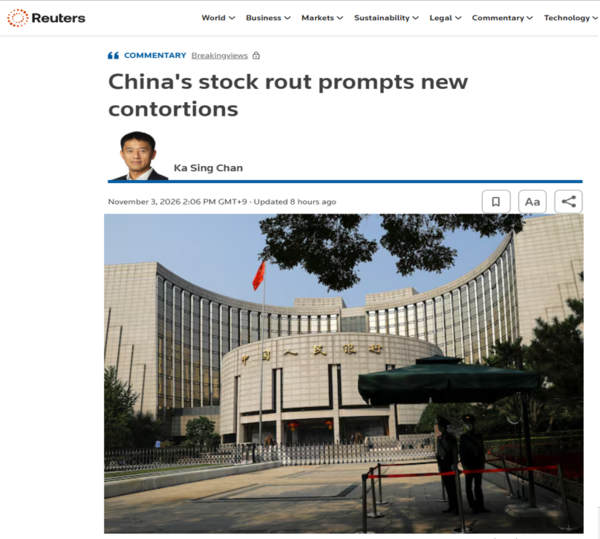
Reuters reported on the 3rd (local time) that "Chinese stocks surrendered their gains the day after authorities unveiled stimulus measures," noting that "while optimism over stimulus had pushed the Shanghai Composite Index up 1.1% on that day—marking its largest single-day gain since August 27—early trading on the 3rd saw both the CSI 300 and the Shanghai Composite slip around 1%, while the tech-heavy STAR Composite Index dropped 1.6%."
According to the U.S. financial media outlet TheStreet, the STAR 50 plunged 3.8% on that day, completely wiping out the previous day’s rebound. Chen Jiande, a fund manager at Fujian Tianlang Asset Management, told Reuters: "These measures fell short of expectations. Many investors trapped in hammered tech stocks are using any rebound as an opportunity to rush for the exits."
Skeptical reactions were mirrored in international media commentaries. A column by Reuters Breakingviews on the 3rd diagnosed that "Beijing is turning emergency bailouts into permanent tools by lowering the cost of loans for share repurchases." Reuters added that "with the benchmark index down 13% year-to-date, President Xi Jinping's ambition to lift asset prices looks fraught with difficulty," noting that "while policy effects may appear with a time lag, corporate earnings ultimately must improve." Bloomberg also assessed on the same day that "efforts to boost the market failed to gain traction." Citing a chief investment officer (CIO) in Shanghai, Bloomberg reported that "these tools have already been around for two years and provide no fresh support."
According to Reuters, the regulatory prescription unfolded as follows: The PBOC transitioned the relending facility for share buybacks and stake increases—initially introduced in 2024—from a temporary framework into a permanent facility, lowering the interest rate from 1.25% to 1%. It instructed commercial banks to scale up lending through this program. Authorities also decided to reduce fees and broaden participating institutions for the swap facility, which allows brokerages, fund managers, and insurers to exchange their holdings for central government bonds or central bank bills to raise equity-purchasing capital. According to the CSRC, 31 brokerages and asset managers applied for more than 100 billion yuan in the third batch of swap operations. To date, contracts signed for share buyback and stake acquisition loans total approximately 440 billion yuan, of which over 280 billion yuan has actually been disbursed.
The CSRC also sharply relaxed regulations on share buybacks. Companies are permitted to repurchase shares once stock prices fall below their initial public offering (IPO) price, while firms retaining proceeds from previous equity offerings are mandated to buy back stock if market stability thresholds are triggered. Regulators publicly urged major constituent stocks and "dragon head" (industry leader) tech firms to execute "aggressive share repurchases." The Financial Times (FT) reported that "authorities verbally instructed investment banks to halt new IPOs and restricted major shareholders from executing large-scale block sales." This constitutes a "pincer maneuver," pumping in liquidity while choking off the supply of equity. From this day onward, the PBOC began conducting daily overnight reverse repurchase operations (reverse repo) at a rate of 1.25%, an operation previously signaled on October 30.
The fundamental issue lies in firepower. When authorities first introduced these policy tools alongside a benchmark rate cut in September 2024, the CSI 300 surged roughly 21% in a single month. This time, there was neither a policy rate cut nor a reduction in the reserve requirement ratio (RRR). Some investors assess that the current measures amount merely to "optimizing existing tools," lacking the sense of "shock and awe" that the market experienced back then. Shen Meng, a director at Beijing-based boutique investment bank Chanson & Co., remarked: "Policy signals alone cannot reverse fundamental economic trends."
[Down 8.5% in October Alone, Worst Performance Since 2016]
Behind this bailout package lies an unprecedented cascade of losses. On October 22, the CSI 300 entered a technical bear market as its drop from its June peak surpassed 20%. The 8.5% plunge in October was the steepest monthly decline since the "circuit breaker crisis" of early 2016, and the 12-week losing streak is without precedent in the history of China's stock market. Estimates of the total fallout vary across institutions. Bloomberg calculations estimate market value wiped out since May at roughly $3.5 trillion (approximately 4,708 trillion won), while Reuters figures focusing solely on mainland exchanges put the loss at around $2.4 trillion (approximately 3,228 trillion won). Either way, it means wealth equivalent to or exceeding South Korea's annual gross domestic product (GDP) vanished in just five months.
The epicenter of the shock was technology shares. In an analytical report on October 26, Reuters reported that "the STAR 50 index on the STAR Market plummeted 40% in under four months, wiping out roughly $480 billion (approximately 646 trillion won)," diagnosing that "China's AI bubble has already burst." At its peak, the price-to-earnings (P/E) ratio of this index reached approximately 250. Although it has since compressed to around 100, concerns over overvaluation persist when compared with the U.S. Nasdaq 100 (around 30). According to Goldman Sachs, AI-related stocks account for 42% of the total market capitalization and 57% of daily trading turnover across mainland- and Hong Kong-listed Chinese equities. The market is structured such that a collapse in AI stocks instantly ripples across the broader financial system. Morgan Stanley warned that "the index could fall another 15%."
["It Did Not Fall Because Money Was Scarce"]
The sharpest observation made by market experts is the mismatch between diagnosis and treatment. In October, the volume-weighted average rate of overnight pledged repo among depository institutions in the interbank market (DR001) stood at 1.2805%, showing ample liquidity in the system. Even so, the ChiNext index sank 23.02% and the STAR 50 dropped 24.13% during the same month. Xu Zhen, a veteran Chinese capital markets observer, stated in an interview with The Epoch Times: "Overnight reverse repo operations are merely technical signals, not market rescue signals. (...) This downward spiral is not driven by a liquidity shortage, but by government selling pressure, the AI bubble, and a crisis of confidence in the government. The real economy is identical: if enterprises have no purchase orders, they will not borrow regardless of how low interest rates fall."
U.S.-based economist David Huang voiced similar caution. He noted: "When enterprises make investment decisions, they prioritize future order books, capacity utilization rates, and market demand over borrowing costs. The same holds true for households. Families face pervasive anxieties over income, employment, retirement, healthcare, and education; even with adequate liquidity, they will not ramp up spending." He added plainly: "This is merely a stopgap measure that fails to resolve root causes." In particular, he warned: "Using debt to buy back corporate shares relies on continually expanding borrowing to prop up purchasing power—a tactic that merely kicks the problem down the road to buy time, which will ultimately worsen the situation." Xu Zhen pointed out the irony: "The government sells equities at elevated prices while nudging listed companies and controlling shareholders to take on debt to buy back shares—this is the greatest contradiction."
[Warning Signs in the Real Economy: The Vicious Cycle Between Markets and Growth]
The market crash cannot be viewed in isolation from sluggish real economic activity. The October manufacturing Purchasing Managers' Index (PMI) released by China's National Bureau of Statistics came in at 49.3, while the non-manufacturing business activity index registered 49.7. Both indicators dropped below the 50-point threshold separating expansion from contraction. Official data revealed that real estate development investment plunged 20.6% year-on-year from January to September, suggesting the property downturn has yet to find a bottom. Credit market jitters are also escalating following debt distress at Zhuhai Huafa Group, a state-owned enterprise in Guangdong province. David Huang warned: "If share prices continue to slide, it will elevate risks for financial institutions holding equities as collateral, exacerbating real economic strains through the financial markets and triggering a vicious cycle of corporate distress and consumer retrenchment."
[Retail Resignation: "A-Shares Are Scarier Than Halloween"]
Despite policy announcements, individual retail investors remain unconvinced. In late October, self-deprecating memes analogizing the market to Halloween flooded Chinese social media: "No need to buy a Halloween costume. Just putting on green clothes that say 'I invest in A-shares' is terrifying enough!" In China's domestic markets, falling prices are displayed in green. An analysis by one netizen captured the battered market sentiment: "The problem with today's A-share market is that the moment government intervention pauses, it drops immediately. (...) There have been five or six sharp V-shaped rebounds, but not a single one proved sustainable! Consequently, investors have developed a knee-jerk habit of fleeing the second any rebound appears." The total reversal of gains on the 3rd was a vivid realization of this dynamic.
[Why Times Insight]
(1) The internal contradiction of a 'managed market.'
Measures that halt IPOs, prohibit major shareholders from selling, and mandate share repurchases financed by bank debt can artificially prop up prices. However, they dismantle the market's fundamental functions: capital allocation and price discovery. As David Huang put it, "If an equity market relies indefinitely on policy decrees to sustain asset valuations, neither corporate development nor the market itself can be deemed healthy." The fact that the rally evaporated the very day after the rescue measures were announced demonstrates that investors have thoroughly internalized the equation: 'government intervention equals an exit window.'
(2) The financial lifeline for China's 'AI rise' is choking up.
Beijing intended to channel household savings into equities to finance the AI and semiconductor industries. In an ecosystem where AI accounts for 42% of total equity capitalization, an erosion of confidence in AI translates directly into systemic risk across the financial system. Xu Zhen observed: "If the stock market collapses, the CCP will find itself disadvantaged in the U.S.-China AI race." He further argued: "State-backed funds that entered during the 2024 bailout likely trimmed their positions near this year's peaks, reaping massive profits off retail investors." The pervasive suspicion that state capital alternates between the roles of 'savior' and 'biggest seller' exposes the true nature of the crisis: a total collapse in credibility.
Key points to watch next:
First, whether the PBOC plays its 'real cards'—namely cuts to the benchmark policy rate or the reserve requirement ratio. Second, how rapidly the 100-billion-yuan swap quota is exhausted. Third, whether the manufacturing PMI rebounds in November. If none of these materialize, this latest stabilization effort will almost certainly share the exact same fate as the six failed V-shaped rebounds before it.

-중국 푸단대학교 한국연구원 객좌교수
-전 EDUIN News 대표
-전 OUR NEWS 대표
-제17대 대통령직인수위원회 정책기획팀장
-전 대통령실 홍보기획비서관
-사단법인 한국가정상담연구소 이사장
-저서: 북한급변사태와 한반도통일, 2012 다시우파다, 선거마케팅, 한국의 정치광고, 국회의원 선거매뉴얼 등 50여권