
Update2026.11.05 (목)


[Spreading Fear! China's Top 3 Financial Regulators Hold Emergency Meeting]
On November 2, China's three primary financial regulatory bodies—the People's Bank of China (PBOC), the National Financial Regulatory Administration (NFRA), and the China Securities Regulatory Commission (CSRC)—took emergency measures by convening a series of meetings with major commercial banks, securities brokerages, and fund management firms to fine-tune market stabilization tools. This move aims to quell mounting fears of an 'economic collapse' after the benchmark CSI 300 Index plunged 8.5% in October—recording its worst monthly performance since early 2016—and both manufacturing and non-manufacturing Purchasing Managers' Indexes (PMI) simultaneously fell into contraction territory below 50. However, the core agenda of the meetings remained limited to 'optimizing' the special re-lending facility introduced in 2024 to support listed companies' share buybacks and major shareholders' stake increases. Rather than addressing real economic bottlenecks—such as flagging domestic consumption, real estate distress, and severe headwinds facing small and medium-sized enterprises (SMEs)—regulators once again resorted to using central bank funds to prop up equity valuations. This reveals that the structural challenges of the Chinese economy have reached a point where even top financial authorities find themselves lacking effective fundamental remedies.
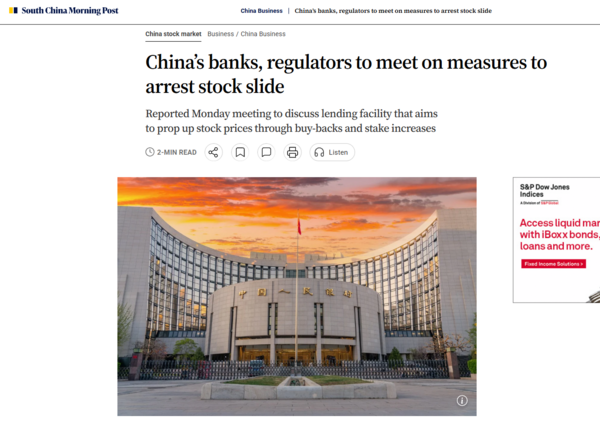
The South China Morning Post (SCMP) reported on November 1 that “the PBOC, NFRA, and CSRC are meeting with key commercial lenders to discuss enhancements to loan programs designed to finance listed firms' share repurchases and stake boosts by controlling shareholders,” adding that “regulators are mounting a concerted effort amid rising concerns over market stability following October's sell-off.”
Chinese business daily Yicai also reported, “Around 9 a.m. on November 2, the PBOC and the CSRC summoned select securities firms and mutual fund managers to review the implementation of capital market stabilization instruments.” It further stated, “On the same day, the PBOC, NFRA, and CSRC convened major banks to study the optimization of the share buyback and stake-increase re-lending policy. Both meetings were held at the PBOC headquarters. The news was first reported on November 1 by domestic outlets citing industry insiders, including Shanghai Securities News, 21st Century Business Herald, and Securities Times, and subsequently carried by Bloomberg and Reuters.” Authorities, however, did not release official confirmations regarding the specific agenda or policy steps.
Precursor signals had already emerged. During an expanded Party committee meeting on October 30 presided over by Chairman Wu Qing, the CSRC emphasized 'stabilizing markets and anchoring expectations' as top priorities. A separate Party committee meeting convened by PBOC Governor Pan Gongsheng likewise underscored the need to maintain a 'moderately accommodative' monetary policy stance and inject ample liquidity. The PBOC also reportedly announced that, beginning November 2, it would conduct open-market daily reverse repo operations at a fixed rate of 1.25%. Furthermore, Chinese financial media reported that a major state-owned commercial bank plans to allocate up to 100 billion yuan (approx. 20.24 trillion KRW) each in additional loan quotas for share buybacks and equity acquisitions to central state-owned enterprises China Reform Holdings and China Chengtong Holdings.
[October's Crash in Numbers: Utterly Devastating!]
What prompted immediate regulatory intervention was October's devastating market performance. According to Reuters, the CSI 300 Index shed 8.5% in October, marking its steepest monthly decline since early 2016. The index also posted 12 consecutive weeks of losses, setting the longest losing streak since its inception in 2005, with cumulative losses reaching approximately 15% during that span. On October 30, the Shanghai Composite Index fell 1.44% to close at 3,599.02, slipping below the psychological 3,600 threshold for the first time this year. For the entire month of October, the Shanghai Composite slid 6.33%, while the Shenzhen Component tumbled 15.94%. The tech-heavy ChiNext and STAR Market boards plummeted more than 20%.
The sell-off was centered in technology equities. As weakness in US tech names reignited worries over the commercial returns of massive AI infrastructure spending, domestic Chinese AI stocks led the downturn. Optical transceiver supplier Eoptolink collapsed 50% in October alone. Third-quarter earnings that fell short of already subdued forecasts further exacerbated selling pressure. According to Bloomberg data, approximately $3.5 trillion (approx. 4,709 trillion KRW) in market capitalization has been wiped out from Chinese equities since their May peak, and the CSI 300 entered bear market territory after dropping roughly 20% from its June highs. As of October 23, year-to-date returns showed the US S&P 500 up 11.4%, compared to a 7.0% decline for the Shanghai Composite. In the credit markets, signs of stress also surfaced surrounding the financial standing of state-backed property developer Zhuhai Huafa Group.
[Real Economy Also 'Contracts'… Warnings Sent by PMI]
Macroeconomic data confirms that the steep equities slide is not purely psychological. According to data released by the National Bureau of Statistics (NBS) on October 31, the official manufacturing PMI for October landed at 49.3. Falling 0.8 points from 50.1 in the previous month, the reading fell back into contraction after just one month and missed Bloomberg's consensus estimate of 49.9. The sub-index for new orders dipped 1.1 points to 49.4, while the production index retreated 1.9 points to 49.8. Broken down by enterprise size, large enterprises remained in expansion territory at 50.2, but medium-sized enterprises stood at 48.4 and small firms slumped to 47.5, indicating that the economic chill is hitting SMEs disproportionately hard.
The contraction in the non-manufacturing sector was even more pronounced. The non-manufacturing PMI, which covers services and construction, dropped from 50.2 in the prior month to 49.7, substantially trailing the market expectation of 50.5. The composite PMI output index declined 1.0 point from 50.7 to 49.7, while the construction business activity index plunged 2.3 points to 48.0. Financial market analysis firm Newsquawk pointed out that “it is rarer for the non-manufacturing PMI to slip below 50 than the manufacturing gauge,” analyzing that “this contraction reflects underlying weakness in domestic consumer demand rather than exports.” Huo Lihui, senior statistician at the NBS Service Survey Center, cited seasonal factors, such as a post-surge pullback in overseas orders and an ebb in holiday spending. Nevertheless, the PMI for consumer goods manufacturing also dropped 1.9 points.
Broad macroeconomic metrics similarly point toward deceleration. Preliminary third-quarter GDP growth was recorded at 4.5%, and September retail sales rose just 1.1% year-on-year. While Beijing has signaled room for additional targeted support to defend its annual growth target of around 4.5% to 5%, Investing.com observed that “the latest PMI data illustrates that existing policy measures have failed to generate sustained improvements across both manufacturing and service sectors.”
[800 Billion Yuan Left Underutilized Even After Two Years of Policy Easing]
The central agenda item of the meeting—the share buyback and stake-increase re-lending facility—is not a novel tool. Governor Pan Gongsheng initially unveiled the mechanism alongside the Securities, Funds, and Insurance Companies Swap Facility (SFISF) during a State Council Information Office press conference on September 24, 2024, and it was formally operationalized on October 18 of that year. Under the framework, commercial lenders extend credit to listed companies and major shareholders for share buybacks, and the PBOC backs 100% of the principal via re-lending. The initial quota was set at 300 billion yuan (approx. 61 trillion KRW) at a re-lending interest rate of 1.75%. At the time, Governor Pan stated: "If this program works well, we could follow up the first tranche of 500 billion yuan with another 500 billion yuan, or even a third tranche. We maintain an open posture."
Authorities subsequently relaxed the borrowing criteria continuously. The maximum loan tenor was extended from one year to three years, the required equity contribution from companies was lowered from 30% to 10%, and state-owned capital management platforms were made eligible borrowers. In May 2025, authorities consolidated the 300 billion yuan re-lending quota with the 500 billion yuan SFISF quota into a unified 800 billion yuan pool (approx. 162 trillion KRW). Nevertheless, according to the PBOC's Q2 2026 Monetary Policy Implementation Report, although cumulative loan agreements exceeded 390 billion yuan (approx. 79 trillion KRW) as of the end of June, actual disbursed funds stood at merely around 210 billion yuan (approx. 42 trillion KRW). Even though over 200 firms announced share buyback plans totaling more than 25 billion yuan since October, it did not stem the equity sell-off.
Markets exhibited an initial relief reaction. The SCMP reported that “Chinese equities rebounded on November 2 from October's rout on heightened expectations of state support.” In Hong Kong trading, financial shares advanced broadly, with CICC, New China Life Insurance, and China Life Insurance surging over 5%. An institutional analyst commented to Yicai that “direct liquidity injections into equities could deliver a notable boost to the current A-share market,” while adding that “the market will need to see what concrete support policies materialize following the meeting.” During the steep market drawdown in February 2024, Rajat Agarwal, Asia equity strategist at Societe Generale, warned that “state-directed interventions can drive tactical rebounds, but whether they are sufficient to fuel a sustained rally remains uncertain.” That cautionary note remains equally pertinent today.
[Why Times Insight — Stock Prices Can Be Propped Up, but Trust Cannot Be Bought with Loans]
This meeting illustrates the trajectory of Beijing's crisis management. The primary bottleneck revealed by October's indicators lies squarely in domestic demand. Non-manufacturing PMI dropped below 50, construction activity contracted by 2.3 points, and the small enterprise PMI languished at 47.5. September's tepid 1.1% retail sales growth confirms that households are pulling back on consumption. Yet, what regulators placed on the agenda was neither direct household income support nor consumption stimulus. Instead, it was a mechanism encouraging listed firms and controlling shareholders to borrow bank capital to buy their own stock. It is difficult to avoid the criticism that this resembles trying to warm up the room by heating the thermometer while the real economy's circulatory system remains blocked.
A more structural problem is that this mechanism is stalled not from a lack of funds, but from a lack of commercial rationale to deploy them. The fact that actual disbursements reached only 210 billion yuan out of 390 billion yuan contracted shows that companies lack the conviction to repurchase shares even with low-interest credit. For businesses facing deteriorating earnings prospects, expanding credit lines and loosening restrictions merely creates additional debt burdens. Borrowing to repurchase equity creates leverage that compounds corporate debt and downside risk if share prices continue to slide. Amid signs of financial stress at state-linked entities like Zhuhai Huafa, concentrating hundreds of billions of yuan in quotas across state capital management platforms closely resembles circulating systemic risk within the public balance sheet.
Looking strictly at top-line figures, fears of an immediate 'economic collapse' may appear amplified. Third-quarter economic growth came in at 4.5%, and large-scale manufacturing remains in expansion. However, the root of market anxiety is not about headline numbers; it is about confidence. From the 'National Team' interventions following the 2015 crash, to the September 2024 stimulus package, and now to this re-lending revision, Beijing has repeatedly leaned on liquidity injections to prop up share prices during downturns. Throughout that time, fundamental structural bottlenecks—property sector deleveraging, local government debt, and private-sector regulatory uncertainty—have remained largely unresolved. State intervention may be capable of putting a floor under equity benchmarks. However, restoring the confidence of investors and consumers in the economy's future is something central bank loans cannot achieve. If this meeting results in merely another transient bounce, Chinese markets remain prone to repeating a well-worn cycle: policy anticipation, technical rebound, disillusionment, and renewed decline.

-중국 푸단대학교 한국연구원 객좌교수
-전 EDUIN News 대표
-전 OUR NEWS 대표
-제17대 대통령직인수위원회 정책기획팀장
-전 대통령실 홍보기획비서관
-사단법인 한국가정상담연구소 이사장
-저서: 북한급변사태와 한반도통일, 2012 다시우파다, 선거마케팅, 한국의 정치광고, 국회의원 선거매뉴얼 등 50여권