Update2026.11.05 (목)


[“Weakening of Party Leadership”… Traces of Anxiety Embedded in a Declaration of Victory]
The Chinese Communist Party (CCP) included an assessment in an official document stating that "there was once a grave reality in which party leadership was weakened and reduced to a mere formality," and the People's Daily drew widespread attention by publishing this on its front page. This serves as an admission in official party language that President Xi Jinping’s grip on power faced its most severe crisis since taking office last year. The epicenter of the crisis was the military. Central Military Commission (CMC) Vice Chairman Zhang Youxia, the second-highest-ranking figure in the armed forces, held military power and exerted pressure on Xi Jinping. Party elders strongly demanded Xi’s 'honorable retirement' while postponing decisive physical action. That very delay appears to have provided Xi with the time needed to launch a counterattack. Xi subsequently placed Zhang Youxia and Liu Zhenli under investigation, gutting the military high command in its entirety. At the recent plenum, the expulsion of 33 individuals from the party was formally ratified.
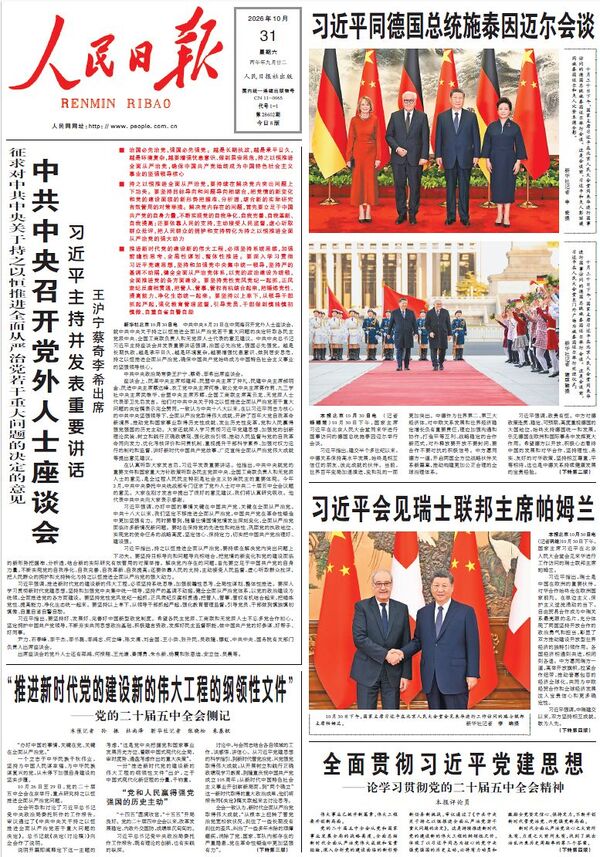
On the 31st of last month, the CCP’s official mouthpiece, People's Daily, co-published a front-page commentary alongside Xinhua reporters reviewing the Fifth Plenum, centered on the theme of 'rigorously governing the party.' Quoting the plenum communique, People's Daily sent shockwaves by reporting that "the Party Central Committee with Comrade Xi Jinping at the core confronted the grave reality that once emerged: the weakening (ruòhuà), hollowing out (xūhuà), and diluting (dànhuà) of party leadership."
Here, 'weakening' (弱化·ruòhuà) refers to a state in which the party's actual leadership capabilities declined—situations where party decisions failed to be executed at lower tiers and directives lacked enforcing power. In short, it concerns the 'strength' of authority.
'Hollowing out' (虛化·xūhuà) signifies a condition where party leadership retained only its form while its substance was emptied, reducing it to a mere name. Party committees and secretary positions existed, but actual authority resided elsewhere. In military terms, this denotes a scenario where the Chairman Responsibility System was preserved on paper, yet actual operational command was exercised by someone else. In other words, it is a matter concerning the 'substance' of authority.
Meanwhile, 'diluting' (淡化·dànhuà) describes an environment where party leadership faded and was pushed out of organizational consciousness. Cadres and organizations stopped treating party guidance as an unquestioned principle, prioritizing operational logic or market imperatives instead. Essentially, this is a question of the 'perception' of power.
These remarks by People's Daily are striking because they signify that laxity and powerlessness in party governance, alongside internal problems, had deteriorated into an unbearable reality. The critical question is why such alarming formulations were made public during this plenum. Ultimately, it describes a process in which the Party Central Committee removed 'grave risks existing within the party, state, and military' through an internal reckoning of 'turning the blade inward.' By publicly adopting a narrative framework that first acknowledges a crisis and then declares it overcome, President Xi Jinping appears intent on broadcasting his ongoing sweeping purge and unyielding determination to reorganize the party to the entire world.
['The More Peaceful the Times, the Keener the Sense of Crisis'… The Precursor from August]
A clue for interpreting these events emerged three months prior. During a symposium with non-CCP figures last August, President Xi stated, "The longer we govern, the more peaceful the times, and the more complex the environment, the more we must heighten our sense of crisis." He emphasized that "we must continuously advance comprehensive and strict party governance (从严治党)." The supreme leader, in his 14th year of rule, explicitly juxtaposed 'long-term governance' with a 'sense of crisis' in a single sentence before external figures. Just before that, on July 30, the CCP Central Politburo set the Fifth Plenum agenda around 'several major issues concerning the continuous advancement of comprehensive and strict party governance.'
The CCP typically addresses the upcoming Five-Year Economic Plan during its fifth plenum. This time, however, party discipline and cadre oversight took center stage. While this shift partly occurred because the overarching framework of the 15th Five-Year Plan had already been outlined at last year's Fourth Plenum, it also reflects the urgent necessity of tightening internal discipline within the party ranks.
[The Military Stood as the Epicenter of the Fracture]
The most visible fractures in party authority appeared within the People's Liberation Army (PLA). Former CMC Vice Chairman He Weidong, then the third-highest-ranking military official, vanished from public view following the closing ceremony of the National People's Congress in March of last year. Ahead of the Fourth Plenum in October, the Chinese Ministry of National Defense announced the expulsion of nine full generals (shangjiang), including He Weidong. The purge peaked in January of this year. CMC Vice Chairman Zhang Youxia, the military's second-in-command directly below Xi, was placed under formal investigation alongside Chief of the Joint Staff Department Liu Zhenli for 'serious violations of discipline and law.' In an editorial, the PLA Daily wrote that "the two individuals severely trampled upon and undermined the CMC Chairman Responsibility System." This formulation is not standard anti-corruption terminology; it describes a direct challenge to supreme military authority.
The Manohar Parrikar Institute for Defence Studies and Analyses (MP-IDSA) of India noted in a February report that Zhang Youxia’s downfall mirrored the most dramatic collapse of a CMC vice chairman since the Lin Biao incident in 1971. The report highlighted analysts' views that this arrest was not a conventional disciplinary measure against senior officers, but rather a coup or 'counter-coup' waged by Xi Jinping's faction against a competing power bloc.
The Fifth Plenum formally endorsed the revocation of party membership for 16 military figures, including Zhang Youxia. The plenum summarized the outcome as having "eliminated grave latent dangers within the party, state, and military." Placing the communique’s mention of 'weakened party leadership' alongside the PLA Daily's reference to 'undermining the CMC Chairman Responsibility System' suggests an official admission that the command structure centered on Chairman Xi Jinping had temporarily ceased to function effectively. Consequently, the CMC—originally composed of seven members—now retains only two: President Xi and Vice Chairman Zhang Shengmin. Zhang Shengmin, who directed the anti-corruption investigations across the military, was elevated to the Politburo during this plenum. The enforcer of the purge filled the resulting void.
[Central Committee Attendance at 74.2%… 'Unprecedented' Vacancies]
The scale of the political purge broke historical precedents. Out of 376 full and alternate members of the 20th Central Committee inaugurated in 2022, only 279 attended the recent session, yielding an attendance rate of just 74.2%. Only 162 of the 205 full members and 117 of the 171 alternate members were present. The Fourth Plenum last year had recorded a historic low attendance of 315 members (83.8%), yet this gathering saw a further decline of 36 members.
Neil Thomas, a senior fellow at the Asia Society Policy Institute, had estimated attendance at 291 prior to the meeting, yet the actual count was 12 lower. This session reviewed discipline violations involving 34 individuals and expelled 33 from the party, more than double the 14 expelled at the Fourth Plenum. While 24 full members were removed, only 10 alternate members were promoted to fill the vacancies. Hong Kong's Ming Pao characterized the remaining 14 vacant seats as "unprecedented." These massive vacancies grant President Xi vast latitude in shaping the upcoming Central Committee and Central Military Commission at the 21st Party Congress next year.
Foremost among personnel vetting standards is absolute 'loyalty.' Huang Jianfa, Executive Deputy Head of the Central Organization Department, stated on the 30th of last month that the party would resolutely eliminate those who practice feigned compliance (yang feng yin wei, 阳奉阴违—outwardly obeying while privately defying). The 17,000-character resolution of the Fifth Plenum released on the 1st institutionalized this standard. The document strictly forbids top leaders (一把手) at all levels from treating their jurisdictions as 'private fiefdoms' and bans efforts to build personal authority. Concurrently, it reiterated foundational pledges of personal loyalty to Xi, including the 'Two Establishes' and the 'Two Upholds.' The organizational pyramid has been sharpened at the summit while tightening control over intermediate cadres. In his explanatory remarks on the resolution, Xi noted that drafting began in January of this year—the exact month Zhang Youxia was placed under investigation.
['Succession Without a Successor' and Institutionalized Purges]
Another key focus is whether 'Xi Jinping Thought on Party Building' will be codified as a distinct component of the Party Constitution (Dangzhang) at next year's Party Congress. The communique defined this ideology as an 'important component of Xi Jinping Thought on Socialism with Chinese Characteristics for a New Era.' It listed it alongside historic guiding ideologies like Mao Zedong Thought and Deng Xiaoping Theory in a single sentence, mandating party-wide study.
The party-building ideology underpins the logic of 'succession without a successor.' Because only cadres thoroughly vetted in this party-building thought can be selected, everyone becomes nominally qualified for succession. This signals an intention to avoid designating a clear second-in-command. However, when 'everyone is a candidate,' it inevitably means 'no one is safe.'
[Why Times Insight; A Postponed Move and Xi Jinping’s Counterattack]
The People's Daily revisiting the 'weakening of party leadership' on its front page cannot be viewed as a standard self-criticism. Why Times assesses that this phrase points directly to the severe crisis Xi Jinping’s authority confronted last year: an ouster attempt centered on Zhang Youxia. This channel has previously analyzed and reported on these developments in depth. When Zhang Youxia consolidated control over the armed forces and applied pressure, party elders appear to have urged Xi to accept an 'honorable retirement,' delaying direct physical action. Ultimately, that hesitation bought Xi critical time to mount a counteroffensive. The unprecedented coverage in People's Daily appears to acknowledge this exact sequence of events.
Surrounding circumstances align with this reading. Last summer, President Xi curtailed his public appearances, which included his absence from certain BRICS summit proceedings. During the same period, overseas Chinese-language and Western outlets repeatedly reported that Zhang Youxia had seized operational control of the CMC and that retired party elders were exploring succession arrangements. The Jamestown Foundation identified retired elders such as Li Ruihuan and Wen Jiabao alongside military leaders like Zhang Youxia as forces contesting Xi Jinping's authority. The fact that Xi placed Zhang under formal investigation in January, initiated the Fifth Plenum document drafting that same month, and closely linked the phrases 'undermining the CMC Chairman Responsibility System' with 'weakened party leadership' corroborates this dynamic of challenge and counterstrike.
In this light, Why Times views the Fifth Plenum not merely as an operation to eliminate potential challengers ahead of Xi’s bid for a fourth term in 2027, but as a systematic restructuring designed to eliminate any institutional space where new rivals could emerge. Yet, intensifying demands for loyalty carries the distinct risk of paralyzing objective reporting and administrative judgment. An expert cited by Lianhe Zaobao observed that "frequent personnel reshuffles make decision-making ever more dependent on top-down directives." Xi Jinping may safeguard his position through continuous purges. However, whether the talent and institutional trust severed in the process of defending that throne can be restored by executive decree remains an entirely separate matter. For this reason, the genuine crisis for a ruler who has reclaimed supreme power may only now be beginning.

-중국 푸단대학교 한국연구원 객좌교수
-전 EDUIN News 대표
-전 OUR NEWS 대표
-제17대 대통령직인수위원회 정책기획팀장
-전 대통령실 홍보기획비서관
-사단법인 한국가정상담연구소 이사장
-저서: 북한급변사태와 한반도통일, 2012 다시우파다, 선거마케팅, 한국의 정치광고, 국회의원 선거매뉴얼 등 50여권