
Update2026.10.24 (토)

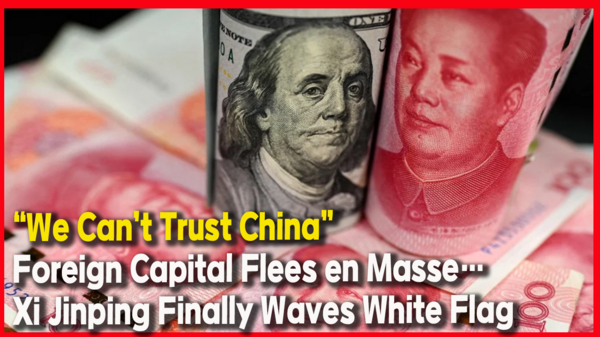
[Foreign Investment Decreases for 5 Consecutive Months… Beijing Announces 15 Emergency Measures]
In a bid to stem the exodus of foreign capital, China has rolled out 15 comprehensive measures, including widening market access to the financial, education, and healthcare sectors. However, the market’s response remains cold. Even as Beijing promises to "open its doors," it has repeatedly reversed foreign corporate transactions on national security grounds. Consequently, a growing chorus of critics points out that the root cause of the capital flight is not a lack of deregulation, but a profound deficit of trust.
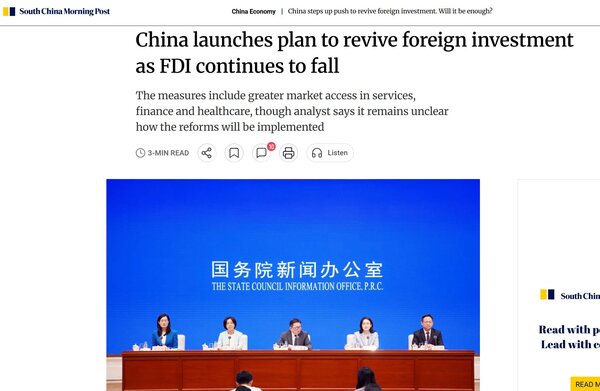
Hong Kong’s South China Morning Post (SCMP) reported on June 23, 2026, that “China’s Ministry of Commerce (MOFCOM), the National Development and Reform Commission (NDRC), and the Ministry of Finance jointly issued the Utilization of Foreign Capital to Stabilize and Promote Optimizing Action Plan on June 22.” The report highlighted that “the core of the plan involves executing 15 measures across five major areas: expanding market access, enhancing foreign investment convenience, strengthening investment promotion, establishing a service guarantee system for foreign-funded enterprises, and optimizing foreign investment management.” SCMP further noted that “the announcement comes as China’s attraction of foreign capital continues to decline for the fifth consecutive month.”
However, the backdrop against which these measures were introduced is far from bright. According to MOFCOM, Foreign Direct Investment (FDI) actually utilized in China from January to May this year stood at 327.29 billion yuan, marking an 8.6% year-on-year decrease. While the number of newly established foreign-invested enterprises increased, the actual volume of invested capital shrank.
This downward trend is not a temporary blip. According to data compiled by Trading Economics, China’s foreign capital inflows have recorded declines across all observed intervals this year, including January–February, January–April, and the first quarter. The U.S. Department of State also analyzed in its recent Investment Climate Statement that “in 2024, China’s net foreign direct investment plunged by $168 billion, recording the largest capital outflow since statistics began tracking in 1990.”
On the ground in China, some argue that the situation is even more severe than official statistics indicate. An anonymous source close to MOFCOM stated in an interview, “In recent months, the pace of foreign capital withdrawal has accelerated by about 30% compared to last year,” adding, “This is a level we haven’t witnessed in the past five years.”
[Doors Open to Finance, Education, and Healthcare… But Why the Disbelief?]
The Global Times, the English-language edition of the Chinese Communist Party's flagship newspaper Global Times, reported that “the focus most emphasized by the Chinese government in this action plan is the opening of the service sector.”
In the financial sector, foreign financial institutions will be allowed broader access to risk management tools, such as government bond futures, and support will be given to foreign firms entering the fund investment advisory business.
In education, pilot programs to open up vocational training institutions and universities in science, engineering, agriculture, and medicine will be expanded.
In healthcare, pilot areas for biotechnology and wholly foreign-owned hospitals will be increased, alongside initiatives encouraging private insurers to cover a wider array of innovative drugs and medical devices.
The Global Times also noted that Beijing promised to address the issue of "discrimination," a long-standing complaint of foreign businesses. The government pledged to apply various corporate support policies equally to foreign enterprises—except in areas touching national security—while tightening fair-competition reviews in government procurement and bidding processes and establishing an online system to report rights infringements to protect the interests of foreign firms.
During a press conference, Ling Ji, Vice Minister of Commerce, stated, "All restrictions on foreign investment in the manufacturing sector have already been lifted. Now, the issue is not market entry, but resolving business licensing. We will address the situation where 'the main gate is wide open, but the side doors remain shut.'" In essence, the government itself admitted that while market thresholds have been lowered, invisible barriers remain rampant at the actual operational stage.
Regarding this, the Global Times explained, “The investment convenience section includes revisions to regulations concerning foreign acquisitions of Chinese enterprises and measures to ease restrictions on cross-border data transfers.” The plan aims to expand industry-specific data export rules, centered around Free Trade Zones (FTZs), and formulate new criteria for critical data in sectors such as automotive, pharmaceuticals, and aviation.
The publication added, “The Chinese side also emphasized that these measures go beyond a mere cyclical response and serve as an expression of its commitment to globalization.” It cited an economic commentator who evaluated that the action plan not only supports China's economic development but also demonstrates its dedication to globalization, asserting that China's opening-up is vital to stimulating global investment and driving world economic growth.
[The True Problem Revealed by the Meta-Manus Incident]
While Manus was an AI startup that originated in China, it had already relocated its headquarters to Singapore. Despite this, Chinese authorities weaponized national security concerns to derail the deal.
What warrants closer attention is that this matter transcended simple economic regulation; it was reviewed at the level of the National Security Commission, an entity directly overseen by President Xi Jinping. While agencies tasked with attracting foreign investment were busy promising an "improved investment climate," the national security apparatus was simultaneously overturning transactions made by foreign corporations.
CNBC previously reported on June 12 that “Meta has commenced dismantling its Manus-related organization after Chinese authorities demanded the reversal of the already completed transaction.” The outlet added, “Furthermore, China recently announced sweeping new regulations expanding its control over overseas deals involving Chinese capital, technology, and data.”
This sends a deeply contradictory signal: one hand claims it will ease cross-border data transfer regulations, while the other tightens control by defining data and technology as matters of national security. Ultimately, what foreign companies fear most is not regulation itself, but the utter unpredictability of when and for what reason the rules might change.
[Factories are Already Moving to Vietnam, India, and Mexico]
While Beijing is busy publishing policy papers, changes are already well underway on the ground. In the Pearl River Delta of Guangdong Province and the Yangtze River Delta spanning Zhejiang and Jiangsu Provinces—the traditional heartlands of Chinese manufacturing—the relocation of production lines is becoming increasingly pronounced.
An official from a trading firm in Guangdong shared, “Overseas clients are demanding that suppliers set up production bases abroad to reduce their dependence on China.” This shift is reportedly most palpable across Shenzhen, Dongguan, and Guangzhou, where clusters of electronics, apparel, furniture, toys, and home appliance manufacturing bases are concentrated.
Similarly, a representative from a trading company in Wenzhou, Zhejiang Province, noted, “Many enterprises are seriously reviewing moves into Vietnam, India, and Mexico.”
In particular, the so-called 'China+1' strategy—retaining research and development (R&D) and management functions within China while moving actual manufacturing facilities overseas—is reportedly spreading rapidly. This transition is not driven by mere cost-cutting; it represents a structural transformation aimed at hedging against US-China friction, supply chain vulnerabilities, and geopolitical uncertainties.
[Domestic Stimulus Stalls; Eyes Turn Back to Foreign Capital]
The timing of this foreign investment stabilization package is also telling. The Chinese economy is currently grappling with a compounding matrix of crises, including a property market slump, sluggish consumption, youth unemployment, and local government debt. Crucially, the domestic demand-driven growth strategy, reportedly championed directly by President Xi Jinping, is widely assessed to have failed to deliver tangible outcomes.
Ultimately, with domestic demand failing to revive, a parallel exodus of foreign capital would leave the Chinese economy with few engines of growth to rely on. Analysts note it is no coincidence that Vice Premier He Lifeng has recently been emphasizing economic cooperation toward Germany and Europe, or that the Chinese leadership repeatedly highlights the importance of globalization and free trade at various international summits.
[The Issue is Not Market Opening, but Trust]
This stabilization plan serves as clear evidence that China desperately needs foreign capital. However, the more critical reality is that foreign capital no longer needs China as much as it used to.
In the past, China drew global capital by leveraging cheap labor, a massive domestic market, and prospects of stable growth. Today, however, its labor cost advantage has eroded, domestic consumption is stagnant, and security narratives consistently override economic logic.
What investors are looking for is not a fresh batch of subsidy policies, but predictability and trust—the assurance that the rules will not be shifted arbitrarily. No matter how many new opening-up measures the Chinese government unveils, the deep-seated skepticism of foreign capital will not easily dissipate as long as national security logic continues to upend business operations, as demonstrated by the Meta-Manus case.
In the end, critics view these 15 measures less as an effective policy to attract foreign investment, and more as a self-inflicted admission of a far more fundamental vulnerability facing the Chinese economy: a "crisis of trust."


-중국 푸단대학교 한국연구원 객좌교수
-전 EDUIN News 대표
-전 OUR NEWS 대표
-제17대 대통령직인수위원회 정책기획팀장
-전 대통령실 홍보기획비서관
-사단법인 한국가정상담연구소 이사장
-저서: 북한급변사태와 한반도통일, 2012 다시우파다, 선거마케팅, 한국의 정치광고, 국회의원 선거매뉴얼 등 50여권