Update2026.11.10 (화)

['China's CATL Grows in Scale Amid Oversupply, but Profits Fall Below Expectations']
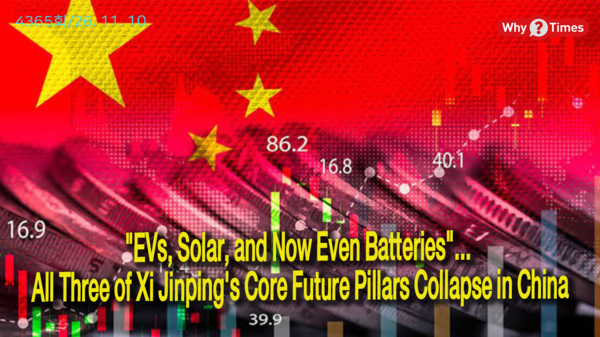
China's "New Three" (新三样)—electric vehicles, solar power, and lithium batteries—promoted as the new growth engines following the real estate slump, are falling into the trap of overproduction one after another. Major solar corporations have posted consecutive losses for over 10 quarters, and the electric vehicle sector has seen operating margins sink to the 2% range amid three years of a cutthroat price war. Even batteries, long regarded as the last line of defense, have entered a "selling more, earning less" dynamic, with world leader CATL’s net profit margin dropping to its lowest level since early 2024. Although Democrats secured control of both chambers of Congress in the US midterm elections, countering Chinese batteries remains a bipartisan consensus, leading to projections that all three of Xi Jinping's future industries will stumble.
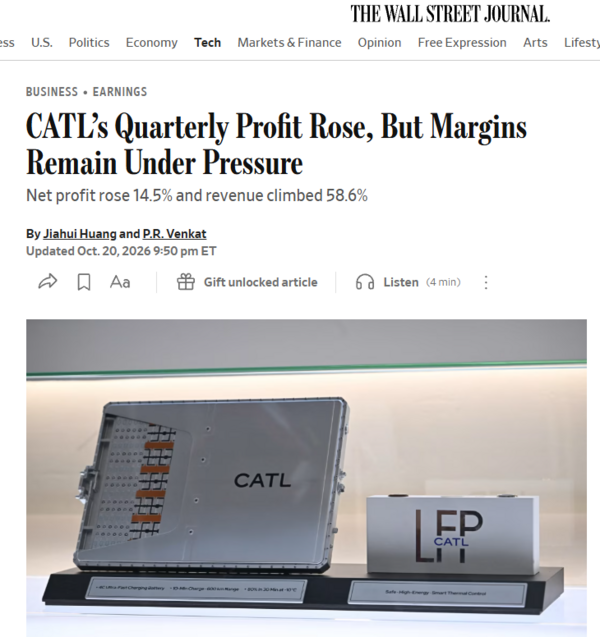
The Wall Street Journal (WSJ) recently reported that while third-quarter net income rose for China's CATL, the world's largest battery maker, margins are being squeezed by rising operating costs, noting that intensifying price competition and slowing demand growth in China's EV market are fueling mounting concerns over battery manufacturers' profitability. Even as Chinese batteries expanded their global market share, a wide divergence emerged between revenue expansion and profit growth at the leading enterprise.
['The Replacement Card for Real Estate: The 'New Three'']
The "New Three" is a concept championed by Chinese authorities to represent high-value replacement sectors for the traditional "Old Three" export pillars (clothing, home appliances, and furniture). As the property sector slipped into a protracted downturn, Beijing channeled subsidies and policy financing into these three industries as alternative growth drivers. Local governments similarly rushed into a fierce race to attract manufacturing plants. The outward expansion is unmistakable: between January and September this year, China's lithium-ion battery export value reached 55.39 billion yuan (approximately $55.4 billion, or about 75 trillion won), up 27% from a year earlier. The problem is that capacity far outstripping demand has accumulated, and the price being paid is a collapse in profitability.
['The First Domino: Solar Sinks Under 10 Consecutive Quarters of Losses']
The first to crumble was the solar industry. According to data compiled by Caixin, the combined losses of leading Chinese solar firms in 2025 are estimated to have exceeded 50 billion yuan (approx. 10 trillion won). Tongwei, Longi, and TCL Zhonghuan logged losses for 10 straight quarters. Bloomberg reported that the combined third-quarter net loss for four major players—Longi, JinkoSolar, Trina Solar, and Tongwei—totaled 4.63 billion yuan (approx. 936.1 billion won). Caixin analyzed that "China's solar production capacity stands at nearly double global demand." In the first half of this year, new solar installations in China plummeted 66% year-on-year to 72.1 GW. As a consequence of restructuring, total employees across the top five solar manufacturers stood at 154,061 at the end of last year, shrinking by 40,589 in a single year.
['The Second Domino: Electric Vehicles in a Three-Year Bloodbath']
Electric vehicles are walking the same path. According to Caixin, domestic auto sales in China dropped more than 20% year-on-year in the first quarter of this year, while the industry's gross profit margin tumbled from 4.1% last year to 2.9% during the first two months of this year. China's largest automaker BYD saw net profit decrease 19% last year despite a 3.5% rise in revenue, while operating cash flow plunged by more than half. Researchers at the China Automobile Dealers Association estimated that the price war between 2023 and 2025 wiped out 471 billion yuan (approx. 95.2 trillion won) in industry revenue. Beijing convened industry meetings multiple times starting in 2025 to issue warnings, and in February this year, it implemented regulations banning sales below cost. Nonetheless, discount competition has not ceased.
['Even the Last Bastion: CATL's Profit Margin Hits 2.5-Year Low']
Batteries, an area where China has boasted "absolute supremacy," are now fully exposed to margin pressure. Global number one CATL posted record quarterly revenue in the third quarter, rising 58.58% to 165.221 billion yuan (approx. 33.38 trillion won). However, net profit attributable to shareholders increased by only 14.54% to 21.246 billion yuan (approx. 4.3 trillion won), falling 5.77% compared to the prior quarter. Its net margin stood at 12.86%, down 4.94 percentage points year-on-year, marking its lowest reading since Q1 2024. According to Goldman Sachs, net profit per kWh fell to 82 yuan (approx. 16,600 won), dropping below both 112 yuan in the same period last year and 97 yuan (19,600 won) in the prior quarter. During the same period, net operating cash flow sharply declined to around 1.4 billion yuan (approx. 282.9 billion won), while inventories climbed 11% in a single quarter to 144.8 billion yuan (approx. 29 trillion won).
CATL management cited three primary factors: a worsening product mix due to a higher proportion of lower-value projects, a 2% battery consumption tax levied starting in September, and reduced export value-added tax (VAT) rebates. The battery consumption tax rate is set to double to 4% starting in September 2027. However, the root cause is "involution" (内卷)—self-destructive overcompetition. Fatigued by bleeding price wars, automakers seeking cost cuts expanded procurement to second- and third-tier battery makers, weakening the pricing power of leading players. Ironically, the tax measures enacted by Beijing to rein in overcapacity are squeezing corporate profits even further.
['Export Escape Routes Closing: US Bipartisan Consensus on 'China Exclusion' Holds Across Power Shifts']
Volumes that cannot be absorbed domestically have no choice but to head abroad, yet that exit channel is narrowing. In the November 3 US midterm elections, Democrats captured both the Senate and the House. Al Jazeera assessed that "this outcome brings an end to the Republican trifecta (where one party holds the presidency, the Senate, and the House concurrently) established in the 2024 election." However, a change in legislative power does not open an escape route for China. In a pre-election report, Hyundai Motor Securities forecast that "given that both the Democratic and Republican parties have a history of tightening tariff policies on Chinese batteries, the policy direction of blocking Chinese supply chains will persist post-election."
An analyst at UBS also told Semafor, an international affairs outlet, that "the momentum toward 'China decoupling' is actually accelerating." Relying entirely on China's battery supply chain is seen as just as unacceptable as relying entirely on Middle Eastern oil was 30 years ago. The EU is also imposing high tariffs on Chinese EVs and holding detailed deliberations ahead of implementing the Industrial Acceleration Act (IAA) to protect internal industries. While CATL and BYD seek detours by building facilities in Hungary and Poland, localized production acts as a boomerang that depresses the utilization rates of manufacturing bases inside China.
['Diverging Fortunes: China 'Sells More, Earns Less' vs. Korea 'Sells Less, Earns More']
In contrast to China, South Korean manufacturers that surrendered market share managed to secure solid margins. LG Energy Solution logged an all-time quarterly high operating profit of 756 billion won in the third quarter, more than doubling the market consensus of 326.4 billion won compiled by FnGuide. While this included 416.9 billion won from the US Advanced Manufacturing Production Credit (AMPC), the company remained profitable even excluding subsidies. Samsung SDI also swung to profitability with an operating profit of 407.8 billion won, posting its strongest performance since Q3 2023. Both companies pointed to surging demand for Energy Storage Systems (ESS) for US AI data centers as their key growth catalyst.
However, it is premature to conclude that China's battery industry will unravel in the short term. CATL's cash and cash equivalents exceed 430 billion yuan (approx. 87 trillion won), and its cumulative net profit for the first three quarters grew 31.6%. A battery industry insider noted, "China remains a powerhouse holding over 90% market share in the global grid-scale ESS market," adding, "Domestic companies must diversify their supply chains not only across the US but to other nations as well." This underscores the need to remain vigilant should China initiate aggressive price dumping in ESS to offload surplus capacity.
['Why Times Insight']
Solar power crumbled first, electric vehicles followed, and now batteries have stepped onto the exact same trajectory. The order differs, but the root cause is identical: state subsidies and inter-local government investment races created vast capacity far exceeding market demand, while the resulting price wars eroded all profitability. The "New Three," conceived as replacement growth engines for real estate, merely replicated the identical overinvestment model across different sectors. This publication views this as a "triple failure" of Xi Jinping's industrial strategy.
More critically, the exit routes are closing. While China historically resolved domestic oversupply through exports, the US has cemented the exclusion of Chinese goods as a constant regardless of the party in power, and Europe is traveling down the same track. Beijing's anti-involution remedy is producing the paradox of further crushing corporate earnings with taxes. As Tu Le, founder of Sino Auto Insights, stated to The Economist, "unviable companies are simply not exiting the market fast enough." If domestic overcapacity and overseas trade barricades intersect without genuine industrial restructuring, all three future pillar industries risk losing their capacity to function as engines of growth.
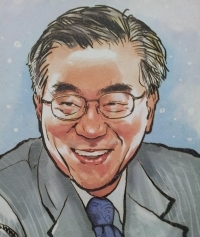
-중국 푸단대학교 한국연구원 객좌교수
-전 EDUIN News 대표
-전 OUR NEWS 대표
-제17대 대통령직인수위원회 정책기획팀장
-전 대통령실 홍보기획비서관
-사단법인 한국가정상담연구소 이사장
-저서: 북한급변사태와 한반도통일, 2012 다시우파다, 선거마케팅, 한국의 정치광고, 국회의원 선거매뉴얼 등 50여권