Update2026.11.10 (화)

[The "statistical fortress" breached after a six-month quiet infiltration]
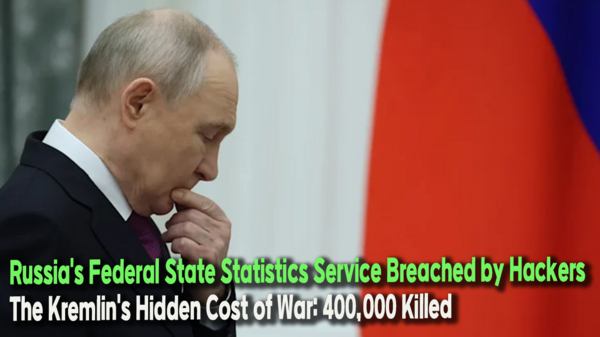
Russia's Federal State Statistics Service has been hacked. Through this breach, the human toll of the war in Ukraine—concealed by the Kremlin for over four years—has been exposed. The war-related death records identified in the leaked data by Bloomberg number approximately 392,700. This significantly exceeds the 325,000 estimated earlier this year by the Center for Strategic and International Studies (CSIS) in the United States and is more than 100,000 higher than the roughly 280,000 casualties individually verified by name by independent Russian media outlets. Because missing persons, unidentified bodies, and deaths classified under alternate causes are omitted, the actual toll is likely even greater. The demographic distribution by age and region also quantitatively reveals that the Kremlin has shifted the human burden of the war onto middle-aged men and peripheral ethnic minorities. Ahead of the resumption of Abu Dhabi peace negotiations mediated by the United States, the price Russia must pay to secure territory has become just as stark as the territorial concessions demanded by Putin.
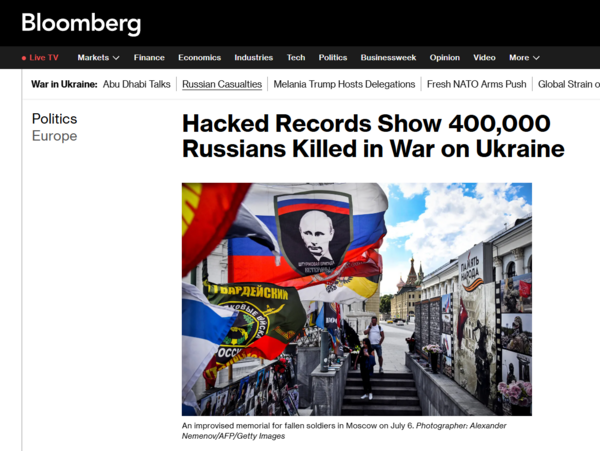
On the 9th, Bloomberg reported that an analysis of internal records hacked from Russia's Federal State Statistics Service (Rosstat) revealed approximately 392,700 death certificates explicitly tied to the war between February 24, 2022, when Russia launched its full-scale invasion of Ukraine, and the end of August 2026.
The breach was the result of a meticulously pre-planned cyber operation. The hackers claim they had penetrated Rosstat's internal network roughly six months prior to the assault. Systematically harvesting internal documents and data during that window, they struck the IT infrastructure between the night of October 31 and the early morning of November 1. They stated that they accessed around 25,000 computers and exfiltrated approximately 23 terabytes (TB) of data. Immediately following the attack, a banner written in Belarusian appeared on Rosstat's official website alongside a graph depicting Russian military casualties. This chart, however, was derived not from Rosstat's internal records but from the daily casualty estimates issued by the General Staff of the Ukrainian Armed Forces. Rosstat acknowledged through the Interfax news agency that it suffered a targeted, disruptive cyberattack from October 29 to November 1. Nonetheless, it countered that no breach of databases or leaks of legally protected information had been confirmed. Even so, citing technical disruptions, it extended the filing deadline for certain statistical reports until November 13.
The operation was carried out jointly by the Cyber Partisans, an anonymous hacking collective that has resisted the Belarusian regime of Alexander Lukashenko, and Silent Crow, a pro-Ukrainian hacker organization. The two groups previously mounted a joint cyber intrusion targeting Russia's state carrier Aeroflot in July 2025. Russia's Supreme Court designated both groups as extremist entities on July 21, 2026. On November 7, the hackers initially unveiled their own estimates based on Rosstat's internal "Demography" database. The Cyber Partisans cited a floor of 393,881 casualties, counting solely records where military operations were explicitly recorded as the cause of death. Silent Crow calculated a ceiling of up to 450,100, incorporating non-combat military fatalities and deaths left with unrecorded causes.
[Bloomberg's verification: "No traces of tampering"]
On the same day, Bloomberg conducted an independent examination of the raw records separate from the claims of the hackers. The dataset comprised roughly 11 million death certificates, each documenting age, residency, and the place of death. Bloomberg screened for war-related fatalities using classification codes for cause of death alongside entries explicitly mentioning military operations, artillery fire, or drone strikes. That filter yielded approximately 392,700 entries from February 24, 2022, through the end of August 2026. A separate integrity audit was carried out. While cryptographic proof of original authenticity was unfeasible, no evidence of fabrication or tampering was uncovered. The metadata aligned consistently with parameters typical of files extracted from operational government systems. The records for 2021 and 2022 varied by only 0.1% and 0.2%, respectively, from the official figures Rosstat had published in the past.
The 2023 figures warrant even closer attention. Fatalities within the leaked data exceeded the officially reported tally by approximately 1%. The deaths of thousands of young men appear to have been omitted from public statistics, pointing to the possibility that the demographic records released by the government were themselves curated and filtered. Bloomberg's tally does not account for missing soldiers, unidentified bodies, or military personnel whose deaths were documented under alternate civilian causes. Although roughly 37,800 military fatalities were entered during 2026, the actual number is believed to be higher because official death registration often takes months. The registration lag has grown steadily longer. The median period from the date of death to civil registration stretched from roughly six weeks in late 2023 to more than four months in 2025. Among the records inputted in August 2026, more than 2,500 were deaths that occurred in 2025. For fatalities sustained in 2024, approximately one in ten took upwards of 14 months to be registered.
[The price paid by contract soldiers in their 50s and peripheral ethnic minorities]
The age data embedded within the death certificates reflects how the composition of Russian forces has shifted as the war dragged on. War-related deaths among men aged 50 to 59 stood at 146 in the first half of 2022, representing less than 1% of all deaths in that age bracket. By the first half of 2025, however, the figure topped 12,600, making up roughly 16% of all deaths in that demographic. In effect, one out of every six male deaths in their 50s was caused by the war. The figures for men aged 18 to 29 are even starker. Close to two-thirds of all deaths in this cohort were war-related. The demographic cohort that would normally have the lowest mortality rates from illness or accidents in peacetime suffered the highest proportion of wartime sacrifice.
Regional disparities were equally pronounced. From the start of the invasion through mid-2024, war-related causes accounted for roughly one-third of all deaths among men aged 18 to 49 in the Republic of Buryatia, the Tuva Republic, and the Zabaykalsky Krai in Siberia. By contrast, that share remained around one-tenth in Moscow and Saint Petersburg. Young and middle-aged men from impoverished peripheral provinces with large Mongolic and Turkic minority populations faced a battlefield fatality risk more than three times higher than their counterparts in the capital regions. The geographical skew toward the periphery—long highlighted by independent Russian outlets like Mediazona and researchers through obituaries and cemetery monitoring—has now been corroborated for the first time by official government source records.
[Vanishing statistics, concealed casualties]
The last time Russia officially disclosed its military casualties was in September 2022, when it claimed 5,937 soldiers had died. Since then, Rosstat has systematically shut down access to data streams that could be used to calculate casualties. In 2022, after the war broke out, detailed subcategories in mortality reports were truncated, and from 2024 onward, annual death statistics broken down by cause were suspended entirely. In May 2025, public dissemination of demographic indicators, including birth rates, was halted. In July 2026, the figures for births, deaths, and population were entirely stripped from the monthly socio-economic bulletin for the first time. The Institute for the Study of War (ISW) in the United States linked this data blackout directly to the Kremlin's efforts to mask severe casualty rates across the Russian armed forces. The final annual figures released showed 1.22 million births in Russia in 2024—the lowest level since 1999—while deaths rose 3.3% to 1.82 million during the same year.
The leaked dataset gains clearer context when viewed alongside external estimates. A joint tracking effort by Mediazona and the BBC Russian Service had verified 285,881 Russian military fatalities by name from open-source records as of November 6. The investigative team has consistently emphasized that this figure remains incomplete and that the true scale is substantially higher. In a January report, CSIS estimated that approximately 325,000 Russian troops were killed and 875,000 wounded or missing between February 2022 and December 2025. The Kremlin dismissed that report as unreliable. The General Staff of the Ukrainian Armed Forces puts overall Russian casualties since the full-scale invasion at 1,609,380, combining both dead and wounded.
[Six dead per square kilometer gained… mounting pressure for mobilization renewed]
Set against the enormous loss of life, the territorial gains remain meager. According to data from the Ukrainian battlefield monitoring project DeepState, the Ukrainian territory seized by Russia since February 2022 amounts to roughly 73,000 square kilometers. Applying Silent Crow's upper casualty estimate of 450,100, Russia has sacrificed roughly six lives for every single square kilometer gained. CSIS noted that even after seizing the battlefield initiative in 2024, Russian forces advanced at a daily average of only 15 to 70 meters across major offensive axes. That pace is widely regarded as one of the slowest large-scale offensives recorded over the past century.
Bloomberg observed that because Russian casualty rates frequently outpace replacement recruitment while yielding no decisive breakthroughs on the frontline, the Kremlin could soon face mounting pressure to expand mobilization. The partial mobilization decree issued in September 2022 was never officially rescinded, granting the authorities the continuous legal prerogative to call up reservists at any time. The casualty figures brought to light by this leak make clear the steep human toll that will attend any such decision.
[Why Times Insight | How Much Longer Can Putin Sustain the Current Offensive?]
First, the credibility of Russia as a data-driven state has been critically fractured. The revelation that actual deaths in 2023 exceeded official disclosures by roughly 1% indicates that the Kremlin did not merely suspend data releases; it actively manipulated and filtered the figures it did publish. Domestic and international financial institutions and analysts who have relied on Rosstat benchmarks now have clear cause to question the integrity of Russia's broader inflation metrics, growth statistics, and demographic reporting.
Second, the structural "outsourcing" of war casualties has been laid bare by primary records. Casualties among residents of Moscow and Saint Petersburg were kept relatively low, while the human cost mounted disproportionately among Siberian ethnic minority regions and men in their 50s. This aligns with assessments that the Putin administration has relied on high-paying contract recruitment to insulate the urban middle class from discontent. This recruitment pool, however, is not inexhaustible. The sharp rise in the proportion of deaths among men in their 50s suggests that the reserve of recruits acquired through monetary incentives is nearing exhaustion. If so, bearing the political fallout of broader mobilizations touching major metropolitan centers will become difficult to evade.
Third, cyberspace has crystallized into a vital front line of information warfare. That a core state statistical institution remained compromised by hackers for six months without detection lays bare severe vulnerabilities across Russian government IT networks. With anti-regime and pro-Ukrainian hacker collectives surfacing strategic intelligence on par with Western intelligence services into the public domain, the stark discrepancy between the Kremlin's narrative of victory and the true costs incurred will emerge as a factor impossible to dismiss at the ceasefire negotiating table.

-중국 푸단대학교 한국연구원 객좌교수
-전 EDUIN News 대표
-전 OUR NEWS 대표
-제17대 대통령직인수위원회 정책기획팀장
-전 대통령실 홍보기획비서관
-사단법인 한국가정상담연구소 이사장
-저서: 북한급변사태와 한반도통일, 2012 다시우파다, 선거마케팅, 한국의 정치광고, 국회의원 선거매뉴얼 등 50여권