
Update2026.11.10 (화)


[Wealthy Chinese Shift Funds Kept in Hong Kong and Singapore to the U.S.]
As Chinese authorities ramp up aggressive tax enforcement to plug fiscal deficits pressured by the real estate slump—broadening the tax net to cover offshore trusts and past investment income of the country's wealthiest—affluent Chinese are pulling assets held in Hong Kong and Singapore and moving them to the United States on a massive scale. This shift represents a calculated move to mitigate Beijing's information access by choosing the U.S., which does not participate in the multilateral automatic exchange of financial account information. As China pursues overseas wealth under the banner of "Common Prosperity," an irony emerges: high-net-worth individuals are finding shelter for their fortunes within their nation's primary strategic competitor.
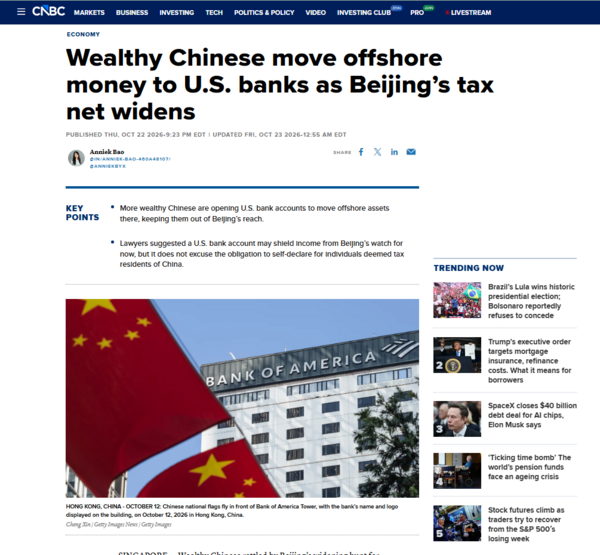
On the 24th, U.S. broadcaster CNBC reported that inquiries from Chinese clients regarding opening U.S. bank accounts have surged, accompanied by actual asset transfers. Private bankers and attorneys catering to Chinese clientele noted that inquiries jumped following the tightening of offshore trust taxation in July, leading some clients to shift assets stored in Hong Kong and Singapore directly to the United States.
According to CNBC, Keith Tan, CEO of Singapore-based Golden Acacia Capital, stated that clients had been preparing to transfer assets to the U.S. since July, with some opening accounts in under two months. American financial institutions are actively eyeing the wealth management demands of Chinese clients as lucrative business opportunities. The significance of this dynamic is substantial: with offshore assets now squarely targeted by Beijing's scrutiny, wealthy individuals are reorganizing where their capital resides. Asset allocation is no longer driven purely by investment yields, but increasingly by Beijing's ability to access information.
[Reuters: "Disposing Assets and Borrowing to Pay Taxes"… Pressure Mounts on the Wealthy's Wallets]
Preceding this capital flight was a concerted scramble for liquidity to settle tax bills. On the 16th, Reuters reported that as wealthy Chinese calculate tax liabilities tied to offshore trusts and restructure their holdings, some banks have begun offering loans collateralized by client stock holdings to cover tax payments.
Being wealthy is distinct from having sufficient ready cash to pay taxes immediately. If the bulk of one's wealth is tied up in corporate equity or real estate, settling tax dues requires offloading assets or borrowing capital. Heightened tax enforcement is therefore placing direct operational and financial pressure on the wealthy's asset management.
On the 7th, the Financial Times (FT) analyzed China's offshore tax crackdown in connection with Xi Jinping's "Common Prosperity" agenda. The outlet highlighted growing apprehension among entrepreneurs and the wealth management industry as the scope of required contributions expands to accumulated offshore fortunes and historical income.
[China's Shrinking Land Sales Revenue… Seeking Tax Sources in Overseas Income]
Underlying this aggressive tax collection drive is China's worsening fiscal predicament. The prolonged property slump does not merely affect developers and homebuyers; it severely strains land sale revenues—a pillar of local government finances—making it imperative to secure revenues from alternative streams.
In an analysis published in August, Reuters stated that the drop in land concession revenues caused by the property downturn prompted tighter enforcement on overseas assets. Carlos Casanova, senior economist at Swiss private bank UBP, interpreted this as an initiative by authorities to diversify revenue sources. As capital mobilization from domestic real estate weakens, Beijing is looking much more aggressively toward taxing foreign-sourced income.
Authorities hold the justification of taxing unreported income and fostering tax fairness. Yet, for asset holders, this feels palpably like the state shifting its fiscal burden onto private wallets. In particular, requiring individuals to settle unpaid historical liabilities in areas where enforcement had previously been lax sparks deep anxiety—not just over current tax obligations, but over subsequent investigations and future liabilities.
[Offshore Trust Tax Rules Detailed… Demands to Settle Historical Unpaid Taxes]
The direct catalyst was the set of offshore trust tax regulations unveiled on July 24 by China's Ministry of Finance and the State Taxation Administration. Trusts serve as vehicles where assets are handed over to trustees for management and administration, widely utilized by high-net-worth individuals for estate planning and wealth succession. The recent measures delineate tax treatments across all stages, from asset contribution to ongoing operations and termination.
At the contribution stage, an individual income tax rate of 20% applies to capital gains—defined as fair market value minus acquisition cost and reasonable expenses. This is not an across-the-board 20% levy on principal. However, income generated during the trust's operation can become reportable even if not actually distributed, resulting in a timing mismatch between cash receipt and tax liability.
Resolving past unpaid taxes adds further strain. Authorities instituted a 90-day reporting and payment window for certain unpaid taxes related to asset contributions made between 2023 and 2025, as well as trust income accrued prior to 2026. The deadline was October 22. Asset owners were forced to audit historical trust tax records while simultaneously securing short-term liquidity.
[Why the U.S.… Tax Liability Remains, but Tracking Grows Difficult]
A principal reason driving certain Chinese asset owners toward the U.S. lies in structural differences within the automatic exchange of financial account information. In Hong Kong and Singapore, which adhere to the Common Reporting Standard (CRS), financial account details of Chinese tax residents can be routinely transmitted to Beijing. In contrast, the United States does not participate in the CRS, meaning the same automated reporting pipelines do not apply. Some wealthy individuals are leveraging this discrepancy to curtail the risk of Beijing accessing their financial records.
Naturally, transferring capital to the United States does not extinguish one's legal tax obligations to China. Nevertheless, whether a tax liability legally exists and whether Chinese authorities can practically uncover and tax unreported overseas assets are two separate matters. Because balances and investment earnings in U.S. accounts are not systematically transmitted through CRS, significant blind spots emerge in Beijing's intelligence gathering.
This does not mean the trail is wholly erased. Historical account data in Hong Kong or Singapore may have already been reported, and originating banks retain outward wire records destined for the U.S. On the 16th, Reuters reported that Chinese tax authorities are cross-referencing public records, such as the Hurun Rich List and corporate disclosures, to identify offshore trust tax targets. Still, such clues do not guarantee automatic visibility into every transaction or income stream generated after funds reach the U.S.
While the U.S.-China bilateral tax treaty contains information-exchange provisions, obtaining data through it is case-specific and hinges on rigorous treaty thresholds and procedural hurdles. The U.S. is not an airtight haven, but it is a jurisdiction where Beijing faces steep barriers to entry. The movement of wealthy Chinese toward the U.S. is not a belief that taxes have vanished, but a calculated effort to step away from channels where assets and income are automatically laid bare.
[Why Times Insight | Taxes Can Be Collected, but Trust Cannot Be Coerced]
At the crux of this development lies a collision between the Chinese state's fiscal appetite and private capital's trust. The government faces an urgent need to shore up revenue, but asset holders are calculating just how deeply the state will demand a slice of their wealth in the years ahead. When retrospective reviews of past income coincide with expanding audit scopes, anxiety inevitably intensifies.
Ultimately, the core of this campaign leans closer to fiscal extraction than genuine tax justice. The statutory tax rates themselves mirror pre-existing laws. However, presenting retroactive tax bills spanning over three years for practices long tolerated, complete with a tight 90-day ultimatum, strongly suggests an attempt to patch up local government deficits hollowed out by collapsing land sales using the wallets of the wealthy. "Common Prosperity" serves as the ideological packaging. From the perspective of the wealthy, it is impossible not to view this as the Communist Party actively emptying their pockets.
Legitimate tax obligations must, of course, be honored. Yet if the process of resolving fiscal deficits heightens private-sector uncertainty, the ensuing economic fallout must also be weighed. If "Common Prosperity" is perceived not as a vehicle expanding opportunities for wealth creation, but as a punitive mechanism stripping away accumulated capital, entrepreneurs will pivot from building new enterprises to shielding existing wealth.
The destination being the United States is equally symbolic. Amid an intense U.S.-China strategic rivalry, the fact that the vault most trusted by China's affluent elite belongs to financial institutions in a rival nation exposes deep fractures in institutional trust. It also signals that Hong Kong has lost its longstanding mantle as an offshore safe harbor.
If this outflow gathers pace, it will paradoxically prompt Beijing's countermoves: tracking wire histories, tightening cross-border capital controls, and broadening taxation across overseas earned income and insurance products. As insecurity among asset holders grows, private investment and consumer spending will contract, feeding into a vicious cycle that further depresses tax revenues. While the term "exodus" has yet to be corroborated by macroeconomic aggregates, the directional trajectory is clear.
The Chinese Communist Party can audit overseas income and levy taxes on the wealthy. However, it cannot coerce the trust required to keep their future enterprises and investments anchored in China. If the state alienates private capital in its bid to plug immediate fiscal gaps, the ultimate economic bill will land squarely on China's own doorstep.

-중국 푸단대학교 한국연구원 객좌교수
-전 EDUIN News 대표
-전 OUR NEWS 대표
-제17대 대통령직인수위원회 정책기획팀장
-전 대통령실 홍보기획비서관
-사단법인 한국가정상담연구소 이사장
-저서: 북한급변사태와 한반도통일, 2012 다시우파다, 선거마케팅, 한국의 정치광고, 국회의원 선거매뉴얼 등 50여권