Update2026.11.12 (목)

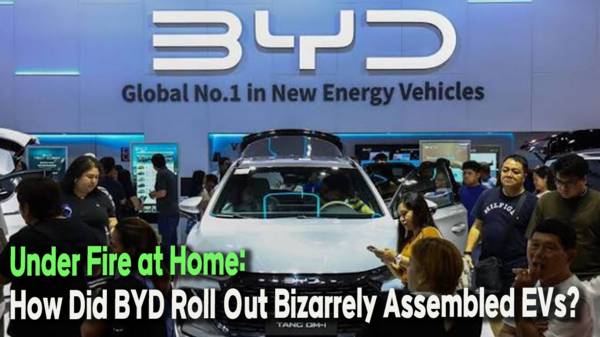
[Owners Spot Defects Before Manufacturer… BYD Admits Assembly Error]
Chinese electric vehicle maker BYD faces fierce backlash from domestic consumers. Certain units of its large electric SUV, the “Datan EV,” were delivered with front and rear wheel rims of differing specifications mistakenly swapped. Many owners only inspected their vehicles after seeing reports posted online by fellow buyers. Although BYD apologized and attributed the root cause to a code entry error by a component supplier, it did not disclose the number of affected vehicles or the production batches involved. The owners’ question is straightforward: how could reversed front and rear parts fail to be detected by anyone prior to delivery?
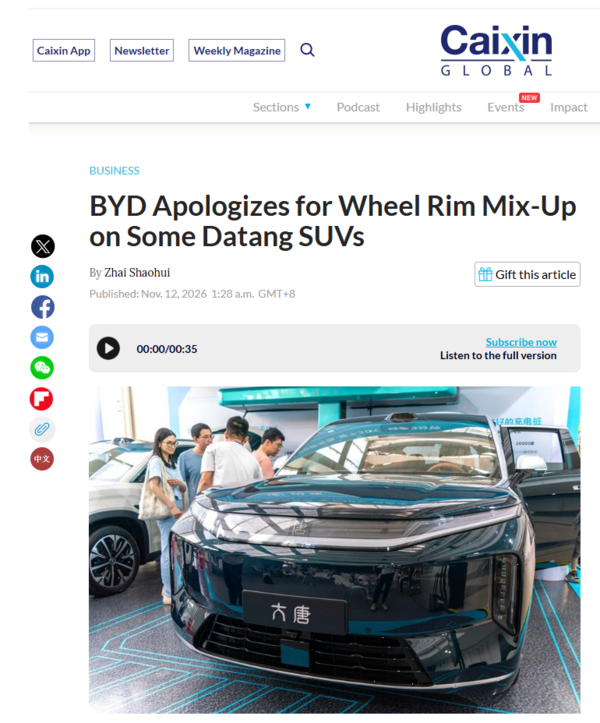
Caixin Global, the English-language edition of Chinese financial media outlet Caixin, reported on the 12th that “BYD confirmed the reverse assembly of front and rear wheel rims on certain Datan EV models and issued a public apology.” Earlier, on the 11th, Reuters reported that “following an internal investigation prompted by owner feedback, BYD found that incorrect parts were mounted on some vehicles due to a coding error made by the wheel rim supplier.” BYD stated that “specialized testing confirmed no impact on handling performance or operational driving safety.”
The controversy had already mounted among owners well before the official apology. On the 10th, Shanghai Securities News reported, “An examination of complaint platforms including China's auto grievance site CheZhiWang revealed that related filings exceeded 100 cases, surging rapidly over the preceding two days.” The outlet added, “Reports concentrated heavily on the 2026 Datan EV 950 km Rear-Wheel Drive LiDAR Flagship, with over 100 cases tabulated by local media.” Exactly how many vehicles were misassembled and whether other specifications were affected remained unverified in official company statements.
The experiences shared by owners, as cited by Caixin, illustrate why frustration ran so high. One owner who took delivery in Shanghai on June 26 filed a complaint on CheZhiWang on November 6, stating, “I discovered the reversed front and rear rims belatedly,” and demanded part replacements along with extended warranties. Another owner who identified the defect after driving 4,533 km demanded a written report alongside comprehensive checks of the tires and undercarriage parts after the service center merely offered to swap the rims back into place.
Some owners only uncovered the mishap upon visiting service centers without any prior notice from the manufacturer. On the 10th, Chinese media outlet Zhengzai Xinwen reported that “an official under the Pingshan Branch of the Shenzhen Administration for Market Regulation confirmed they received related complaints and are verifying the facts.” An issue once raised individually by owners at service desks had escalated into an official inquiry by local market supervision authorities.
[8J and 9J: The Risks Created by a 20 mm Discrepancy]
Under original design specifications, the front wheels employ 255/50R20 tires on 8J rims, while the rear wheels use 275/45R20 tires on 9J rims. This represents a staggered setup where the rear tires are 20 mm wider than the front. However, the problem vehicles rolled out with 9J rims paired with 255 tires at the front and 8J rims fitted with 275 tires at the rear. Because the two rim variants look nearly identical on the outside, distinguishing them visually is difficult, and their precise dimensions can only be verified via markings stamped inside the rims.
Chinese automotive outlet Autohome (Qiche Zhijia) pointed out that “tire manufacturer specifications must be reviewed to determine whether mounting wide 275 tires onto narrower 8J rims falls within the permissible rim width range.” The outlet noted that “exceeding those limits alters the tire’s cross-sectional profile and sidewall load distribution, potentially degrading high-speed driving stability.”
In an online video, one automotive blogger explained: “When wide tires are forced onto narrow rims at the rear, the sidewalls pinch inward, causing the tread to bulge and the shoulder to distort. Prolonged operation under these conditions—especially at highway speeds—leads to uneven wear, sidewall bulging, and heightened blowout risks.” The blogger added, “Conversely, the wide rims on the front stretch the narrow tires outward, pulling the contact patch away from factory parameters, inducing a floating sensation while driving, and compromising braking stability. Over time, this could interfere with electronic control calibrations, including ABS and ESP, which rely on factory tire contact baselines.” Other analyses warned that “since this is a rear-wheel-drive vehicle, reduced grip on the drive wheels could cause the rear end to fish-tail on wet surfaces.”
A Zhihu user possessing apparent automotive engineering expertise wrote: “The suitable rim width for a 275 tire is 9J to 10.5J; squeezing one onto an 8J rim requires immense mechanical force. The more you think about it, the more chilling it gets.”
[“Unheard Of, Never Seen Before”… Where Was the Three-Tier Inspection Net?]
Criticism centers less on the assembly slip itself than on the failure of quality filters to catch it. Automotive blogger Wu Xiaotong, who commands 880,000 followers on Weibo, remarked, “A case where front and rear rims are swapped upon delivery is unheard of and never seen before (聞所未聞,見所未見).” He asked, “After rolling off the assembly line, vehicles undergo pre-intake checks at 4S dealerships followed by a pre-delivery inspection (PDI) before hand-over to clients—how did not a single stage flag this issue?” He emphasized, “What must be clarified moving forward is whether this stems from widespread assembly defects or isolated human errors on a few cars.”
Online public sentiment proved even harsher. Comments included: “Quality control has failed critically; next time a part could go missing or two bolts might be left unfastened”; “If they can mount wheels backward, I shudder to think how other vital components were installed”; and “Pro-forma quality checks—that is the most terrifying part.” Another commenter drew an analogy: “It is like dressing an individual who is 180 cm tall in 160 cm clothes, while putting 180 cm clothes on someone who is 160 cm tall,” noting that “traditional automakers historically engineered parts with fool-proofing (poka-yoke) designs so misaligned components would physically never fit.”
[A Week of Silence, Followed by Blaming the Supplier]
BYD’s initial posture was bureaucratic. CheZhiWang complaints received identical form responses stating, “Your inquiry has been forwarded to the relevant department; please wait,” while on the 9th, customer service hotlines advised owners merely to visit nearby service centers for a checkup. Confirmations came first from the field. BYD after-sales personnel in Ningbo and Shanghai confirmed to the press that “rims were indeed swapped on certain production batches, and affected status can be checked via Vehicle Identification Numbers (VIN).” On the 10th, the Maluan Market Supervision Office under the Pingshan Branch of the Shenzhen Administration for Market Regulation stated that “authorities are looking into complaints and public feedback to verify facts.”
Ultimately, on the 11th, BYD issued its “Statement on Wheel Rim Installation Issues for Certain Datan Vehicles.” The statement outlined that “an input code error by wheel sub-assembly supplier Hubei Boyu Industrial led to improper rim mounting on certain vehicles,” adding that “complete inspections and code revisions have concluded, and the supplier has introduced vision-based error-proofing systems on the production line.” It reiterated, “Dedicated testing shows no impact on steering performance and poses no operational safety risks.” Compensation terms included free inspections, rim replacements, and loaner vehicles or transit allowances during repair periods, with warranty clocks for affected units reset from the statement’s release date.
[Unresolved Questions in the Wake of an Apology]
Key questions lingered even after the formal statement. BYD disclosed neither the exact volume of impacted vehicles nor the specific production batches. Nor did it clarify whether tires driven over thousands of kilometers would be replaced or how suspension and chassis components subjected to abnormal loads would be diagnosed. Requests from owners for full wheel-and-tire set replacements, precision undercarriage checks, extended drivetrain warranties, and formal recall announcements were left unanswered.
Whether attributing the failure to the supplier will quell criticism remains doubtful. Hubei Boyu Industrial is not a raw wheel manufacturer, but a tier supplier responsible for wheel sorting, tire mounting, and barcode verification to supply completed wheel assemblies. Even if an input coding error served as the immediate trigger, it does not alter the fact that the resulting defects sailed cleanly through BYD’s final assembly line, end-of-line inspections, and dealer PDIs. The statement provided no answers to the exact questions raised by Wu Xiaotong.
[Quality Controversies Erupt Amid Domestic Sales Slump]
The incident carries extra weight because it coincides with BYD’s wobbling footing in its home market. According to US-based EV industry media outlet CnEVPost, BYD’s domestic sales in China from January to October fell 27.81% year-on-year to 2,108,590 units. Bloomberg reported that “domestic sales in October alone stood at roughly 320,000 units, down 10.6% from a year earlier.” Weak consumer demand alongside price wars among local rivals was cited as key drivers. In contrast, overseas exports surged 93.75% over the same period to 1,513,154 units, underscoring an operating structure increasingly dependent on international sales to buoy overall figures.
BYD has already surrendered its domestic sales crown. Following precipitous year-on-year sales declines exceeding 53% in January and 65% in February, BYD relinquished the number-one sales spot in China to Geely. First-quarter net profit dropped 55.4% year-on-year to 4.09 billion yuan, marking its sharpest quarterly drop since 2020.
Nor is this the first quality dispute. According to Dow Jones of The Wall Street Journal, BYD recalled more than 115,000 vehicles following an investigation by China’s State Administration for Market Regulation (SAMR) in October 2025, covering 44,535 Tang hybrid vehicles and 71,248 Yuan Pro electric vehicles. In July of this year, video footage circulated showing a Tang vehicle in Shenyang whose rear motor assembly detached on a flooded road, dragging by high-voltage wiring; BYD claimed this stemmed from severe underbody impacts incurred while crossing flooded stretches rather than manufacturing flaws. While root causes vary, recurrent quality headlines surrounding the “Tang” badge continue to erode consumer goodwill.
[Why Times Insight]
The crux of this affair lies not in two misplaced wheels, but in the paradox of scale. Through aggressive vertical integration and price cuts, BYD grew into an automaker producing more than 4 million units annually, outsourcing significant sub-assembly and module work to external partners to maintain that rapid pace. The seams ruptured precisely at that hand-off interface. While holding a supplier’s coding mistake accountable may be technically accurate, it risks appearing as an attempt by the OEM to deflect final assembly responsibility down the supply chain.
Even more significant is the fact that the epicenter of criticism is mainland China itself. Rather than Western media or overseas competitors, domestic consumers on CheZhiWang, Douyin, Weibo, and Xiaohongshu are pulling back support from a brand once heralded as a national champion. The intervention of Shenzhen market authorities in response to public outcry is equally telling. When declining domestic sales cross paths with quality mishaps, BYD’s primary competitive weapon—value for money—risks being reinterpreted as “cheap quality at a cheap price.”
This dynamic also poses headwinds to overseas expansion. While BYD has set its sights on expanding international sales to the 2 million-unit mark this year, domestic quality lapses swiftly translate into brand liabilities in markets with stringent recall and safety mandates like Europe, Australia, and South Korea. How overseas regulators and buyers interpret BYD’s handling—including its refusal to disclose the volume of impacted vehicles—will be the critical variable to watch going forward.

-중국 푸단대학교 한국연구원 객좌교수
-전 EDUIN News 대표
-전 OUR NEWS 대표
-제17대 대통령직인수위원회 정책기획팀장
-전 대통령실 홍보기획비서관
-사단법인 한국가정상담연구소 이사장
-저서: 북한급변사태와 한반도통일, 2012 다시우파다, 선거마케팅, 한국의 정치광고, 국회의원 선거매뉴얼 등 50여권