Update2026.11.12 (목)

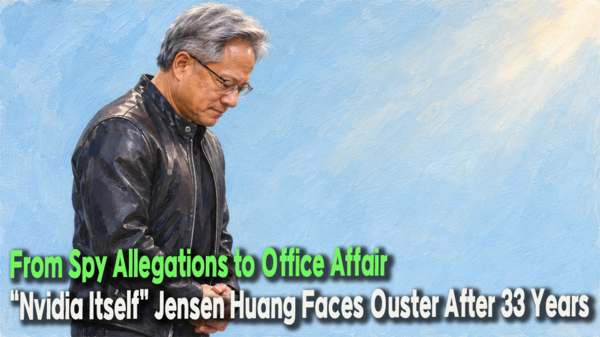
[Three Days Ago, “Confidence in Leadership”… Now Discussing the Founder’s Fate]
Nvidia, which has virtually dominated the global AI semiconductor market, has plunged into its worst corporate governance crisis since its founding. Chief Executive Officer Jensen Huang admitted to an extramarital affair with a woman suspected of ties to Chinese intelligence agencies. Just three days later, on the 11th (local time), The New York Times (NYT) further exposed an inappropriate relationship between Huang and a female vice president who reports directly to him. Shortly thereafter, The Wall Street Journal (WSJ) reported that the board of directors is preparing removal proceedings. What began as a personal indiscretion has escalated into an issue of national security and internal controls. Markets reacted with a steep plunge in after-hours trading. The fate of the founder—who transformed a gaming graphics chipmaker co-founded in 1993 into a multi-trillion-dollar AI infrastructure giant—now rests in the hands of the board.
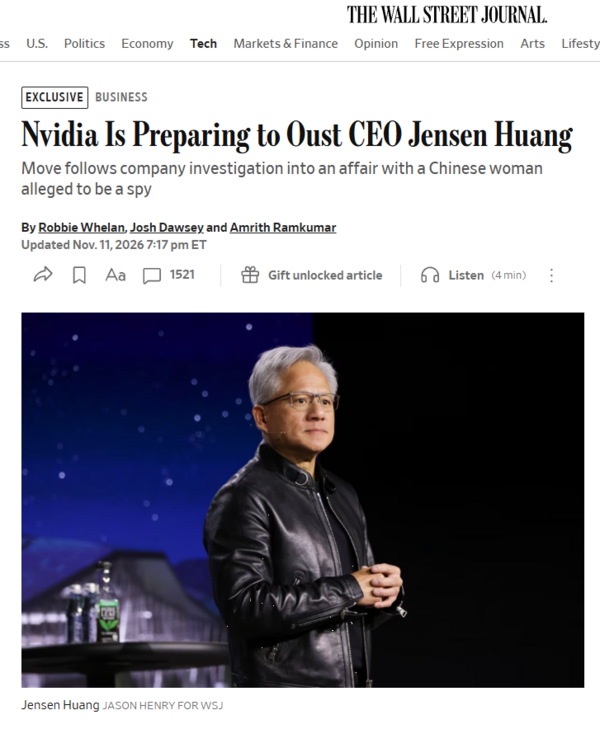
Citing sources familiar with the matter, The Wall Street Journal (WSJ) reported on the 11th (local time) that “Nvidia’s board of directors is preparing to remove CEO Huang.” Reuters subsequently reported that “the board convened that evening to discuss his future.” As of the 12th, Korean Standard Time, confirmed reports extend up to the board deliberation stage.
Only three days earlier, on the 8th, in response to reports that a foreign intelligence agency had targeted Huang, the board stated that it “retains confidence in Huang and the management team even as it launches an independent investigation.” It also declared that it “has found no basis to believe U.S. national security or Nvidia confidential information was compromised.” On the 10th, outside directors retained Joon Kim, former Acting U.S. Attorney for the Southern District of New York, and the law firm Wachtell, Lipton, Rosen & Katz to conduct the probe. A board that publicly expressed trust just days ago is now weighing the replacement of its CEO.
[The Decisive Blow: A Relationship Within the Direct Reporting Line]
Citing five former Nvidia employees, The New York Times (NYT) reported on the 11th that “Jensen Huang engaged in an extramarital relationship with Kimberly Powell, vice president of healthcare, who reports directly to him.” Both individuals are married. According to the report, the two were seen displaying physical intimacy at a hotel near the venue during Nvidia’s annual GTC developer conference in San Jose in March. Witness accounts also alleged that when an observer photographed the pair on a mobile phone, Huang’s security detail took the individual aside and compelled them to sign a non-disclosure agreement (NDA).
Vice President Powell is an 18-year veteran who joined the company in 2008. Starting with medical imaging equipment, she pioneered the integration of Nvidia’s semiconductor technology into the healthcare sector and was promoted to vice president of healthcare in late 2017. The crux of the problem is that she is one of roughly 60 executives reporting directly to CEO Huang. Nvidia’s code of conduct requires avoiding situations where personal relationships create conflicts of interest and mandates immediate investigation upon reports of misconduct.
The fundamental reason U.S. corporations strictly regulate relationships between superiors and subordinates lies in power asymmetry. Even in consensual relationships, fairness cannot be assured when a supervisor controls promotions, performance evaluations, and compensation. Perceptions of favoritism breed resentment among colleagues, and once a relationship ends, disputes involving retaliation or sexual harassment frequently arise. These standards tightened significantly following the spread of the #MeToo movement in 2017. In 2018, Intel announced the resignation of then-CEO Brian Krzanich after confirming a relationship with an employee violated company policy, and McDonald’s ousted its CEO in 2019 for the same reason. If allegations regarding the deployment of security personnel to enforce an NDA prove true, this affair will stand as a textbook failure of internal controls.
[The Preceding Risk: National Security Allegations]
The board’s swift pivot stems from the gravity of the initial allegations. Earlier this year, the Financial Times (FT), citing a U.S. government memo compiled from intelligence material, reported that “CEO Huang was in a romantic relationship with Alice Huang (Huang Le).” Prior to that, the NYT reported that “U.S. intelligence agencies assessed Alice Huang, a Chinese national, to be an asset of Chinese intelligence.” Republican leaders in the U.S. House of Representatives have summoned CEO Huang to appear for a closed-door briefing before three committees overseeing China, foreign affairs, and intelligence. While the Chinese government has denied the espionage allegations and Alice Huang has issued no statement, the board’s statement referred to CEO Huang merely as a “target,” and no evidence of actual leaks of classified data has yet been made public.
[The Limits of a Founder Without Dual-Class Voting Rights]
CEO Jensen Huang lacks structural defenses to block a board decision. Unlike certain founder-led Big Tech peers, Nvidia does not maintain a dual-class share structure. According to a May filing with the Securities and Exchange Commission (SEC), Huang’s beneficial ownership stood at 3.58% as of March 23, inclusive of shares held via family trusts. Under the corporate bylaws, the board holds the authority to remove him as CEO, though removing him as a director requires a shareholder vote—a simple majority for cause, or a two-thirds supermajority without cause.
The larger dilemma is a vacant succession pipeline. Operating a flat organizational hierarchy, Huang has personally coordinated technology, product development, and sales. With decision-making concentrated in a single individual, transferring authority presents a formidable challenge. Although Nvidia’s stock closed nearly 3% higher during regular trading that day, shares plunged 7% to 9% in after-hours trading following reports of removal preparations. According to Reuters tallies, roughly $600 billion in market capitalization has evaporated this week alone.
Gil Luria, head of technology research at D.A. Davidson, noted, “If CEO Huang violated the law or breached company policy, the board is highly likely to act the moment it secures evidence.” Nvidia is scheduled to report third-quarter earnings on the 17th, while Huang has been requested to brief the three House committees on the 18th.
[Silicon Valley’s “Rescue Campaign”]
Efforts to shield CEO Huang began immediately. Venture capitalist Jason Calacanis posted on X that day: “A better solution for Nvidia’s board, shareholders, customers, employees, and the United States is to complete the investigation and, if necessary, retain Jensen Huang as chairman.” Gavin Baker, managing partner at investment firm Atreides Management, shared the post and added, “A shareholder vote could also be held once the investigation concludes.” Pointing to the after-hours stock plunge, he argued that “it would be difficult to claim that firing him is in the best interests of shareholders.”
The core pillar of the defense is national competitiveness. Shaun Maguire, partner at Sequoia Capital, acknowledged that “Jensen Huang’s actions were foolish and bad for America,” yet stressed that “he is irreplaceable for U.S. AI leadership.” Tesla CEO Elon Musk lent his weight, replying, “Agreed.” Baker warned that “if Jensen Huang falls, it will be a catastrophe for the United States and a gift to China.” Pershing Square CEO Bill Ackman expressed support, noting that “even remarkable people make mistakes,” while adding the caveat that “if this extends beyond a simple affair, it is clearly a serious matter.”
[Ripple Effects Across the AI Supply Chain]
Behind the defense lies the web of AI industry interests anchored around Nvidia. Model developers such as OpenAI and Anthropic cannot scale their services without Nvidia graphics processing units (GPUs). Taiwan’s Commercial Times reported on the 10th that “Nvidia may slow its order pace due to the current controversy and potential tightening of U.S. semiconductor export reviews toward China.” Such a slowdown would directly affect TSMC and packaging-and-testing firm ASE, while opening opportunities for rivals like AMD, Broadcom, and MediaTek to secure TSMC fabrication capacity.
So far, however, there are no signs of actual order cuts. Taiwan’s Economic Daily News reported that “orders and shipments among suppliers providing server chassis, racks, and cooling systems to Nvidia are proceeding normally.” The prevailing view holds that as long as U.S. AI infrastructure investments continue, long-term demand remains intact. Nevertheless, concerns persist that losing a leader who has personally overseen product roadmaps and key partner relationships could delay critical decision-making.
[Shaken “Family Management” Controversy]
The prospect of the founder’s departure has also cast a spotlight on Huang’s children and son-in-law working at Nvidia. His daughter, Madison Huang, serves as senior director of marketing for physical AI platforms; his son, Spencer Huang, is director of robotics product management; and his son-in-law, Nico Caprez, holds the role of vice president of global AI infrastructure growth. Having transitioned from non-semiconductor backgrounds—including work as a chef, cocktail bar operator, and competitive skier—they joined the company sequentially between 2020 and 2024. According to The Information, some employees view Madison and Caprez as next-generation leadership.
In SEC disclosures, neither child is classified as a principal executive officer nor reports directly to CEO Huang. Yet their standing has effectively rested upon the founder’s authority. CNBC reported that “employees who have long admired Jensen Huang are struggling to accept the affair allegations.” Ann Lipton, a law professor at the University of Colorado, told TechCrunch that “employing a founder’s children at the company is undesirable from a governance standpoint,” adding that “the absence of a clear succession plan is another risk factor.” Todd Henderson, a law professor at the University of Chicago, similarly remarked that “at a massive publicly traded corporation like Nvidia, the notion of a founder’s child inheriting the CEO seat is absurd.”
[Why Times Insight]
The essence of this crisis is not an extramarital affair, but “key-man risk.” It has laid bare the reality that the hardware foundation of American AI supremacy depended virtually on the judgment and reputation of a single individual. For a $4 trillion enterprise to link dozens of executives directly to one CEO while leaving its succession bench empty served as a speed advantage during rapid expansion, but became a structural vulnerability once crisis struck.
Whether foreign intelligence operations succeeded in extracting trade secrets remains unconfirmed. Yet shaking the command structure of America’s flagship AI company and wiping out hundreds of billions of dollars in market value already yields substantial strategic dividends for Beijing. Even so, sweeping the matter aside on grounds of “irreplaceability” cannot serve as a solution; doing so would dismantle both U.S. corporate governance standards and counterintelligence principles simultaneously. The task before the board is to separate accountability on security matters from the preservation of industrial competitiveness. That is precisely why retaining Huang as chairman is being floated as a pragmatic compromise—though any evidence of a cover-up or information leaks uncovered by the investigation would erase even that room for maneuver.

-중국 푸단대학교 한국연구원 객좌교수
-전 EDUIN News 대표
-전 OUR NEWS 대표
-제17대 대통령직인수위원회 정책기획팀장
-전 대통령실 홍보기획비서관
-사단법인 한국가정상담연구소 이사장
-저서: 북한급변사태와 한반도통일, 2012 다시우파다, 선거마케팅, 한국의 정치광고, 국회의원 선거매뉴얼 등 50여권