Update2026.11.12 (목)

[Wages Delayed Two Months After Announcing a '1 Billion Yuan Order']
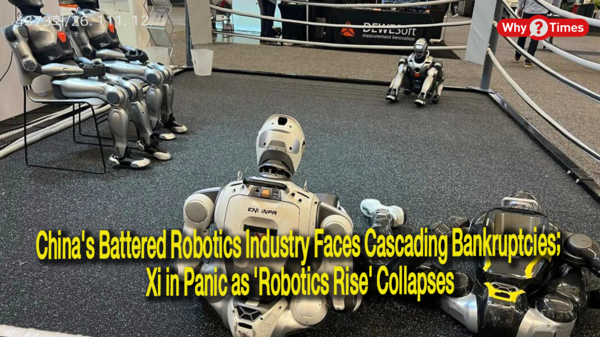
China's robotics sector—designated by the central government as a "future industry" and heavily funded by state-owned capital alongside local governments—has entered an era of massive shakeouts. The city of Nanjing heavily promoted robotics startup Wujing Dongli (无境动力) as a premier incubated enterprise. Yet, just eight months after its inception, the company halted operations with roughly 8 million yuan (around 1.6 billion KRW) in unpaid wages across 30 to 40 employees, while its controlling shareholder vanished. Yinghe Robot, backed by ByteDance and Meituan, and DeepBlue Robot, once valued at 14 billion yuan (around 2.8 trillion KRW), have likewise initiated bankruptcy proceedings. Meanwhile, investment deal volume in physical AI plummeted by nearly half in a single month. Around the same time in the United States, multibillion-dollar Nvidia chip smuggling cases and allegations concerning Chinese intelligence assets erupted one after another, underscoring that China's AI ecosystem remains tethered to American semiconductors. Robotics and semiconductors—the twin pillars of Xi Jinping’s drive toward technological self-reliance—are showing severe vulnerabilities at the same time.
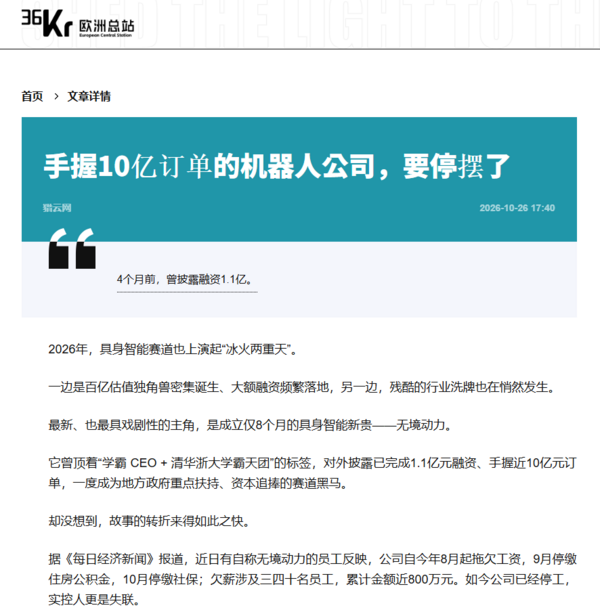
Chinese tech outlet 36Kr reported on the 9th that "Nanjing-based robotics startup Wujing Dongli began missing payroll in August and completely halted operations by October," noting that "employees reported unpaid wages totaling approximately 8 million yuan, while the company's CEO stated in an internal meeting that he could not reach the controlling shareholder." This collapse occurred over a mere eight months at a company founded in February to develop quadrupedal robots for electrical substation inspections.
According to 36Kr, Wujing Dongli's launch was met with fanfare. Chief Executive Officer Yuan Haihui (袁海辉) was a serial entrepreneur who entered Shanghai Jiao Tong University at age 16. The founding team, drawn from Tsinghua, Zhejiang, and Harbin Institute of Technology, was dubbed an "elite academic brigade (学霸天团)." The company targeted industrial quadrupedal robots for substation inspections and petrochemical facilities. In June, Nanjing local media reported that within four months of establishment, the firm had secured framework agreements worth roughly 500 million yuan (around 100 billion KRW) with central state-owned enterprises, along with preliminary regional orders of 500 million yuan and 110 million yuan (around 22 billion KRW) in secured funding. The figure later touted as a "1 billion yuan order" merely aggregated these framework agreements and projected volumes rather than confirmed revenue.
The underlying cash flows told a starkly different story. On July 20, the official website of the Jiangning District Government in Nanjing published another promotional release stating that the company had finalized an initial 110 million yuan funding round in the first half of the year. The lead investor was Huarui Venture Capital (华瑞创投), affiliated with a local industrial park, and the investment was framed as "patient capital." However, when direct shareholding changes occurred on August 24, the expected industrial fund was nowhere to be found on the shareholder registry; the committed capital injection never materialized. Workers stopped receiving wages in August, public housing fund deposits lapsed in September, and social insurance contributions ceased by October.
Robotics hardware firms bear heavy research personnel costs and component expenses long before receiving confirmed production orders. Industrial equipment requires prolonged on-site deployment, inspection, and payment cycles. When these cycles stretch, companies must bridge operating expenses with follow-on funding rounds. In the case of Wujing Dongli, payroll arrears began just two months after publicizing major contract announcements. The lag between announcing an order and receiving actual cash directly dictated the firm's survival.
[ByteDance's Capital and a 14 Billion Yuan Valuation Proved Futile]
Wujing Dongli is by no means an isolated case. Yinghe Robot (盈合机器人) was incubated by Infore Group (盈峰集团), led by He Jianfeng (何剑锋), son of the Midea Group founder. ByteDance, Meituan’s strategic investment division, and GSR Ventures joined as institutional shareholders. In 2021, the company even announced plans to construct a 10 billion yuan (around 2 trillion KRW) manufacturing base. However, revenue last year amounted to just 4.33 million yuan (around 870 million KRW) against a net loss of 67 million yuan (around 13.4 billion KRW). The Shenzhen Intermediate People's Court convened its first creditors' meeting on October 19.
DeepBlue Robot (深兰机器人), once appraised at a 14 billion yuan valuation, initiated bankruptcy liquidation proceedings in May. The outstanding claims of 102 unpaid employees exceed 23 million yuan (around 4.6 billion KRW). Pool-cleaning robotics firm Smorobot (智橙动力) entered bankruptcy review in September as well. According to public reporting and court notices, more than 20 robotics enterprises underwent bankruptcy, dissolution, liquidation, or discontinued operations over the 19-month span starting in February 2025, impacting at least 11 industry sub-sectors.
[Investment Deals Halved… 'Concentration' and 'Elimination' Occurring in Tandem]
Capital sources are drying up rapidly. According to data compiled by IT Juzi (IT桔子), venture funding across the physical AI segment logged 33 transactions totaling 10.105 billion yuan (around 2.02 trillion KRW) in October—cutting the deal count nearly in half compared to September's 60 transactions totaling 11.028 billion yuan. Compared to the June peak of 55 deals worth 30.892 billion yuan (around 6.2 trillion KRW), total transaction value dropped to roughly one-third. 36Kr reported that "one startup seeking a 1 billion yuan valuation was forced to accept a 20% to 30% discount just one month later."
Industry front-runners are not entirely shielded from market realities. AgiBot (智元机器人) placed its planned Hong Kong IPO on hold, seeking instead a new financing round of 1 to 1.5 billion yuan (around 200 to 300 billion KRW) at a post-money valuation of roughly 50 billion yuan (around 10 trillion KRW). Yao Maoqing (姚卯青), Senior Vice President of AgiBot, characterized the ongoing contraction not as a dynamic unique to robotics, but rather as an inevitable "re-convergence" typical of overheated sectors. Cao Wei (曹巍), partner at venture capital firm BlueRun Ventures (蓝驰创投), commented that "the industry has arrived at a moment where true report cards must be turned in, and players must demonstrate substantive operational metrics to satisfy public markets." Cao identified only a small cadre of firms with verified delivery track records—such as Unitree, AgiBot, and Youibot—as viable, stable investment destinations.
[1 Year Ago, Beijing Had Already Issued Warnings]
The current upheaval was anticipated. The 2025 Chinese Government Work Report formally designated embodied AI (具身智能) as a strategic "future industry." In November of that year, National Development and Reform Commission (NDRC) spokesperson Li Chao (李超) noted that the number of humanoid robotics enterprises had surpassed 150 and continued to climb. Li warned of speculative froth, stating that an influx of copycat products risked diluting research and development bandwidth, and cautioned that more than half of these entities were untested startups or players crossing over from unrelated industries.
Following those warnings, state capital outlays accelerated rather than moderated. In the first eight months of 2026, robotics funding hit 124.51 billion yuan (around 25 trillion KRW)—double the annual total recorded in 2025. Industry data shows that major financing rounds were predominantly driven by regional state-owned capital and municipal guidance funds. The rapid demise of enterprises like Wujing Dongli, courted by municipal administrations under the guise of "patient capital," reveals the structural vulnerabilities embedded in state-directed industrial funding.
[AI Semiconductors: Flimsy 'Self-Reliance' Propped Up by Smuggled Chips]
Parallel fractures are surfacing across China's semiconductor ecosystem. The US Department of Justice indicted individuals involved in routing roughly $2.5 billion (around 3.3 trillion KRW) worth of Supermicro servers to China under the cover of Southeast Asian front entities. On October 1, Greg Lui was arrested on charges of smuggling servers containing approximately $300 million (around 400.3 billion KRW) in restricted AI chips to China. Bloomberg reported that dozens of data center complexes engineered to host 115,000 export-restricted Nvidia processors are under construction across western China, with US officials assessing that at least that volume of chips has already entered illicit channels.
These developments were compounded by allegations surrounding "Alice Huang." Reporting from The New York Times (NYT) and The Wall Street Journal (WSJ) indicated that US intelligence agencies assessed Alice Huang (Huang Le)—an executive at Singaporean data center provider Megaspeed—to be an operative for Chinese intelligence. While under federal scrutiny for suspected hardware diversion, she developed direct ties with Nvidia CEO Jensen Huang. She previously worked as a correspondent for Chinese state media.
US officials do not believe Jensen Huang was cognizant of any intelligence operations, and Nvidia stated the engagements fell within routine business interactions. Jensen Huang commented last spring that there was "no evidence" of AI chips illicitly leaking into China. Nonetheless, recurring indictments and intelligence assessments underline that Beijing is incurring immense risks and expenditures to secure American silicon despite its political rhetoric around domestic substitution.
[Why Times Insight]
In the view of Why Times, robotics insolvencies and semiconductor smuggling are not isolated occurrences, but symptoms stemming from the identical institutional system. Under the banner of "new quality productive forces," the Xi administration transformed technical competition into a rigid political mandate. Consequently, local governments were assessed on "recruitment volume" rather than operational metrics, while state-directed capital responded to bureaucratic signals rather than commercial validation. Wujing Dongli serves as a case study of this mechanism: a company that promoted non-binding framework accords as firm orders and claimed uncommitted funding as completed rounds was showcased twice on official municipal platforms.
A similar dynamic governs semiconductors. Beijing continues to stall import clearance for Nvidia’s H200 in a bid to nurture domestic chipmakers, while entities concurrently purchase American chips through third-country smuggling conduits. This dual track underscores that technological "self-reliance" remains an unfulfilled political slogan. That China's National Development and Reform Commission (NDRC) warned of a market bubble a year ago yet could not arrest the tide of capital demonstrates the core weakness of an apparatus where political mandates routinely override structural warnings.
Confronted with these realities, President Xi Jinping faces mounting pressure. This landscape does not presage an immediate collapse of China's entire robotics establishment; leading players like Unitree and near-term IPO candidates retain operational footing. However, the unraveling of the broader robotics ecosystem inflated by sovereign capital carries profound strategic implications. The resulting sunk costs directly siphon away central government development funds and lead to severe misallocations within municipal budgets.


-중국 푸단대학교 한국연구원 객좌교수
-전 EDUIN News 대표
-전 OUR NEWS 대표
-제17대 대통령직인수위원회 정책기획팀장
-전 대통령실 홍보기획비서관
-사단법인 한국가정상담연구소 이사장
-저서: 북한급변사태와 한반도통일, 2012 다시우파다, 선거마케팅, 한국의 정치광고, 국회의원 선거매뉴얼 등 50여권