Update2026.11.09 (월)

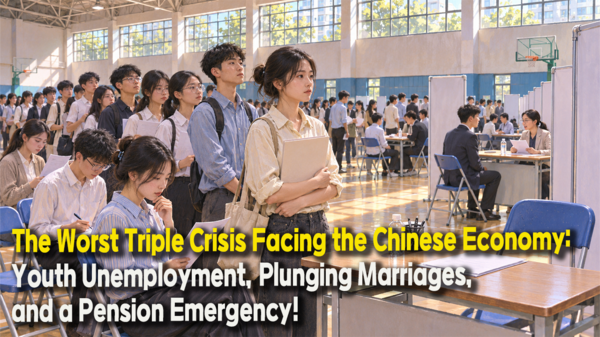
[Chinese Youth Giving Up Even on Marriage, the Collapse of the Future Consumer Base]
The Chinese economy is confronting a grave structural crisis. Young people cannot secure jobs, marriages and childbirths are plunging, and with mass retirements taking place in earnest, warning lights are flashing across pension finances. Even more critical is that these three crises are interlocking, steadily undermining the foundations of future growth for the Chinese economy. While the Xi Jinping administration champions an economic resurgence through fostering advanced high-tech industries, the employment, consumption, and demographic foundations that uphold the economy are deteriorating. This is why warnings are mounting that China has passed beyond a mere cyclical downturn and entered a pivotal juncture marked by a structural crisis where employment, demographics, and public finances pull each other down.
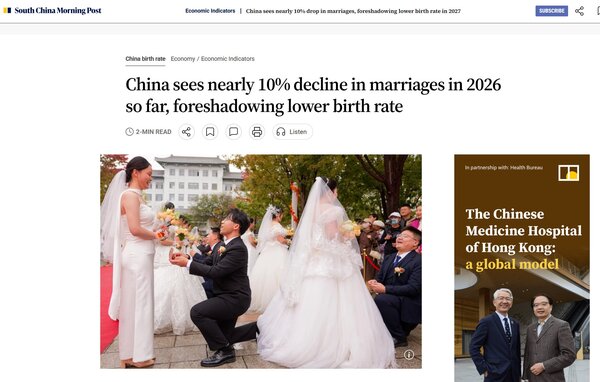
Hong Kong’s South China Morning Post (SCMP) reported on the 5th that “marriages registered across China between January and September this year dropped by roughly 10% compared to the same period last year.” It added that “according to data released by China's Ministry of Civil Affairs, 4.648 million couples registered marriages through the third quarter of this year, a decrease of 504,000 couples compared to 5.152 million during the same period last year, marking a decline of 9.8%.”
SCMP pointed out that “such a decrease in marriages could drag down future birth numbers even further,” noting that “Chinese demographic expert He Yafu projected that total marriage registrations this year could stay between 5.88 million and 6.46 million couples, implying that the temporary rebound in registrations recorded last year may reverse back into a downward trend.”
The real issue is that the drop in marriages is not merely a social phenomenon, but a vital symptom of an economic crisis. Young Chinese find it hard to land stable jobs and feel overwhelmed by the costs required to acquire housing and raise children. As anxiety over future income expands, deferring or entirely abandoning marriage and childbirth has become widespread. This delivers a dual blow to the Chinese economy. In the short term, consumption tied to marriage and household formation—such as housing, home appliances, and furniture—contracts. Over the long run, falling births shrink the labor force and consumer population, debilitating potential economic growth.
China has already entered a phase of population decline. The number of births, which reached roughly 18 million in 2016, shrank to around 9.5 million in 2024. If the drop in marriages persists, downward pressure on upcoming birth numbers will intensify. Although the Chinese government is implementing childbirth incentives and childcare subsidies, it remains difficult to turn birth rates around through such measures alone if youth are economically precluded from planning their futures. China’s demographic crisis is not simply about people choosing not to have children; at its core lies the reality that the younger generation can no longer chart their life courses amid persistent economic insecurity.
[Youth Unemployment Approaches 19%, the Generation Supplanting the Economy Shakes]
The second crisis gripping the Chinese economy is youth employment. Reuters reported on September 17 that “China’s youth unemployment rate rose to 18.9% in August, hitting its highest level in a year.” This refers to the official urban survey unemployment rate covering non-students aged 16 to 24.
The reality reflected in this metric is severe. It means nearly one out of every five young participants in the labor force who want a job is unable to find one. On top of that, competition has grown fierce as record numbers of college graduates have entered China's labor market this year.
The proliferation of artificial intelligence and automation has emerged as an additional variable. The Xi Jinping government is actively promoting high-tech fields—semiconductors, electric vehicles, robotics, and artificial intelligence—as the new growth engines of the Chinese economy, termed “new quality productive forces.” This strategy aims to elevate productivity and drive economic expansion through cutting-edge technologies and innovation, departing from the old growth model that leaned heavily on real estate, construction, and low-wage manufacturing. However, high productivity and export competitiveness in advanced sectors do not automatically translate into mass job creation. Ultimately, even if the government pours vast resources into advanced industries, employment insecurity will persist unless these sectors sufficiently absorb the jobs disappearing from legacy industries. This presents one of the deepest dilemmas facing Xi's economic doctrine.
Even if economic growth materializes through increased corporate production capacity and export volumes, domestic demand cannot regain momentum if those gains fail to flow adequately into household incomes and employment. High youth unemployment depresses consumption, which in turn leads corporations to scale back investment and hiring. Consequently, young adults postpone marriage and parenthood, eroding the future labor force and consumer base. Today’s youth joblessness is forging tomorrow's demographic cliff, which in turn deepens long-term stagnation in a self-reinforcing downward spiral.
[Pension Emergency Amid Massive Retirements, the Future of China Warned by the IMF]
The third crisis is even more protracted and structural: rapid population aging and pension finances. As the massive cohort born during the 1960s reaches retirement age, China is caught in a vice between a declining working-age population and a growing pool of pension beneficiaries. The International Monetary Fund (IMF) detailed explicit warnings regarding this predicament in its report published in February this year, titled "Population Aging and Pension Reforms in China." According to the IMF, China’s population aged 20 to 60 is projected to fall from approximately 840 million in 2024 to around 614 million by 2050—a loss of roughly 226 million working-age individuals in just 26 years.
Projections for pension expenditures are even more stark. The IMF’s demographic simulations indicate that without reform, China’s pension spending could soar from 5.4% of GDP in 2024 to 15.3% by 2050. Factoring in the statutory retirement age increases already underway lowers the 2050 expenditure share to 11.9%, which nevertheless remains a crushing fiscal burden.
Aging also directly impacts economic expansion. The IMF analyzed that “due to the shrinkage of the labor force and slowing capital accumulation, real annual GDP growth could be reduced by about 2 percentage points by 2050.”
This involves far more than simply having an older demographic profile. It denotes a system where the working contributors paying into pensions are diminishing, while recipients drawing benefits are multiplying. If broader GDP growth slows simultaneously, the fiscal leeway required to shore up pension payouts will be severely restricted. Expanding pension benefits balloons fiscal strain, whereas capping them risks exacerbating retirement poverty and consumer retrenchment. China faces an intractable bind: struggling to generate enough jobs for the younger generation while simultaneously needing to allocate expanding resources to sustain the elderly.
[Structural Contradictions of Xi Jinping's Economic Model: Expanding Production Capacity Versus Shrinking Consumer Bases]
What makes China’s economic crisis uniquely grave is that employment, demographic, and pension challenges are entangled with a sluggish property sector and mounting pressures on local government finances. In past decades, China expanded by relying on real estate development, infrastructure investment, and manufactured exports. Property development generated employment across construction, steel, cement, and appliances, while local governments relied on land lease sales to fund fiscal outlays. With the prolonged real estate downturn, however, this growth architecture is shaking. The slumping housing market suppresses household wealth and consumer confidence while reducing jobs throughout property-related industries. Reduced land revenues concurrently squeeze local governments' fiscal capacity to sustain social safety nets and public services.
Yet Beijing's policy response has been to double down on an industrial strategy centered on high-tech manufacturing. Fostering advanced industry is not intrinsically misguided; technological innovation is crucial for China to survive its tech competition with the United States and enhance productivity.
However, industrial sophistication does not automatically ensure the well-being of citizens. Even if the output of electric vehicles and robots surges, youth job insecurity will not disappear on its own; even if semiconductor fabrication expands, weak consumption cannot be resolved without sufficient growth in household incomes. A state may succeed in driving investment and physical output, but if households lack confidence in the future, recoveries in consumption, births, and long-term private investments will remain out of reach. Compounding this, escalating social security spending driven by aging will narrow the government’s policy options even further.
[Why Times Insight; The True Crisis of the Chinese Economy Is the Shaking of Foundations Supporting Its Future]
China’s economic crisis cannot be viewed merely through the lens of a real estate slump, sluggish exports, or moderating headline growth rates. The shift underway across China is far more fundamental.
China certainly retains a massive manufacturing ecosystem, deep engineering capabilities, and potent state mobilization mechanisms. Yet these strengths cannot single-handedly solve structural demographic decline, job insecurity, and escalating social security deficits. Herein lies the most difficult challenge confronting the Xi Jinping leadership: enhancing the nation's industrial dominance does not necessarily align with building an economy where citizens can secure stable livelihoods, establish households, and prepare for retirement.
If Beijing continues to pour capital into high-tech sectors while failing to revive household income, social protection systems, and private-sector job creation, the Chinese economy is poised to face extended low growth and acute fiscal strain. China's real crisis is not that today's headline GDP growth is slowing; it is that the young labor force needed to sustain tomorrow's economy is shrinking, consumption and family formation are stalling, and the fiscal burden of supporting the elderly is soaring.
Youth ready to work cannot find jobs, young people eligible to marry choose to abandon the prospect, and the responsibility to support retiring cohorts grows ever heavier. Unless this vicious circle is broken, no amount of rhetoric championing high-tech supremacy will shield the Chinese economy from structural decline.
The year 2026 marks a decisive inflection point that will test how China confronts this triple crisis across employment, demographics, and public finance, extending far beyond an ordinary economic slowdown.


-중국 푸단대학교 한국연구원 객좌교수
-전 EDUIN News 대표
-전 OUR NEWS 대표
-제17대 대통령직인수위원회 정책기획팀장
-전 대통령실 홍보기획비서관
-사단법인 한국가정상담연구소 이사장
-저서: 북한급변사태와 한반도통일, 2012 다시우파다, 선거마케팅, 한국의 정치광고, 국회의원 선거매뉴얼 등 50여권