
Update2026.10.24 (토)

["Domestic Demand is the Future," Said Xi—But Reality Moved in the Exact Opposite Direction]
The Chinese economy has once again arrived at a critical crossroads. As consumption and investment contract simultaneously, the domestic demand expansion strategy—personally designated by President Xi Jinping as the "core engine of China's economic growth"—is hitting a much larger wall than anticipated. A more serious issue is that while the leadership in Beijing is well aware of the root causes behind the sluggish domestic demand, their policy options to address it remain severely limited. Experts diagnose that China’s economy has moved beyond a simple cyclical slowdown, falling into a "structural trap where it must increase consumption, yet faces structural barriers that prevent it from doing so."
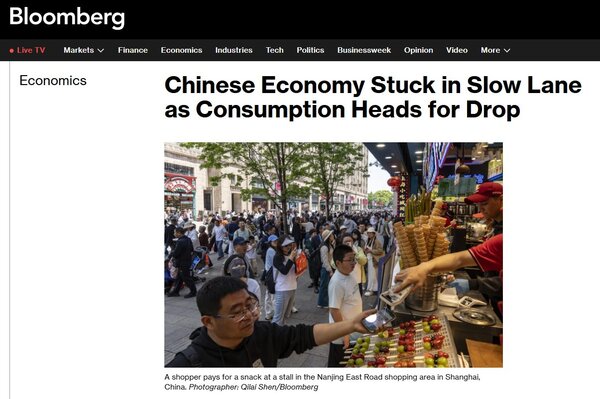
Analyzing the May economic indicators recently released by China’s National Bureau of Statistics (NBS), Bloomberg reported, "China’s first drop in consumer spending since the pandemic is threatening growth," adding that "weighed down by a property crisis and a weak job market, domestic consumption lags far behind the growth of manufacturers and exporters, showing no signs of a rebound."
Sheana Yue, senior economist at Oxford Economics, commented on the situation: "China's transition away from property-led growth remains uneven. While high-value manufacturing and exports continue to perform well, domestic demand remains weak." She further noted, "Companies are absorbing higher costs amid weak pricing power, suggesting that new growth drivers have not yet offset the slowdown of the old model."
This downturn is drawing intense scrutiny because it directly clashes with the policy framework personally ordered by President Xi. The diplomatic journal Foreign Policy pointed out, "At last December's Central Economic Work Conference, President Xi explicitly stated that the primary driver of China’s economic growth in 2026 must be found in expanding domestic demand—specifically through consumption and investment." The publication added, "In an article published early this year in the Communist Party’s theoretical journal Qiushi, Xi elevated the expansion of domestic demand to a core issue of economic stability and national security, defining it not as a 'temporary expedient, but a strategic choice'." Foreign Policy then sharply noted, "However, indicators emerging just six months later show that the policy direction personally overseen by Xi is operating in the exact opposite direction on the ground." In short, this implies that the economic revitalization project directed and managed by Xi himself has culminated in a complete failure.
[Consumption Shock Defies Expectations: Sharp Drop in Auto, Home Appliance, and Housing-Related Spending]
According to the National Bureau of Statistics, China's retail sales in May declined by 0.6% year-on-year. This marks a reversal back into negative territory from April’s 0.2% increase, falling short of market expectations which predicted a flatline. The shock to the market was particularly severe given that consumption contracted despite the inclusion of the Labor Day holiday, a peak spending season.
Regarding this, the global financial platform Investing.com stated, "The core of May's consumption contraction lies in the collapse of spending on durable and high-ticket goods." It detailed that "automobile sales plunged 16.1% year-on-year, home appliances and audio-visual equipment sales dropped 15.6%, building and interior decoration materials fell 13.6%, gold, silver, and jewelry declined 8.9%, furniture slid 8.7%, and sports and leisure goods dropped 8.0%."
The automotive market, in particular, serves as a bellwether for Chinese consumer sentiment. Reuters analyzed that "the slump in Chinese auto sales has persisted for eight consecutive months," highlighting that "the likelihood of a prolonged demand slowdown in the world's largest auto market is growing."
Conversely, spending on daily essentials such as beverages, pharmaceuticals, apparel, and cosmetics increased. This demonstrates that while Chinese consumers are maintaining necessary day-to-day expenditures, they are deferring big-ticket purchases—such as vehicles or housing-related expenses—as much as possible.
This trend is inextricably linked to the fading efficacy of the government's "Yijiu Huanxin" (以舊換新, subsidies for replacing old products with new ones) policy. Demand that had been pulled forward late last year and early this year under the cushion of subsidies has now bottomed out, leading to an immediate consumption cliff as the subsidies dried up. This policy-dependent demand boost exposed its inherent limitations, proving that it only yields temporary effects and fails to fundamentally lift household purchasing power or consumer confidence.
[The Bigger Problem is Investment: Even Manufacturing Begins to Slump]
What caught the market's attention even more than the sluggish consumption was the investment data. Investing.com pointed out, "Fixed-asset investment for the January–May period fell 4.1% year-on-year," noting that "this outcome is far worse than market expectations." It further highlighted, "Property development investment, in particular, plummeted 16.2%, meaning that the real estate slump—now in its fifth year—continues to drag down the broader Chinese economy."
While NBS spokesperson Fu Linghui explained that this sluggishness was due to extreme heat and heavy rainfall in some regions, alongside the transition process between old and new growth drivers, the market appears reluctant to take these remarks at face value.
Investing.com warned, "The more alarming part is manufacturing investment." It explained, "In recent years, the Chinese economy has nurtured advanced manufacturing—such as electric vehicles, batteries, solar energy, and semiconductors—as its new growth engine to replace real estate. However, in May, the growth rate of fixed-asset investment in manufacturing turned negative for the first time since 2020." With the real estate sector already collapsed, a slowdown in manufacturing investment signifies that both pillars of the domestic economy—consumption and investment—are weakening simultaneously.
[Xi Jinping's Personal Directive: "Domestic Demand is Key"]
These results are receiving heightened attention precisely because President Xi personally designated the expansion of domestic demand as the top priority for China's economy. As Foreign Policy explained, "Xi defined expanding consumption and investment as the core engine of economic growth for 2026 at last year's Central Economic Work Conference, and underscored it as a strategic choice in his Qiushi article early this year."
In other words, the current slump in consumption and investment goes beyond a routine cyclical issue; it serves as a clear signal that the core pillar of Xi's economic strategy is failing to deliver the expected results.
However, it remains difficult to abruptly write this off as a total policy failure. Rather, these latest indicators serve as a stark demonstration of how incredibly difficult it is to materialize domestic demand expansion in reality, even when the top leadership fully recognizes its necessity.
[Exports Grow Solo: Why This Itself Signals Danger]
Intriguingly, while consumption and investment stagnated, industrial production and exports maintained strong momentum. Industrial production in May rose 4.5% year-on-year, and exports clocked their fastest growth rate in three months. Notably, semiconductor exports—buoyed by the global AI boom—surged by 111% year-on-year, with computers and semiconductor-related items driving the export growth.
On the surface, this looks like a positive sign. However, experts view this trend with concern. It increases the likelihood that the Chinese economy will lean even more heavily on exports rather than domestic demand. In fact, even the NBS acknowledged in its official statement that "structural imbalances of strong supply and weak demand still persist."
If China continues to ramp up production while domestic consumption fails to keep pace, the surplus inventory has nowhere to go but overseas markets. This is precisely why the United States and Europe are fiercely criticizing China's overcapacity issue.
[Why China Can't Lift Consumption]
Many experts attribute China's failure to transition into a consumption-driven economy to structural flaws rather than temporary economic cycles. For decades, the Chinese economy has grown by centering on investment and production. Local governments secured revenues by selling land, and corporations grew by expanding investment. In contrast, household consumption was rarely placed at the center of economic policy.
The crux of the matter is that increasing consumption requires boosting household income and strengthening the social safety net. However, doing so would drastically increase the fiscal burden on local governments. With local finances already severely depleted by the real estate meltdown, Beijing cannot easily opt for massive welfare expansion or cash handouts. Furthermore, Xi Jinping has repeatedly expressed deep skepticism toward Western-style welfare state models in the past.
Consequently, China finds itself trapped in a dilemma: it knows it must boost consumption, yet it cannot easily implement the very policies required to achieve it.
[Analysis: The Real Issue is Not the "Slump in Domestic Demand," But the "Absence of Solutions"]
The most critical takeaway from May's economic indicators is not the mere fact that consumption decreased. Rather, it is that despite the Chinese leadership proclaiming domestic demand expansion as a national strategy, the policy tools available to realize it are becoming increasingly constrained.
Xi Jinping has framed domestic demand as the future growth engine of the Chinese economy. However, to unlock consumption, the state must channel more income to households and provide a robust social safety net—actions that risk triggering new crises by swelling local government debt and national fiscal burdens. Conversely, maintaining the current investment- and production-centered structure ensures that the consumption slump will persist.
Ultimately, the Chinese economy is confronting a structural catch-22: it must grow consumption, but it cannot create the conditions to do so. While exports and advanced manufacturing are currently propping up the GDP growth rate, China’s economic imbalances are highly likely to deepen if domestic demand fails to revive.
This synchronized slump in consumption and investment is no ordinary economic slowdown. It serves as a loud warning siren, exposing just how formidable a challenge Xi Jinping's personally designed 'domestic demand-driven growth' strategy faces when confronted by reality.


-중국 푸단대학교 한국연구원 객좌교수
-전 EDUIN News 대표
-전 OUR NEWS 대표
-제17대 대통령직인수위원회 정책기획팀장
-전 대통령실 홍보기획비서관
-사단법인 한국가정상담연구소 이사장
-저서: 북한급변사태와 한반도통일, 2012 다시우파다, 선거마케팅, 한국의 정치광고, 국회의원 선거매뉴얼 등 50여권