
Update2026.10.24 (토)

[Flirting with Blockades, Tolls, and Retaliatory Strikes: Trump's Calculated Pressure]
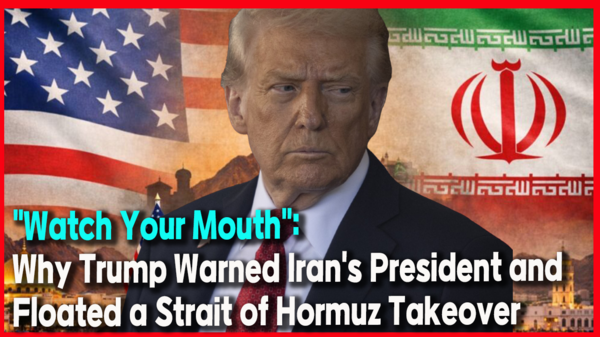
Just before the first high-level follow-up negotiations between the United States and Iran commenced, U.S. President Donald Trump delivered an ultra-hardline warning to Iran's president, effectively hinting at military action. Following statements that Iran would "not have a country" if it closed the strategic Strait of Hormuz, Trump went as far as threatening that the U.S. could directly impose a transit toll on the waterway. While such rhetoric risked completely derailing the talks, it had the exact opposite effect. The negotiations did not collapse; instead, after an 18-hour marathon session, both sides achieved measurable progress. The episode demonstrates that President Trump likely engineered a deliberate escalation of tension not to break the talks, but to seize the upper hand at the negotiating table.
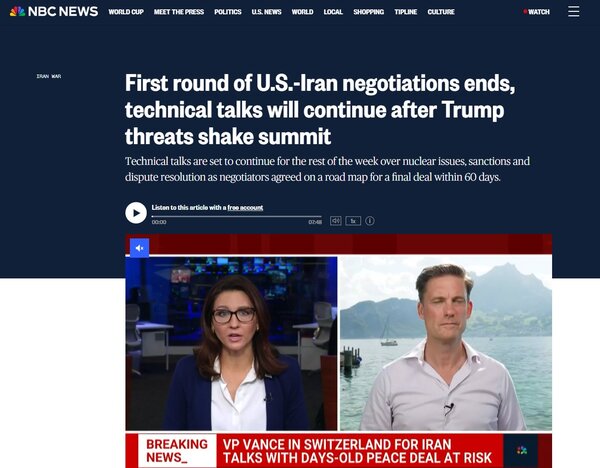
On June 22, NBC News reported that President Trump warned the Iranian side: "You close it [the Strait of Hormuz] and you won't have a country," adding that they "won't even make it back to your country."
NBC News further noted that Trump's warning grew sharper as it directly targeted Iranian President Masoud Pezeshkian. When Pezeshkian asserted that Iran would "never back down from our right to enrich uranium," Trump fired back: "He better watch his mouth. He better shape up or we'll take over the rest of the country."
The warnings extended beyond mere threats into concrete economic leverage. Trump floated the idea of the U.S. military acting as a "Guardian Angel" for the Strait of Hormuz, suggesting it could impose a 20% toll on transiting crude oil. He remarked, "If they don't make a deal, we'll collect tolls." Far from a casual, off-the-cuff remark, this warning carried immense weight, coming from the commander-in-chief right before the start of critical negotiations during a fresh crisis that flared up just a week into a fragile ceasefire.
[A Fragile Ceasefire: Crisis Re-emerges After One Week]
The backdrop to Trump's aggressive stance is the highly volatile Middle Eastern security landscape following the initial truce. According to the congressional news outlet The Hill, the memorandum of understanding (MOU) signed on June 14 by President Trump and President Pezeshkian was a provisional agreement meant to halt the U.S.-Iran conflict and reopen the Strait of Hormuz.
However, the peace was short-lived. In the early hours of June 20—just a day after Israel agreed to a ceasefire with Hezbollah—Israeli forces launched fresh airstrikes in southern Lebanon, killing 16 people. Tehran characterized the strikes as a direct violation of Article 1 of the MOU and immediately declared a re-closure of the Strait of Hormuz.
With the first follow-up session between Washington and Tehran scheduled for the very next day, Trump could not sit idly by as Iran leveraged the blockade card before talks even began. Consequently, his explosive remarks were interpreted not as a willingness to abandon diplomacy, but as an unyielding message to the negotiating room: a blockade of the strait would under no circumstances be tolerated.
[Negotiations Teetered on the Brink of Collapse]
Trump's rhetoric triggered immediate shockwaves. Iran's semi-official Tasnim News Agency reported that following Trump's statements, the Iranian delegation initially refused to return to the negotiating room, exchanging messages only through Qatari and Pakistani mediators.
Mohammad Bagher Ghalibaf, the Speaker of the Iranian Parliament and chief negotiator, fiercely pushed back. According to ABC News, Ghalibaf claimed, "Iran's military is prepared to respond differently," adding, "We do not rely on American threats. The U.S. is the one that needs to watch its words."
The global maritime market reacted immediately to the friction. Data from the shipping analytics firm Kpler revealed that the number of vessels transiting the Strait of Hormuz plummeted to just 5 on June 21, compared to 26 the previous day. This drop demonstrated that the maritime logistics industry treated the escalating rhetoric as a tangible danger. At that moment, observers widely assessed that the talks were on the verge of a total breakdown.
[Against the Odds, the Talks Held Together]
Intriguingly, neither side walked away entirely. Bloomberg reported on June 22 that both the U.S. and Iranian delegations offered a positive and constructive assessment of their first high-level meeting in Switzerland.
According to Bloomberg, the two nations agreed to establish an emergency communication hotline specifically for the Strait of Hormuz. Furthermore, they agreed to set up a high-level committee to oversee the implementation of the MOU and laid out a roadmap to reach a permanent agreement within 60 days.
Iran also highlighted the achievements of the session. Foreign Minister Abbas Araghchi noted that meaningful progress had been made, including discussions on easing restrictions on petroleum and petrochemical exports, unfreezing a portion of sanctioned assets, and initiating talks on reconstruction projects.
This outcome underlines a fundamental reality: both nations have powerful incentives to keep negotiating. The U.S. requires stability in the Strait of Hormuz and a de-escalation of Middle East tensions, while Iran desperately needs sanctions relief to revive its battered economy. Given these mutual dependencies, the framework is structurally built to withstand intense friction.
[The Real Wildcard is Lebanon]
The most critical takeaway from this round of diplomacy is that the single greatest threat to the process is neither the nuclear dispute nor the Strait of Hormuz itself. Rather, it is the volatile situation on the ground in Lebanon, which served as Iran's explicit justification for re-closing the strait.
Upon declaring the re-closure, Iran’s Khatam al-Anbiya Central Headquarters asserted that "Israel is repeatedly violating the agreement in southern Lebanon." Following Israel's renewed strikes immediately after the truce, Hezbollah claimed it was justified in launching retaliatory operations. Recognizing this volatile loop, the framework emerging from the Switzerland talks reportedly includes a proposal to create a separate conflict-mitigation mechanism that would include Lebanese participation, mediated by Qatar and Pakistan.
Following the meetings, Foreign Minister Araghchi emphasized that "the first real test will be the Lebanon conflict resolution mechanism."
[Trump's Threats: Strategic Management, Not Sabotage]
This crisis illustrates that President Trump's hyper-aggressive rhetoric does not necessarily signal a desire to blow up a deal. Instead, it mirrors his established negotiating playbook: applying maximum pressure immediately before a session to freeze the counterparty in place and force them to operate within his boundaries.
While the Iranian delegation reacted with public fury, they ultimately remained engaged in the process, yielding concrete results like an emergency hotline and a 60-day roadmap toward a final pact.
The genuine danger, however, lies outside the negotiating room. Washington and Tehran may find diplomatic room to compromise on sanctions and nuclear thresholds, but the Lebanese front remains an external variable that neither government fully controls. Should large-scale hostilities reignite between Israel and Hezbollah, the Strait of Hormuz crisis could instantly flare up again.
Ultimately, the true arbiter of this negotiation sits neither in Washington nor Tehran, but in Lebanon. Whether Trump’s threats remain a calculated asset for a final deal or morph into the prelude to a broader war depends entirely on whether the guns fall silent in southern Lebanon over the next 60 days.

-중국 푸단대학교 한국연구원 객좌교수
-전 EDUIN News 대표
-전 OUR NEWS 대표
-제17대 대통령직인수위원회 정책기획팀장
-전 대통령실 홍보기획비서관
-사단법인 한국가정상담연구소 이사장
-저서: 북한급변사태와 한반도통일, 2012 다시우파다, 선거마케팅, 한국의 정치광고, 국회의원 선거매뉴얼 등 50여권