
Update2026.11.22 (일)

[Teetering on the Brink of 3,500… A Distorted Market Where ‘Only Banks Rise’]
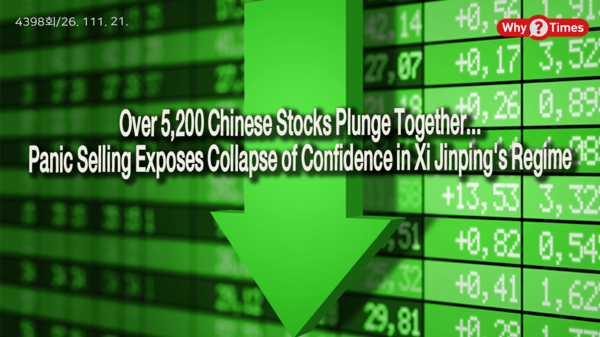
Mainland Chinese stock markets were swept by a wave of panic selling on the 20th, with more than 5,200 stocks falling simultaneously. A week-long lethargic decline—marked by trading volume drying up to annual lows while limit-down stocks multiplied—finally erupted into a full-blown sell-off backed by heavy volume. While risk-off sentiment spreading across Asia, triggered by over 5% plunges in Japanese and South Korean markets, pulled the trigger, deep-seated structural cracks unique to China lie beneath the surface. Retail sales growth in October stalled at 0.4%, fixed-asset investment from January to October fell 8.1%, and new home prices have declined for 40 consecutive months. Although even the Chinese Communist Party (CCP) Politburo has repeatedly cited "sluggish domestic demand" in official documents, Beijing has left the confidence of households and private enterprises to wither while pouring national resources into the race for technological supremacy.
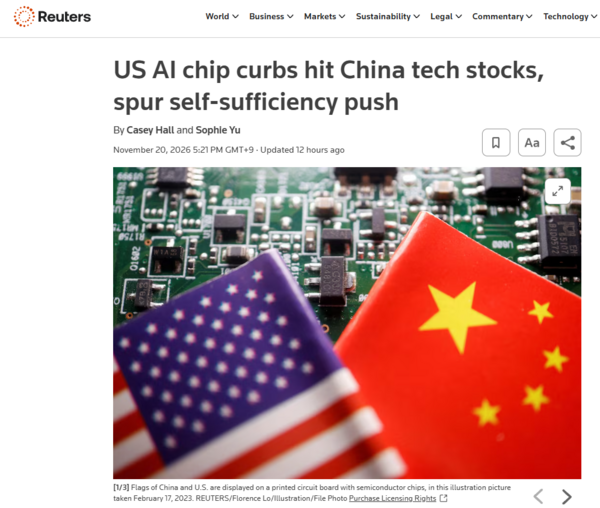
Reuters reported on the 20th (local time) that "mainland China and Hong Kong stocks fell in tandem in the aftermath of a sharp drop in U.S. tech shares," noting that "on the Shanghai and Shenzhen exchanges that day, 5,236 stocks declined while only 313 advanced. Following the previous day's annual low in turnover, trading volume picked up alongside an even broader wave of declining shares."
Indeed, the Shanghai Composite Index fell as low as 3,500.83 intraday, setting a fresh annual low before closing down 1.22% at 3,533.79. The Shenzhen Component Index dropped 3.09%, and the ChiNext Index tumbled 3.54%. Losses were steepest among small-cap and tech stocks: the STAR 50 Index shed 3.12%, while the Beijing Stock Exchange 50 Index plunged 4.85%. Combined turnover on the Shanghai and Shenzhen exchanges reached roughly 1.4222 trillion yuan (approx. 284 trillion won), up about 117 billion yuan (approx. 23 trillion won) from the previous session, as 5,236 stocks fell against just 313 gainers. While 61 stocks hit the daily downward limit, the 21st Century Business Herald tallied 68 limit-down stocks, including Tongfu Microelectronics and Andon Health.
Polarization within the market was equally extreme. The SSE 50 Index rebounded from an intraday drop of over 2% to close up 0.45% at 2,785.92, while top-weighted Industrial and Commercial Bank of China (ICBC) climbed 3.30% to post an all-time record closing high. Single-day turnover for the SSE 50 ETF surpassed 24 billion yuan (approx. 4.8 trillion won), shattering its previous record of 21.45 billion yuan (approx. 4.3 trillion won) set on January 28 this year. Conversely, the semiconductor supply chain—the poster child of "AI self-reliance"—took a direct hit, with lithography equipment theme stock United Chemical plunging to its 20% daily limit-down.
U.S. regulatory pressure lay behind the semiconductor rout. Reuters noted on the same day that "a string of U.S. measures targeting China's access to advanced AI chips dealt a further blow to Chinese tech stocks this week." Washington has restricted Chinese firms' remote access to advanced AI chips and imposed new licensing requirements on overseas data centers servicing Chinese AI companies. Taiwan's TSMC has halted some previously approved advanced chip orders for Chinese clients. Shares of Chinese AI firms Zhipu (Z.AI) and MiniMax have plummeted 22% and 34%, respectively, over the past two weeks. Alibaba CEO Eddie Wu stated that "new regulations may force us to scale back our target of building 20 gigawatts of computing capacity." Neil Shah, Vice President at market research firm Counterpoint Research, commented that "in the cutting-edge arena, it looks difficult to narrow the gap even by 2028 or 2030."
The shockwave across broader Asian markets was severe. Both the Nikkei 225 and KOSPI plunged more than 5%, shaking regional equities, though A-share losses were comparatively smaller. However, the weakness in Chinese equities began well before Asia's synchronized sell-off. Over the week through the 19th, the Shanghai Composite fell 1.56%, the Shenzhen Component lost 3.52%, and the ChiNext dropped 5.47%.
[Eve of the Sell-Off: Vanishing Volume and a Wave of Limit-Downs]
On the eve of the rout, the market was already in a state of exhaustion. On the 19th, the Shanghai Composite slipped 0.28% to 3,577.62, marking its lowest close of the year at the time. According to Chinese financial outlet Jiemian News, the number of limit-down stocks jumped from 45 to 72 in a single day, with over 4,800 stocks declining. Combined turnover across the three major exchanges fell to roughly 1.31 trillion yuan (approx. 262 trillion won), setting a new annual low. Consumer-related stocks collapsed to their daily limits, including cinema chain Hengdian Entertainment and ice-and-snow tourism play Changbaishan Tourism. The simultaneous breakdown of "service consumption" and "ice-and-snow economy" themes—championed by Beijing to boost domestic demand—underscores market skepticism toward the authorities' stimulus pledges.
[The Naked Reality of the ‘AI Localization’ Bubble]
The speculative bubble burst most dramatically in the AI sector. Tencent-backed AI chipmaker Enflame plunged 20% on the 19th to close at 364.33 yuan—36.16% below its closing price on the 13th. According to estimates by National Business Daily, roughly 107 billion yuan (approx. 21 trillion won) in market capitalization evaporated from its intraday peak on the 13th. Listed on September 11 at an IPO price of 142.18 yuan (approx. 28,400 won), the stock had skyrocketed to 397 yuan (approx. 79,400 won) on its debut. Yet the company posted a net loss of 754 million yuan (approx. 150.8 billion won) in the first three quarters, and 83.79% of its 2025 revenue came from transactions related to its largest shareholder, Tencent. Even companies unrelated to AI, such as auto parts maker Tianpu Shares and home appliance firm Solareast, soared on consecutive limit-ups after being packaged as "AI beneficiaries," only to crash on consecutive limit-downs.
[Sub-1-Yuan ‘Penny Stocks’ Proliferate… Delisting Fears Mount]
Ecological restoration firm Dongzhu Ecological, flagged with a delisting risk warning (*ST), fell to 0.89 yuan on the 19th, breaching the delisting threshold (closing below 1 yuan for 20 consecutive trading days). Environmental firm Tus-Environmental, under a similar warning, suffered four consecutive limit-downs amid uncertainty over whether restructuring proceedings would even begin. Citing Wind data, Yicai reported that the number of stocks closing below 2 yuan more than doubled from 50 on June 1 to 107 on November 17. Wanjia Asset Management diagnosed that "the willingness of fresh capital to enter the market is weak." In a market starved of new money, a game of "pass the parcel" repeated until a single external shock triggered full-scale capitulation.
[Indicators Point to a Cooling Real Economy]
Industrial production in October grew 4.8%, missing both expectations (5.3%) and September's figure (5.5%), while retail sales rose just 0.4%, falling short of forecasts (0.8%) and the prior month's 1.1%. Fixed-asset investment from January to October contracted 8.1%, marking the sharpest drop since the COVID-19 pandemic. Cumulative retail sales for the first ten months reached 41.6464 trillion yuan (approx. 8,330 trillion won), inching up only 1.0%.
Manufacturing momentum also faltered again. October's official manufacturing Purchasing Managers' Index (PMI) slipped from 50.1 in September to 49.3, sliding back into contraction territory. Meanwhile, the Producer Price Index (PPI) surged 5.7% in October, whereas the Consumer Price Index (CPI) rose a mere 0.7%. With Middle East energy shocks driving up input costs while weak domestic demand prevents firms from passing prices on to consumers, corporate margins are being squeezed from both ends.
Real estate and employment offer no clear exit either. New home prices across 70 cities fell 2.4% in October, extending their decline to 40 straight months. The youth unemployment rate for ages 16–24 (excluding students) stood at 17.2% in October, after hitting a 12-month high of 18.9% in August.
[Even the Party Admits ‘Sluggish Domestic Demand’… Yet Prescriptions Remain ‘Token’]
The CCP leadership is not blind to the crisis. At its December 2025 meeting, the Xi Jinping-led Politburo resolved to "make domestic demand the primary driving force and build a strong domestic market," and at its April meeting this year acknowledged "difficulties and challenges facing the economy." Its July 30 meeting convened as weak domestic demand and deepening structural imbalances weighed heavily on second-quarter growth. Even the third quarter's 4.5% growth rate was buoyed by an AI-related export boom, while this year's full-year growth target of 4.5–5% is the lowest in decades outside the pandemic years.
The problem lies in the prescription. One analyst quoted by AFP noted that "a better-than-expected third-quarter performance could delay a meaningful policy pivot in the fourth quarter." In a recent column, Milton Ezrati, Chief Economist at U.S. investment communications firm Vested, criticized Beijing for "pouring vast resources into technological competition with the United States in robotics, AI, and space, while offering only enough economic measures to meet growth targets." He added that "even the liquidity injected into the system flowed mostly to state-owned banks to prop up the Party's tech strategy, barely reaching the private economy." The fact that bank stocks propped up the index on the 20th eerily echoes this critique.
[Institutional Cracks Masked by High-Speed Growth]
Commentator Zhao Pengbo traces the roots of the stagnation to the political system itself. The achievements of Reform and Opening-Up resulted from the Party partially loosening economic control, society taking risks within that space, and favorable external conditions such as demographic dividends and WTO accession. That combination is now unraveling amid an aging population and supply-chain security doctrines. A deeper issue is the vacuum of the rule of law: in a system where even the courts operate under Party leadership, businesses and households cannot be sure that an enterprise legal today will still be recognized tomorrow. As Zhao wrote, "repeatedly demanding that society have confidence cannot substitute for the institutional conditions required to generate that confidence."
[Why Times Insight]
The defining scene of the market on the 20th was not the magnitude of the index drop, but the distorted picture of "banks rising while 5,200 stocks fell." ICBC posting a record closing high alongside all-time peak turnover in the SSE 50 ETF strongly suggests—though unconfirmed officially—that state-affiliated funds stepped in to buy blue chips to defend the headline index. If so, what authorities are trying to protect is not the broader market, but the "face of the index." Ezrati's logic of "prestige over prosperity" is playing out once again on the trading floor.
Asia's synchronized sell-off and U.S. AI chip curbs were merely triggers, not root causes. Even prior to the 20th, Chinese equities were suffering from internal ailments: vanishing liquidity, the collapse of the AI bubble, and a surge in penny stocks. Although the Politburo has touted "domestic demand" as its top priority for nearly a year, retail sales growth has sunk into the 0% range. Unless Beijing alters a structure that channels resources exclusively into state-directed semiconductors and AI while shunning reforms that require relinquishing Party control—such as household income redistribution, social security for migrant workers, an independent judiciary, and local fiscal reform—a recovery in confidence will remain elusive.
What China faces is not an overnight catastrophe, but a protracted war of attrition in which eroding trust steadily chips away at potential growth. The decisive variable determining its outcome is not the size of stimulus packages, but whether those in power are willing to place themselves under the rule of law.


-중국 푸단대학교 한국연구원 객좌교수
-전 EDUIN News 대표
-전 OUR NEWS 대표
-제17대 대통령직인수위원회 정책기획팀장
-전 대통령실 홍보기획비서관
-사단법인 한국가정상담연구소 이사장
-저서: 북한급변사태와 한반도통일, 2012 다시우파다, 선거마케팅, 한국의 정치광고, 국회의원 선거매뉴얼 등 50여권