Update2026.11.21 (토)

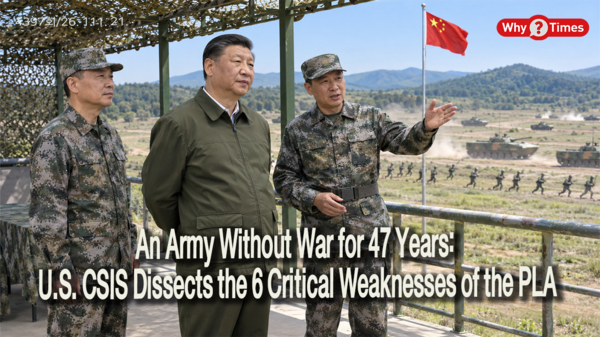
[Sharp Assessment by U.S. CSIS: "Hardware Alone Does Not Equal Combat Power"]
The People's Liberation Army (PLA) is flexing its muscles by filling the skies over the Taiwan Strait with military aircraft and live-streaming encirclement drills. Beneath this imposing exterior, however, lies the unvarnished reality of a military that has not fought a major war in 47 years since the Sino-Vietnamese War of 1979. While its shipyards launch warships faster than the United States and massive resources are poured into artificial intelligence (AI) and quantum technology, battle-tested doctrines and combat-experienced officers are nowhere to be found. Compounding this, the purge of over 100 senior generals on corruption charges since 2022 has left the Central Military Commission—the military's highest command body—virtually empty. This malady, which the Chinese leadership itself calls "Peace Disease," has become a prime subject of analysis for the United States and its allies. Questions are also mounting over whether the PLA's repeated aggressive posturing in the Taiwan Strait is a display of confidence or a staged performance designed to mask anxiety over its actual combat capabilities.
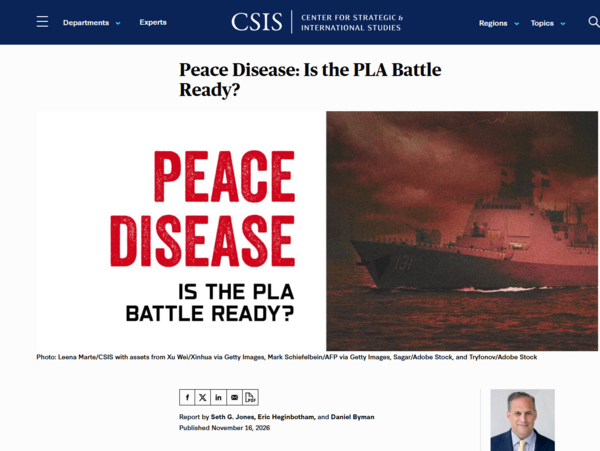
On the 16th (local time), the Center for Strategic and International Studies (CSIS), a leading Washington-based security think tank, released a report titled Peace Disease: Is the PLA Battle Ready?. The report's release coincided with President Trump's Asian tour for the ASEAN Summit in Manila and the APEC Summit in Shenzhen. Amid active U.S.-China summit diplomacy, American security experts have taken direct aim at the Chinese military's Achilles' heels.
The report begins by acknowledging the Chinese military's strengths. China is modernizing across all major warfighting domains, and its defense industry is producing ships, aircraft, and tanks faster than the United States. Beijing is also making massive investments in defense-related technologies such as AI and quantum computing. Nevertheless, CSIS underscored that "raw military, technological, and industrial strengths do not automatically translate into battlefield effectiveness."
Until now, U.S. defense discourse has focused primarily on the PLA's quantitative expansion. In contrast, this report aims to complement the vast body of existing research on the PLA's strengths by identifying the vulnerabilities most likely to be exposed in operational-level warfare.
['Peace Disease': China's Own Self-Diagnosis]
The term "Peace Disease" (和平病) in the report's title was not coined by the West. China has not fought a major war since 1979, and not only some Chinese analysts but also President Xi Jinping himself have referred to this vulnerability as "Peace Disease." With more than a generation having passed since the 1979 Sino-Vietnamese War, the vast majority of PLA officers have never experienced real combat, and their tactical doctrines have never been tested on an actual battlefield.
The Australian Strategic Policy Institute (ASPI) already highlighted this issue in 2019. What Xi Jinping calls the PLA's "Peace Disease" is fundamentally a lack of combat experience, which Chinese commentators attribute to an inability to train under realistic conditions. This strikes at the heart of the Chinese Communist Party's concerns regarding PLA capabilities. The internal diagnosis by Chinese military authorities has been even more direct.
In a 2014 front-page article, the PLA Daily reported that military authorities had distributed a document to all units listing 40 weaknesses in current training methods. Since 2018, Xi Jinping has personally issued annual mobilization orders at the start of each year, pushing for "combat-realistic training." Xi's remarks reported by Xinhua News Agency—"Only when we can fight can we stop a war; only when we are prepared to fight may we not have to fight; and the less capable we are of fighting, the more likely we are to be beaten"—vividly reveal his sense of crisis. The fact that the paramount leader has repeated the same prescription for nearly a decade is also proof that the disease has yet to be cured.
[Dissecting the 6 Critical Weaknesses of the People's Liberation Army]
The first critical weakness presented in the report is the command structure. The PLA maintains a dual-command system in every unit, pairing a military commander with a political commissar. While designed to uphold the principle that "the Party commands the gun," the report points out that in wartime, this leads to conflicting judgments and additional layers of approval, eroding rapid response and the initiative of field commanders. It is the exact opposite of the "mission command" emphasized by the U.S. military, a culture where subordinate commanders exercise discretion within the framework of their superiors' intent.
The second is power projection and logistics. China has very few overseas bases, such as the one in Djibouti, and lacks sufficient strategic airlift and sealift capabilities. This means sustaining long-term operations beyond the First Island Chain (the line connecting Okinawa, Taiwan, and the Philippines) would be difficult.
The third is undersea warfare. Submarine warfare and anti-submarine warfare (ASW) remain weak links for the Chinese Navy, and the development of modern ASW platforms and technologies has been slow.
The fourth is joint operations. Through massive reforms in 2015–2016, the PLA reorganized its seven military regions into five theater commands to promote integrated command across the army, navy, air force, and rocket force. However, changing an organizational chart is a different matter from changing a command culture that has been entrenched around the ground forces for decades.
The fifth is dynamic targeting. While the PLA can strike pre-planned, fixed targets with precision, its ability to rapidly identify, engage, and assess mobile targets appearing in real time on the battlefield is assessed to be lacking. This is the area where a military devoid of real-combat data is inevitably most vulnerable.
The sixth and final weakness is corruption. Pervasive corruption throughout the military and the defense industry can lead to equipment defects, falsified training data, and fabricated logistics records. This creates an unbridgeable gap between paper strength and actual combat capability.
[Command Vacuum Created by Purges Fuels the Peace Disease]
Paradoxically, purges carried out under the banner of anti-corruption are further destabilizing the first weakness: the command structure. According to a purge database independently compiled by the CSIS China Power Project, 101 senior officers who held positions at the level of the Central Military Commission, theater commander, or theater deputy commander have been dismissed or have disappeared. The purges peaked in January 2026. On January 24, China's Ministry of National Defense announced that Zhang Youxia, the military's highest-ranking general, and Liu Zhenli, Chief of Staff of the Joint Staff Department, were under investigation for severe violations of discipline and law. This left Zhang Shengmin as the sole remaining general on the Central Military Commission alongside Xi Jinping. Subsequently, on September 21, Xinhua News Agency announced that the Politburo of the Communist Party had approved the expulsion of Zhang Youxia from the Party.
There is a direct link between Zhang Youxia's downfall and the "Peace Disease." Singaporean media outlet Mothership pointed out that "this purge has left the PLA's top leadership dangerously thin, and Zhang Youxia was one of the last senior leaders with direct combat experience." With the disappearance of the last general from the generation that fought in the 1979 Sino-Vietnamese War, virtually no one with firsthand combat experience remains in the PLA's top brass. According to the U.S.-based Jamestown Foundation, a front-page commentary in the PLA Daily declared 2026 the "decisive year" in the battle against military corruption—signaling that the purges are far from over. In an organization where superiors can be hauled away at any moment, subordinate commanders are unlikely to exercise bold initiative.
[Shows of Force in the Taiwan Strait: The Numbers Behind the Facade]
Against this backdrop, how should the PLA's shows of force around Taiwan be interpreted? The PLA has indeed consistently flexed its muscles around the island. During the "Justice Mission-2025" drills conducted on December 29–30, 2025, the PLA publicly stated for the first time that the purpose of its exercises around Taiwan was to "deter" external military intervention. However, the trend shifted in 2026. According to Hong Kong's South China Morning Post (SCMP), the number of PLA fighter jets detected near Taiwan in the first half of this year fell by more than half year-on-year to 1,334, while the number of days with zero fighter jet detections hit an all-time high. During this period, the PLA did not conduct a single large-scale exercise around Taiwan—a first since 2022.
Activity has not ceased entirely. According to data from George Mason University's Taiwan Security Monitor, 255 PLA aircraft were detected around Taiwan in September alone, an increase of 82 from August. Taiwan's Ministry of National Defense is closely watching for potential large-scale drills ahead of the November–December "training season." Reasons cited for the drop in sorties include turmoil stemming from leadership purges as well as political restraint amid U.S.-China summit diplomacy.
[A 'Cost-Imposition' Strategy and Lingering Questions]
The report proposes that the United States and its allies develop a cost-imposition strategy against China to strengthen deterrence and exploit the PLA's vulnerabilities. Specific measures include disrupting PLA command chains through cyber and electronic warfare, accelerating the deployment of undersea assets such as low-cost unmanned underwater vehicles (UUVs), geographically dispersing allied forces to raise the threshold for China to initiate a war, and using information warfare to foster mutual distrust within the PLA. The report also acknowledges that any military, including the U.S. armed forces, would face severe challenges in a high-intensity great-power conflict. The core objective is not to belittle the adversary, but to accurately identify its weaknesses and leverage them for deterrence.
[Why Times Insight]
There is a saying that the louder the bluster, the less substance lies behind it, serving merely to mask inner fear. Russian President Vladimir Putin, attending this APEC Summit, is a textbook example. Arriving for a summit with the U.S. President, he stepped off his plane carrying the nuclear briefcase—and even staged the moment to ensure press photographers had an ample view. It was pure comedy. Putin was the only leader to put on such a display. Why did he do it? Sheer bluster—an attempt to cover up Russia's glaring weaknesses as it suffers heavy setbacks in the Ukraine war.
The same logic applies to the PLA's shows of force in the Taiwan Strait. Filling surrounding airspace with hundreds of military aircraft and live-streaming "encirclement drills" certainly has an intimidating effect, yet it also substitutes theatrical staging for capabilities never proven in real combat. For a military that has not fought a war in 47 years, putting on a show is the only tool left.
The developments of 2026 lend further weight to this hypothesis. It is hard to view the disappearance of large-scale drills during the first half of the year—precisely when the top brass was hollowed out—as a coincidence. A military with a shaken chain of command struggles to pull off even large-scale theatrical displays, let alone an actual war. At the same time, the fact that Xi Jinping has spent nearly a decade calling for curing the "Peace Disease" and conducting "combat-realistic training" suggests that the PLA's aggressive posture stems less from confidence and more from an underlying anxiety: an inability to answer the question, "If we fight, can we win?"
However, this assessment warrants caution. An anxious military is not necessarily a less dangerous one. In a high command where purges have eliminated generals willing to voice dissenting opinions, the checks and balances against miscalculation by the paramount leader have vanished as well. Accurately understanding the PLA's weaknesses is not meant to encourage underestimating it, but to design deterrence that prevents those very weaknesses from leading to fatal miscalculation.

-중국 푸단대학교 한국연구원 객좌교수
-전 EDUIN News 대표
-전 OUR NEWS 대표
-제17대 대통령직인수위원회 정책기획팀장
-전 대통령실 홍보기획비서관
-사단법인 한국가정상담연구소 이사장
-저서: 북한급변사태와 한반도통일, 2012 다시우파다, 선거마케팅, 한국의 정치광고, 국회의원 선거매뉴얼 등 50여권