Update2026.11.21 (토)

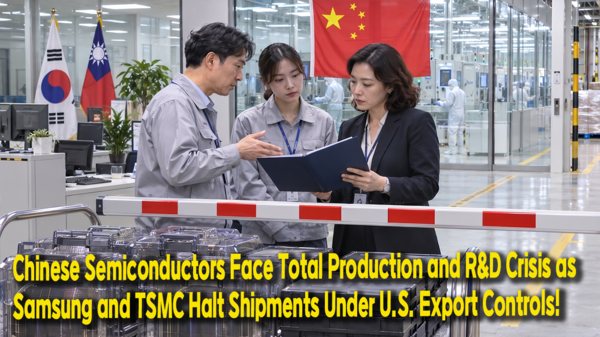
[New U.S. Rules Shake Even Production of Chips Designed Directly by China]
The United States has blocked the last remaining avenue through which Chinese semiconductor design firms sourced advanced chips via Taiwanese and South Korean foundries. On November 19, when the U.S. Commerce Department's Bureau of Industry and Security (BIS) put new export control rules into effect, TSMC and Samsung Electronics—the world's top two foundries—notified Chinese clients of a halt in shipments of certain processors, with TSMC effectively suspending orders at 16 nanometers and below. Baidu's AI chip subsidiary Kunlunxin and TikTok parent ByteDance, as well as smartphone chips for Xiaomi, Oppo, and Vivo, all fell within the blast radius. Although a Trump-Xi summit took place in Shenzhen the very same day, Washington showed no sign of loosening its regulatory grip. Compounding matters, Belgium's imec—long dubbed the "Switzerland of the semiconductor industry"—formalized its break with China on advanced research cooperation and announced plans to establish its first research base in Hokkaido, Japan. China's semiconductor sector now faces dual isolation, simultaneously losing both manufacturing channels and windows for technological exploration.
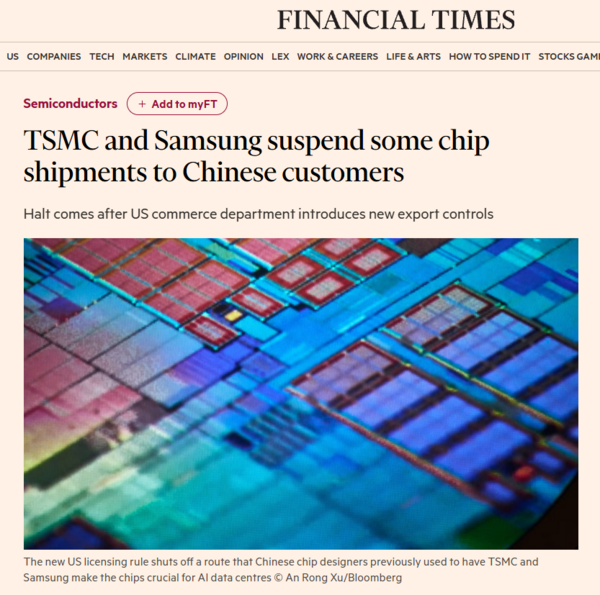
Britain's Financial Times (FT) reported on the 19th (local time) that "Samsung Electronics and Taiwan's TSMC have halted shipments of certain processors to Chinese customers in response to new U.S. export controls," adding that "the two companies notified clients that they would suspend supplies of the affected products while applying for export licenses from the U.S. Department of Commerce."
The FT named Baidu's AI chip unit Kunlunxin and ByteDance as Samsung Electronics' Chinese clients. As high-performance Nvidia processors became harder to obtain, the two firms had been diversifying their supply chains by combining in-house chip design with overseas contract manufacturing. With this latest measure, Chinese companies can no longer secure overseas foundries to mass-produce chips even if they design them themselves.
The epicenter of the shock is an interim final rule (IFR) unveiled by the Commerce Department's BIS on the 16th. Under the "foundry due diligence rule" introduced in January 2025, foundries were allowed to ship chips without a license if the designer was an "approved" or "authorized" designer designated by the U.S. government, or if transistor counts verified at the packaging stage proved the chip fell below control thresholds. Chinese fabless firms had been ordering high-performance chips by routing them through independent outsourced semiconductor assembly and test (OSAT) providers to pass this verification process. The new rule closes that pathway by stripping this eligibility from designers headquartered in Country Groups D:1, D:4, or D:5, including China. Not a single mainland Chinese company appears on the U.S. government's list of approved designers.
Reuters reported the same day, citing two sources, that "TSMC has suspended work on processes at 16 nanometers and below for Chinese customers that have not received U.S. export licenses." While 28nm and 40nm processes remain largely permitted, chips using high-bandwidth memory (HBM) or requiring advanced packaging are excluded. Previously, TSMC could determine whether a chip fell under controls by directly examining technical specifications such as computing performance, but advanced chips for those customers are now treated across the board as controlled items. The scope of vetting has also expanded to cover packaging partners, shipping routes, shareholders, and parent companies, as well as orders placed through overseas subsidiaries and intermediaries. Companies that have designed high-performance AI chips now face the predicament of finding alternative production sites or revising their designs to lower target performance.
The shockwaves extend beyond AI chips. The new rule also eliminates the exemption that previously excluded chips from controls simply because they were designed for non-AI uses such as smartphones. One lawyer cited by the FT explained, "With this provision gone, TSMC and Samsung must also apply for licenses for consumer chips made using advanced processes." Regarding chips that TSMC manufactures on contract for Xiaomi, Oppo, and Vivo, one industry official predicted that while the Commerce Department is likely to grant licenses for smartphone chips, delays in review could cause significant production disruptions.
[The Encirclement That Began with the 2024 'Huawei Chip Incident']
This measure marks the final link in an encirclement tightened step by step over two years. In October 2024, Canadian research firm TechInsights tore down Huawei's AI chip Ascend 910B and discovered a die manufactured by TSMC, which turned out to have been ordered by Chinese design firm Sophgo. The U.S. Commerce Department immediately issued an "is-informed letter" to TSMC, blocking shipments of AI chips at 7 nanometers and below to China starting in November 2024. In January 2025, Washington established the foundry due diligence rule and added Sophgo to the Entity List, yet the transistor-count verification pathway created at that time became a new workaround. The latest rule closes that very loophole.
[Overseas Data Center 'Remote Access' Also Blocked]
The same rule also takes aim at renting computing power from overseas cloud providers instead of buying chips outright. Exporting advanced chips to data centers that provide computing resources to companies headquartered in Country Group D:5—including China—or Macau now requires a license. The threshold is set at a data center Total Processing Performance (TPP) of 12 million, which the industry estimates at roughly 300 advanced chips. Data centers already providing large-scale computing power to Chinese firms must obtain a license within 90 days to continue operating. Licensing requirements have also been newly imposed on advanced chip exports to five countries deemed high-risk for diversion: Indonesia, Malaysia, Singapore, Thailand, and Brazil.
The impact was immediate. Beijing-based AI startup Moonshot AI canceled a $150 million (approximately 200.6 billion won) contract with an Indonesian cloud provider that it had signed to use Nvidia B300 chips to train its next-generation "Kimi K4" model. Chinese tech companies were already grappling with record-high memory prices and limited capacity at domestic foundries such as SMIC. Huawei has reportedly asked customers of its new AI chips to source their own memory. Allegations reported by The New York Times (NYT) that Alibaba indirectly acquired Nvidia chips—which Alibaba denied—also gave Washington justification to tighten controls.
['Switzerland of Semiconductors' imec Parts Ways with China]
Founded in Leuven, Belgium, in 1984 as a nonprofit research organization, imec neither sells chips nor operates commercial fabs. Instead, it has served as a collaborative research platform where global semiconductor companies test next-generation processes and new materials ahead of commercialization. At one point, imec was close enough to China to establish joint ventures and spin-offs with SMIC and Huawei. As U.S. concerns over technology leakage mounted, however, imec phased down cooperation, and former CEO (now Chairman of the Board) Luc Van den hove stated in 2024 that research partnerships with Chinese universities had also been halted. Given that current CEO Patrick Vandenameele, who took office in April this year, previously held a senior executive role at Huawei, his declaration carries major symbolic weight.
In interviews with outlets including TV Tokyo in June, Vandenameele stated that "semiconductor R&D has split into two camps," confirming that separation from China in advanced semiconductors was complete. In effect, imec—long the symbol of industry-wide joint research—has formally embraced bloc-based alignment.
While distancing itself from China, imec is shifting its center of gravity toward U.S. allies. At the "ITF Japan" event held in Tokyo on the 16th, Vandenameele announced the establishment of "imec Hokkaido" on Hokkaido University's Sapporo campus. It is the first time imec will station research personnel permanently in Japan. Supported by the Ministry of Economy, Trade and Industry, the initiative involves Japan's Leading-edge Semiconductor Technology Center (LSTC), Hokkaido University, Tohoku University, and Yokohama National University, focusing on silicon photonics and advanced packaging. Vandenameele cited collaboration with Rapidus, which is preparing for 2nm mass production in Chitose, as the reason for choosing Hokkaido.
[Beijing's Response and the Limits of 'Self-Reliance']
At a regular briefing on the 13th, when asked about efforts by the U.S. Congress and Commerce Department to block Chinese firms from accessing overseas computing resources, Chinese Foreign Ministry spokesperson Mao Ning replied, "China consistently opposes the abuse of export control measures that disrupt the stability of global industrial and supply chains, which serves no party's interests." Beijing also warned of "necessary measures."
The solution Beijing is championing is self-reliance. Proposals for the 15th Five-Year Plan (2026–2030) include deploying "extraordinary measures" to achieve decisive breakthroughs across the "entire industrial chain" in core sectors such as integrated circuits. Yet the reality gap remains wide. According to U.S. research institute Epoch AI, the computing throughput of Huawei's flagship 2026 chip, the Ascend 950, is roughly one-seventh that of Nvidia's B300 and half that of the H100 released in 2022. When production volume is factored in, Huawei's total computing output this year stands at roughly one-twenty-fifth of Nvidia's.
[Why Times Insight]
The essence of the new rule lies in shifting the control criterion from "what chip it is" to "who designed it." Until now, Chinese fabless firms could access TSMC's cutting-edge lines as long as they kept chip specifications below regulatory thresholds, but now nationality itself has become the subject of scrutiny. Chinese designers will have no choice but to crowd into SMIC, which already lacks spare capacity, worsening supply bottlenecks. Combined with soaring memory prices and HBM shortages, China's AI industry is now being squeezed simultaneously across all three supply lines: chips, memory, and cloud computing.
The break with imec carries longer-lasting consequences than immediate production disruptions. The global semiconductor industry has long drawn the "roadmap" for next-generation processes together at imec, and China must now bear that exploratory cost alone. Following the ban on exports of ASML extreme ultraviolet (EUV) lithography systems to China, the fracturing of the R&D ecosystem means the semiconductor world is solidifying into two camps across all three layers: equipment, manufacturing, and research. That a CEO with a Huawei background personally declared this split underscores that the trend has passed the point of easy reversal.
Still, it is premature to declare an outright "collapse." Licenses for smartphone chips are likely to be granted eventually, and 28nm and 40nm processes remain open. China's capacity for workarounds—such as DeepSeek releasing models optimized for the Ascend platform—cannot be dismissed either. Holding rare earths as a retaliatory card, Beijing also poses the risk of weaponizing supply chains, much as it did during the 2025 Nexperia episode. Rather than a sudden collapse, this development is more accurately viewed as a process in which the technology gap becomes structurally entrenched. The pace of license reviews, Beijing's countermeasures, and the fate of the U.S.-China trade truce set to expire on January 10, 2027, will serve as the next inflection points.


-중국 푸단대학교 한국연구원 객좌교수
-전 EDUIN News 대표
-전 OUR NEWS 대표
-제17대 대통령직인수위원회 정책기획팀장
-전 대통령실 홍보기획비서관
-사단법인 한국가정상담연구소 이사장
-저서: 북한급변사태와 한반도통일, 2012 다시우파다, 선거마케팅, 한국의 정치광고, 국회의원 선거매뉴얼 등 50여권