Update2026.10.24 (토)

[Massive Orders from China’s Flagship Tech Giants Head to Nvidia]
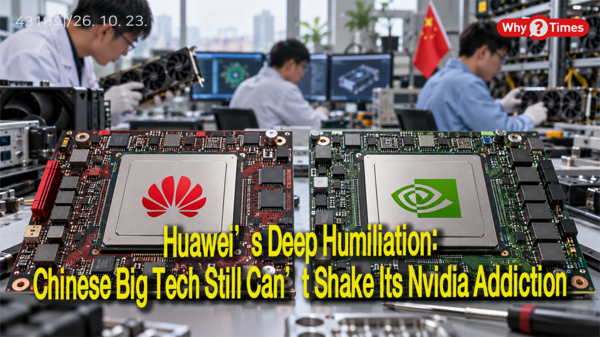
While China pushes for semiconductor self-reliance with Huawei at the forefront, its leading Big Tech corporations have instead placed massive orders to secure Nvidia products. ByteDance, Alibaba, and Tencent have ordered over 3 million graphics cards, an order exceeding $35 billion based on list prices. Even as Huawei grows, the thirst for American-made semiconductors remains unquenched. These orders clearly reveal that China’s domestic substitution policy has failed to eliminate corporate reliance on Nvidia in the field.
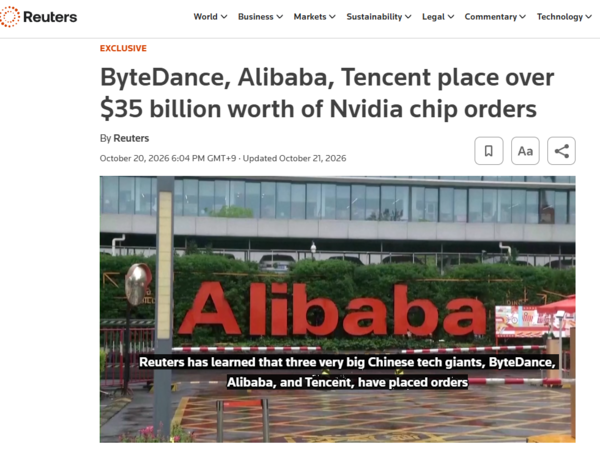
Reuters reported on the 21st that "three Chinese Big Tech firms have placed massive orders for Nvidia’s RTX PRO 5500," drawing widespread attention by adding that "total orders from Chinese customers have surpassed 6 million units, though Nvidia has reportedly informed them that supply cannot be guaranteed. This highlights intense demand to secure Nvidia hardware even when purchasable products are strictly limited under U.S. export controls."
According to Reuters, what makes this situation particularly awkward for Huawei is the identity of the buyers. ByteDance, Alibaba, and Tencent sit at the core of China’s AI services and cloud computing industries. Unlike promotional press releases championing domestic technology, their purchasing decisions are pragmatic choices made to secure the equipment vital for actual commercial operations. While external messaging loudly boasts that Huawei, as the champion of Chinese semiconductors, has caught up with Western tech and joined the global elite, domestic tech giants continue to rely on Nvidia over Huawei. The fact that customers representing China’s most advanced industries still show overwhelming demand for American-made silicon underscores the tangible limits of the "Huawei substitution" narrative.
[Why Chinese Tech Turns to Nvidia Even Without Top-Tier Chips]
The RTX PRO 5500 is a workstation-class card, distinct from Nvidia’s top-tier AI accelerators designed for massive data centers. Chinese companies are forced to seek products they can legally acquire under U.S. export restrictions. The crucial takeaway is that demand for Nvidia remains robust even when access to the most powerful hardware is blocked.
When enterprises choose AI semiconductors, they look beyond maximum raw compute performance. They evaluate how seamlessly existing software runs, how long it takes developers to adapt to a new ecosystem, and the total cost of operating services. If switching hardware incurs greater friction and expense than the benefits gained, buyers naturally gravitate toward familiar platforms.
In workloads closely tied to live operations, such as AI inference, these calculations become even more critical because response latency and operational efficiency directly determine user experience and overhead. That said, these orders alone do not justify jumping to the conclusion that the three tech giants are outsourcing all commercial workloads to Nvidia while relegating Huawei strictly to a backup role. Each company’s task-specific hardware allocation and procurement strategy must be assessed independently.
[Huawei’s Stumble in Securing Enterprise Customers]
Huawei’s historical weaknesses have also surfaced in actual reporting. Reuters reported last March that "despite government incentives to adopt domestic semiconductors, Huawei struggled to achieve large-scale adoption of its Ascend 910C among private Big Tech firms," whereas "ByteDance and Alibaba planned orders for the newer Ascend 950PR thanks to notable improvements in software compatibility and response speed."
This coverage demonstrates that enterprise clients do not choose Huawei purely out of national pride. Purchases materialize only when a product minimizes friction in practical environments and delivers tangible commercial advantages. Regardless of Huawei’s symbolic status as the vanguard of Chinese technological self-reliance, winning over enterprise clients requires separate, market-tested competitiveness.
Of course, this does not mean one should flatly claim that "Chinese Big Tech has completely abandoned Huawei." The genuine significance of this episode is not that Huawei makes products nobody wants, but that despite Huawei’s strides, Beijing’s overarching goal of replacing Nvidia is far from complete.
[Rising Market Share Is Distinct from Ending Technological Dependency]
Huawei’s growth across the Chinese market is undeniable. According to IDC data cited by Reuters on October 13, Huawei held a 28% market share by shipments in China’s data center AI chip market during the first half of this year, trailing Nvidia at 34%. Credit must be given where due: Huawei is winning real customers and increasing unit sales.
Yet market share growth alone does not resolve core competitive challenges. A surge in domestic sales within an artificially restricted market—where American supplies are bottlenecked—must be distinguished from customers freely comparing options and choosing domestic chips on merit. One must also weigh how much of this growth stems from state policy support versus genuine product competitiveness.
The latest Nvidia orders show why that distinction matters. A domestic sector can expand while intense demand for American hardware persists simultaneously. Rather than framing China’s semiconductor drive as either an "unmitigated triumph" or an "absolute failure," the industry must scrutinize which workloads have seen successful substitution and where reliance on foreign technology stubbornly endures.
[Substitution Is Impossible Without Adequate Supply Capacity]
Production capability poses an equally steep challenge. In September, Huawei Rotating Chairman Eric Xu (Xu Zhijun) stated that "the company's AI computing equipment production cannot satisfy all domestic Chinese demand." This remarks simultaneously affirm that demand exists for Huawei products and expose severe bottlenecks in delivering adequate volumes. Such an outcome is hardly surprising: lacking advanced EUV lithography systems, Huawei is forced to fabricate semiconductors using lower-tier DUV equipment. Straining DUV technology to produce high-efficiency chips inevitably depresses yields and imposes hard limits on manufacturing cutting-edge processors within desired delivery windows.
Under these constraints, the massive influx of Nvidia orders cannot be dismissed solely as a vote of no-confidence in Huawei’s chip quality. Enterprises weigh delivery timelines, allocatable volumes, and system interoperability alongside raw benchmarks. Even if Huawei possesses a technically viable product, purchasing demand quickly diverts elsewhere if volume cannot be delivered when clients need it.
Furthermore, Beijing’s timeline diverges from corporate timelines. The state can afford to steer a protracted technological self-reliance campaign, but private enterprises must launch live services and defend their market share today. If a firm forfeits business momentum while waiting on domestic hardware, the firm alone bears that financial penalty. If an import substitution policy is to succeed in practice, it must satisfy these commercial realities on the ground.
[Why Times Insight | Even State-Backed Champions Cannot Escape the Customer’s Evaluation]
This massive order is bitter medicine for Huawei because China’s flagship national champion, nurtured by state support over decades, remains incapable of displacing Nvidia dependence even on home soil. Huawei’s technological progress and corporate growth deserve recognition. However, packaging that progress as a finalized replacement for American hardware ignores economic and technical reality.
Semiconductor self-reliance is not accomplished with keynote launches or benchmark demos. It requires delivering volume at scale, enabling smooth migrations from legacy environments, and proving operational cost-efficiency to earn recurring purchases. State backing can assist market entry, but it cannot substitute for these fundamental commercial requirements.
Framing enterprise purchasing choices through the lens of patriotism likewise carries inherent limits. If companies utilizing domestic hardware must endure greater costs or operational delays, the structural burden of self-reliance cascades across the entire digital economy. Even as domestic suppliers are cultivated, clients must feel empowered to voice flaws candidly and demand performance upgrades.
For Huawei, market-proven competitiveness felt directly by end-users matters far more than proclamations of closing the gap with foreign rivals. It must prove where its operational advantages lie, quantify transition costs, and demonstrate reliable, scalable supply. Only then can market share initially secured through policy support transform into enduring customer partnerships.
The surge in Nvidia orders from Chinese Big Tech does not signal Huawei’s collapse. It does, however, lay bare how far China’s Huawei-led technological self-reliance campaign still has to travel. Even when a player is groomed by the state as its national champion, it ultimately cannot bypass the customer’s bottom-line assessment of performance, cost, and dependable supply.
One final word of counsel to the South Korean press: please refrain from writing articles based solely on press releases distributed by Chinese authorities or uncritically echoing their promotional claims. Only by reporting with a clear-eyed grasp of the actual realities on the ground in China’s semiconductor sector can we deliver accurate, reliable intelligence to our own citizens.

-중국 푸단대학교 한국연구원 객좌교수
-전 EDUIN News 대표
-전 OUR NEWS 대표
-제17대 대통령직인수위원회 정책기획팀장
-전 대통령실 홍보기획비서관
-사단법인 한국가정상담연구소 이사장
-저서: 북한급변사태와 한반도통일, 2012 다시우파다, 선거마케팅, 한국의 정치광고, 국회의원 선거매뉴얼 등 50여권