Update2026.10.24 (토)

[Reuters looks into China: Unable to leave jobs despite bonus cuts by half]
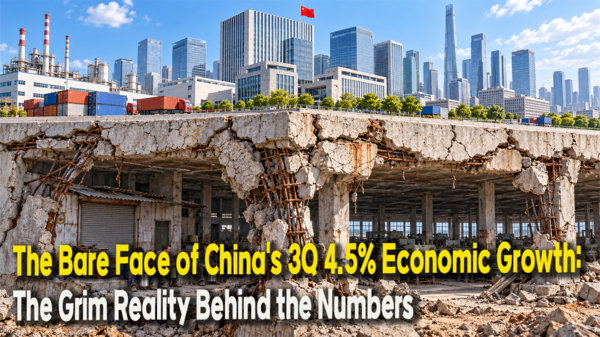
Although China's economy rebounded with a 4.5% growth in the third quarter, stagnation in investment and real estate alongside sluggish consumption continues underneath the surface. While exports and advanced manufacturing support the growth rate, private enterprises are cutting back on investments, and households are tightening their wallets due to employment and income insecurity. The problem is that even the exports bridging the domestic demand deficit remain vulnerable to shifts in global demand and foreign trade barriers. Rather than a scorecard declaring an economic recovery, this rebound in growth serves as a warning sign revealing the growing disconnect between state growth and the daily lives of its citizens.
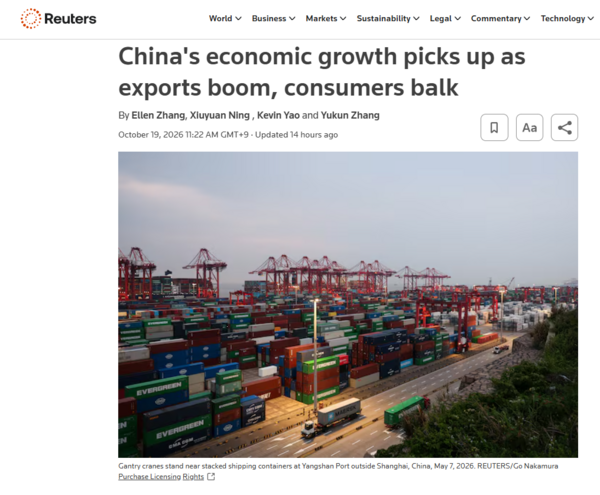
On October 19 (local time), Reuters drew attention by reporting: "Although China's economic growth rate showed a rebounding trend, it is necessary to pay attention to the disparity in citizens' livelihoods despite the export boom. While the growth rate rebounded, individuals are reducing spending and enduring unfavorable employment conditions."
Reuters highlighted concrete cases, noting that "an accounting worker in Hangzhou could not change jobs because pay conditions elsewhere were worse, even though her bonus was cut nearly in half; another woman who lost her job slept in her car to save on travel accommodation costs."
According to Reuters, the third-quarter growth rate announced by China's National Bureau of Statistics was 4.5%. This was up 0.2 percentage points from 4.3% in the second quarter, exceeding the market expectation of 4.4%. However, The Wall Street Journal (WSJ) pointed out, "While exports drove up the growth rate, consumer sentiment and real estate issues persisted," adding, "Rather than evidence that the overall economy has become healthy, this rebound is a scorecard showing the disconnect between strong exports and weak domestic demand."
[Consumption up merely 1.1%: Citizens remain uncertain about recovery]
According to Reuters, the most direct warning sign is consumption. In September, total retail sales of consumer goods increased by 1.1% year-on-year. Although this improved from 0.4% in August, it is too weak to be called a full-fledged recovery. Zhang Zhiwei, chief economist at Pinpoint Asset Management, told Reuters that "taking price factors into account, real retail sales barely grew." This implies that a slight increase in revenue does not mean the public's purchasing power has revived.
Of course, not all consumption has ground to a halt. According to official statistics from China's National Bureau of Statistics, service retail sales increased by 5.0% from January to September, while combined retail sales of goods and services grew by 2.6%. However, conventional total retail sales of consumer goods grew by only 1.1%, and just 0.9% in urban areas. Strong performance in select service sectors alone cannot cover up the widespread slump in goods consumption. A genuine recovery—where citizens expand spending out of confidence in future income—remains weak.
Sluggish consumption in turn pressures employment. When customers cut spending, self-employed business owners reduce labor costs and orders, which subsequently impacts suppliers' revenues. Workers facing income insecurity tighten their spending further. It is precisely this vicious cycle that China must break. Even if production output increases, domestic demand will struggle to self-sustain unless households feel stability in employment and income.
[Private investment drops 10.4%: Corporate actions diverge from government optimism]
Corporate investment decisions are far cooler than government optimism. Fixed-asset investment decreased by 7.2% from January to September, while private investment plunged 10.4%. Crucially, even excluding real estate development, private investment fell by 6.7%. This point is vital, as it indicates that the investment contraction cannot be blamed solely on real estate developers. Other private enterprises are also hesitant to spend capital on business expansion and new investments.
Manufacturing investment fell by 2.1%, and infrastructure investment decreased by 4.2%. Geographically, investments declined across the Eastern, Central, and Western regions, with the Northeastern region recording a steep drop of 26.0%. This reveals that facility expansion in a few high-tech industries does not translate to nationwide investment recovery. The performance of advanced manufacturing plants alone cannot explain or resolve the investment cooling across China.
What this investment decline means for citizens is clear. Fewer new factories and stores restrict hiring opportunities, and reduced machinery orders diminish work for suppliers. Young people lose employment opportunities, and workers lose chances for wage increases. Today’s investment contraction weakens the foundation of income citizens will earn tomorrow. The lack of revival in corporate investment appetite despite the growth rebound demands serious scrutiny.
[A quarter of new construction starts vanish: Real estate slump eats away at the living economy]
In the real estate sector, contraction runs even deeper. From January to September, real estate development investment fell by 20.6%, new construction floor space plummeted by 24.9%, and completed floor space dropped by 25.1%. Funds secured by development companies also decreased by 21.6%. Everything from new construction projects to completing existing projects and raising necessary funds is contracting simultaneously. Even as overall growth rebounds, the foundation for real estate recovery remains fragile.
This shock does not stay confined to construction companies' balance sheets. Reduced construction starts lower demand for steel, cement, and construction equipment; reduced completions constrain demand for interior decorating, furniture, and home appliances. The workloads and revenues of site workers, subcontractors, and surrounding local restaurants are all shaken. The real estate slump is both an asset issue for homeowners and an income crisis for those who make a living constructing and decorating homes.
Sales area for new commercial housing decreased by 13.2%, and sales value dropped by 13.9%. Conversely, transaction area for secondhand housing increased by 10.7%. However, transactions where ownership of existing homes changes hands differ fundamentally from transactions where developers receive funds for new pre-sales. An increase in secondhand transactions does not automatically resolve liquidity shortages or construction contractions in new development projects. A rebound in one segment of transactions should not be misread as a normalization of the real estate sector as a whole.
[Price illusions: Gasoline and semiconductors rise, while pork falls]
Surface price indicators might superficially resemble signals of escaping deflation. From January to September, the Consumer Price Index (CPI) rose 0.9%, while core CPI (excluding food and energy) rose 1.1%. The Producer Price Index (PPI) rose 2.3% over the same period, reaching 5.0% in September—up 1.2 percentage points from August. However, looking into individual items reveals that the upward momentum came from external factors. Gasoline prices surged 16.6% in September. Driven by the AI boom, data storage devices jumped 46.7%, computers rose 21.8%, and mobile phones increased 14.9%. In contrast, pork prices in traditional markets—a staple directly linked to ordinary households—dropped by more than 10% compared to a year ago.
Alicia García-Herrero, Chief Asia-Pacific Economist at French investment bank Natixis in Hong Kong, warns against this illusion. She views that "despite high international oil prices, China's inflation rate remains low due to excessive domestic market competition—the so-called neijuan (involution: hyper-competition where working harder leaves everyone poorer)—which causes 'structural deflation.'" She asserts that "this risk is real, and avoiding it requires massive stimulus measures." The dilemma, however, is that such stimulus presupposes adequate fiscal capacity. Some market analysts also note that the surge in PPI could narrow the People's Bank of China's leeway for further interest rate cuts—a combination of cold demand and rising costs that represents the trickiest scenario for monetary policy to handle.
[The sprint of high-tech industries: Growth that fails to reach consumer purchasing power]
China's high-tech sector has achieved real performance. From January to September, value-added output in high-tech manufacturing rose 14.3%, and industrial robot production jumped 29.1%. However, overall industrial production growth stood at 5.3%. Rapid growth in select industries fails to spread across the broader economy. The core takeaway from this release lies in the gap between factories' expanded production capacity and citizens' ability to consume.
When domestic demand fails to absorb production, companies turn to overseas markets. However, if trade partners perceive the influx of Chinese goods as a threat to their domestic industries and employment, trade barriers will rise. ANZ (Australia and New Zealand Banking Group) assessed that "China has not yet entered a self-sustaining recovery." If the time bought by exports is not used to revitalize domestic demand, China's economy will inevitably become increasingly vulnerable to external shifts.
[Why Times Insight | Achieving state targets is not the same as public recovery]
The "fallacy" to scrutinize in this 4.5% growth figure is the impression of recovery conveyed by numbers alone. Aggregate growth rates can rise even when investment and real estate contract and consumption stagnates. While the government speaks of meeting target metrics, citizens evaluate the economy based on job security, income, and living expenses. Ignoring the gap between these two scorecards risks turning growth metrics into a justification for disguising problems rather than a diagnostic tool.
Even more concerning is the paradox where target achievement delays necessary remedies. If exports offset weak domestic demand, the government may feel less pressure to support households. Reuters also noted that "expectations for early monetary easing weakened following the announcement of favorable growth rates." The belief that target metrics can be achieved without a genuine recovery in citizens' livelihoods threatens to lower the urgency of supporting the public economy. This suggests that Chinese Communist Party authorities are being blinded by growth figures and failing to grasp the real situation on the ground.
In this light, the questions facing the Xi Jinping leadership are clear: When will the achievements in nurturing high-tech industries lead to stable jobs and household purchasing power? What remedies will encourage businesses to invest with confidence in future demand? If China remains stuck in a model of expanding production capacity while relying on exports to cover domestic demand deficits, industrial competitiveness gains and public livelihood anxiety will continue to coexist over the long term.
The window provided by resilient exports is an opportunity to restore domestic demand. Mistaking this buffer as proof that economic issues have been resolved will only make responding far more difficult when foreign demand softens. The grim reality behind the 4.5% growth figure is that despite the top-line expansion, citizens remain anxious about the future, businesses are cutting investments, and real estate distress continues to erode everyday livelihoods. Industrial achievements by the state can never replace the recovery of its people's living standards.


-중국 푸단대학교 한국연구원 객좌교수
-전 EDUIN News 대표
-전 OUR NEWS 대표
-제17대 대통령직인수위원회 정책기획팀장
-전 대통령실 홍보기획비서관
-사단법인 한국가정상담연구소 이사장
-저서: 북한급변사태와 한반도통일, 2012 다시우파다, 선거마케팅, 한국의 정치광고, 국회의원 선거매뉴얼 등 50여권