Update2026.10.24 (토)

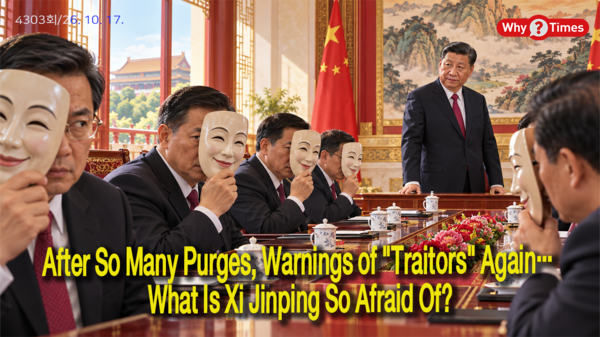
[Warning Published in Official Party Theoretical Journal: “Do not trust everyone who claims loyalty”]
Chinese President Xi Jinping has once again issued a stern warning aimed squarely at the interior of the Communist Party of China (CPC). He urged the Party to filter out officials who pay lip service to loyalty while disobeying directives behind the scenes—those who stand ready to jump ship whenever personal interests dictate. Despite extensive purges and repeated personnel reshuffles since taking power, Xi remains deeply vigilant against ulterior motives hiding behind voices of allegiance. Having removed so many rivals and concentrated power in his hands, why does Xi Jinping still find it impossible to trust his own organization?
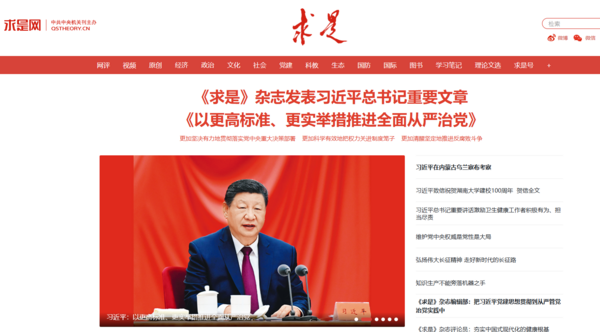
Qiushi (Seeking Truth), the flagship theoretical journal of the CPC Central Committee, published Xi Jinping's speech in its 20th issue of 2026 on October 16, issuing a forceful warning against "two-faced people" (兩面人) within the Party. The term refers to individuals who act one way in public and another in secret. The piece represents key excerpts from a speech Xi delivered on January 12 during the Fifth Plenary Session of the Central Commission for Discipline Inspection (CCDI), which Xinhua News Agency first released on October 15.
According to Xinhua, Xi's target is not merely overt dissidents who publicly oppose him. Rather, it encompasses cadres who are quickest to applaud central decisions yet fail to implement them in practice, officials who utilize his ideology only when convenient, and those who build private factions. He directed particularly harsh criticism at political opportunists who move according to self-interest and are prepared to "change boats" at any moment. The paramount leader himself directly raised the problem of a substantial gap between spoken loyalty and actual conduct.
To be sure, the expression "changing boats" should not be interpreted hastily as preparation for party defection, exile, or a coup. Nevertheless, it clearly signifies a warning that extends beyond simple financial corruption to question political trust and the potential for betrayal. Embedded in Xi’s warning is a persistent anxiety: "Will the person swearing loyalty to my face remain on my side until the very end?"
[Why Release a Nine-Month-Old Speech Right Before the Fifth Plenum?]
The CPC will convene the Fifth Plenary Session of the 20th Central Committee—the so-called Fifth Plenum—in Beijing from October 26 to 29. The main agenda announced by the Central Political Bureau includes deliberating decisions on full and rigorous self-governance of the Party (全面從嚴治黨). The release of this speech is visibly aligned with the plenum's agenda.
According to Xinhua, Xi emphasized in his speech that "local leadership reshuffles will proceed sequentially starting this year," instructing authorities to "ensure two-faced people do not pass screening when selecting cadres." This indicates an intent to tighten control over current officials while simultaneously re-verifying the loyalty of incoming leaders. It is read as a message that political trustworthiness will be scrutinized with extreme rigor during the process of forming the next leadership team.
However, the disclosure of a past speech does not in itself serve as definitive proof of an extraordinary power crisis. What matters is not merely the timing of the release, but its content. Xi simultaneously brought into question whether the Party properly executes his directives, whether cadres prioritize personal relationships over formal organizational structures, and whether outward loyalty is genuine. At the core of the message presented ahead of the plenum lies a demand to re-examine and verify the organization rather than trust it.
[Even Zhang Youxia, Who Criticized False Loyalty, Could Not Survive]
A prime case that underscores the severity of this latest warning is Zhang Youxia, former Vice Chairman of the Central Military Commission. On January 24, China's Ministry of National Defense announced that Zhang Youxia and Liu Zhenli, Chief of the Joint Staff Department, were under investigation for serious violations of discipline and law. This announcement came just 12 days after Xi delivered the speech. AFP reported at the time that "the crackdown has expanded to the highest levels of the Chinese military."
According to the Central News Agency (CNA) of Taiwan, Zhang Youxia himself wrote an article in the People’s Daily in November 2025 cautioning against two-faced individuals and fake loyalty. While it cannot be definitively concluded that Zhang was subsequently labeled a "two-faced person" officially, the fact remains that even a track record of emphasizing loyalty and criticizing deceitful allegiance failed to guarantee his political safety.
In such an environment, how are cadres supposed to prove themselves? When pledging loyalty is insufficient and past contributions provide no safety net, officials have little choice but to resort to ever-stronger expressions of devotion and ultra-cautious behavior. Yet, as expressions become standardized and uniform, it becomes even harder for the leader to distinguish sincerity from performance. The pressure to verify loyalty risks creating an organization where true loyalty is nearly impossible to discern.
[Investigation Extends to Huang Qifan… The Unending Cleanup of Top Officials]
On October 13, two days prior to the release of the speech, an investigation into Huang Qifan, former Mayor of Chongqing, was also announced. According to Xinhua, the CCDI and the National Supervisory Commission stated he was being investigated for serious violations of discipline and law, though specific charges were not disclosed. Therefore, linking this case to anti-Xi activities or treason charges lacks sufficient evidence.
The scale of investigations remains extensive. According to a CCDI work report released by Xinhua, 181 centrally managed cadres were filed and investigated in 2025. Citing separate statistics, Xinhua further reported that "in the first half of this year, 74 provincial- and ministerial-level officials were disciplined, surpassing last year's total of 69."
These figures alone do not necessarily mean Xi’s grip on power has weakened. The ability to investigate top-tier officials can also demonstrate strong power. However, having the capacity to punish and building an organization you can trust and delegate to are two entirely different matters. Repeated purges of senior officials raise questions not only about Xi's authority, but also about the effectiveness of the personnel and oversight system he has established.
[Why Times Insight] What Fuels Xi Jinping’s Anxiety Is His Own Style of Governance]
While Xi Jinping’s actual psychological state cannot be confirmed from the outside, the political distrust revealed in this speech is stark. He warned against officials whose words and actions diverge, whose private interests override central commands, and who may defect depending on the situation. The central question running through this entire affair is why that distrust remains uncorrected even after long years of rule and repeated purges.
First, purges can enforce obedience, but they cannot generate trust.
Cadres who fear punishment will readily assent to the leader’s directives. However, it is difficult to know whether that assent stems from genuine conviction in the policy or mere self-preservation. The more harshly Xi criticizes fake loyalty, the more elaborately officials may stage their performative devotion. This creates a paradox where intensifying surveillance and punishment fails to verify true intent.
Second, as distrust deepens, the risk increases that information reaching the top leader will become distorted.
If reporting policy flaws risks being suspected of lacking resolve or harboring discontent toward the leadership, cadres gain a strong incentive to conceal bad news. Failures are minimized while achievements are exaggerated. Consequently, it becomes difficult for the leader to grasp reality accurately; when directives misalign with results, the leader again suspects the executioners of disloyalty. Purges and information distortion form a self-reinforcing loop.
Third, Xi Jinping cannot escape responsibility for the defects in the system he created.
In the early days of his tenure, he could blame the personnel decisions and practices of previous administrations. However, if untrustworthy cadres continue to emerge after a long period of restructuring personnel and power, the explanation must change. One must ask who selected them, why such individuals were promoted, and what made the appearance of loyalty more advantageous than honest reporting. Ultimate responsibility inevitably returns to the paramount leader.
Fourth, relentless loyalty checks threaten to undermine the nation's capacity to govern.
When officials prioritize political safety over problem-solving, difficult decisions are deferred. Even if central directives clash with reality, offering corrective feedback becomes too risky. Xi may interpret this paralysis as irresponsibility and disobedience, applying even further pressure. When the entire organization ends up simply waiting for the paramount leader's word, power concentration deepens, but actual executive capacity declines.
The spectacle of Xi Jinping guarding against two-faced people yet again after eliminating countless individuals exposes precisely this contradiction. While dissenting voices around him have dwindled, he can hardly be certain that trustworthy voices have increased.
What Xi Jinping needs is not cadres who proclaim loyalty louder, but an organization that speaks the truth and operates responsibly. Yet, if he seeks the answer to his distrust solely through further purges, strengthening his power will only isolate him further. If he remains anxious despite so many purges, the problem no longer lies merely with remaining "traitors," but with Xi Jinping’s own method of governance.

-중국 푸단대학교 한국연구원 객좌교수
-전 EDUIN News 대표
-전 OUR NEWS 대표
-제17대 대통령직인수위원회 정책기획팀장
-전 대통령실 홍보기획비서관
-사단법인 한국가정상담연구소 이사장
-저서: 북한급변사태와 한반도통일, 2012 다시우파다, 선거마케팅, 한국의 정치광고, 국회의원 선거매뉴얼 등 50여권