Update2026.10.24 (토)

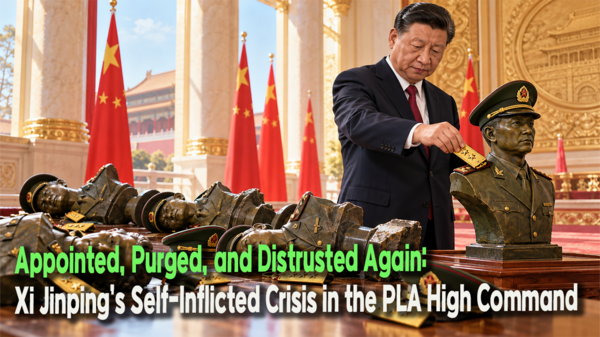
[Commander-in-Chief Xi Jinping Neutralizes His Own High Command]
It was not an external adversary that paralyzed the top military leadership of China's People's Liberation Army (PLA), but President Xi Jinping himself. Following successive purges of generals he personally selected, the Central Military Commission (CMC) has been reduced to just Xi Jinping and Vice Chairman Zhang Shengmin, whose career centers on political and disciplinary affairs.
Xi’s concentration of power—aimed at absolute control over the military—has ultimately undermined the expertise and trust required to lead it. Paradoxically, Xi’s ambition to build a "world-class military" has turned the PLA into a figurehead force capable only of awaiting his direct orders.
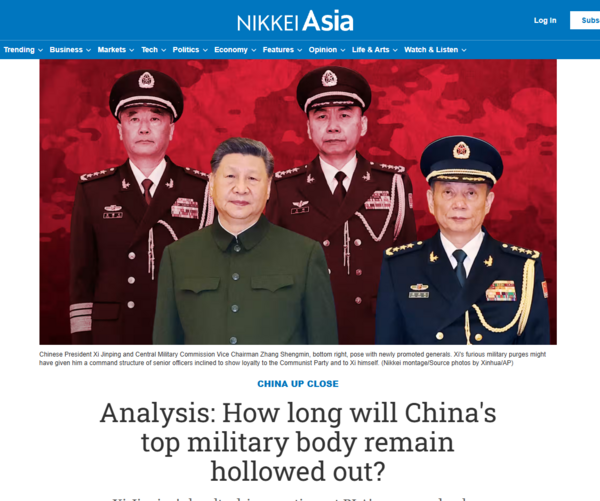
On October 15, Nikkei Asia published an analytical report by senior columnist Katsuji Nakazawa, pointing out that “China's top military decision-making body has effectively been hollowed out.” Nakazawa added: “Ahead of the 5th Plenary Session of the 20th Central Committee (5th Plenum), scheduled for October 26–29, the internal foundation for military advice within the CMC has been severely weakened. This upcoming session is expected to reveal how Xi intends to address the command vacuum he brought upon himself.”
whytimes.kr
Nikkei further highlighted: “On September 21, the Chinese Communist Party (CCP) announced the expulsion of former CMC Vice Chairman Zhang Youxia and former Chief of the Joint Staff Department Liu Zhenli from both the party and the military. Accused of corruption, factionalism, and political disloyalty, their purging demonstrates that the crackdown on top military brass extends far beyond anti-graft efforts to encompass strict political obedience.”
“From its seven-member composition at the launch of Xi’s third term in 2022, active figures on the CMC have dwindled to just two: Xi Jinping and Zhang Shengmin,” Nikkei noted. “The sole remaining active general, Zhang Shengmin, built his career in political and disciplinary supervision.” The U.S. Congressional U.S.-China Economic and Security Review Commission (USCC) also noted that “Zhang Shengmin lacks the operational and combat experience of Zhang Youxia or Liu Zhenli. Compared to internal surveillance mechanisms, the senior talent pool capable of evaluating war risks and coordinating complex military operations has grown critically thin.”
Vision Times
[The Downfall of Handpicked Generals: Responsibility Lies with Xi]
This crisis cannot be explained simply as the wrongdoing of purged generals. Early in Xi’s tenure, purges could be framed as sweeping away legacy networks from previous leaders. However, the leadership structure collapsing today consists of individuals whom Xi personally promoted and elevated to the highest posts.
Japan’s National Institute for Defense Studies (NIDS) observed: “The top military figures investigated during Xi’s third term were all selected by Xi himself. Neither He Weidong, considered a close confidant, nor Zhang Youxia, who shared a long-standing personal relationship, was an exception. When leaders appointed under the assumption of absolute loyalty are purged one after another, the judgment and oversight of the supreme leader who chose them must also be called into question.”
If corruption was rampant, it reflects a failure in personnel management and supervision. If political distrust fueled the expanded purges, it points to a failure in governance. In either case, accountability lands on Xi Jinping. Removing subordinates cannot erase personal failure in personnel decisions. Furthermore, if this process disables the functionality of the supreme command structure, the responsibility becomes even weightier.
A commander-in-chief's duties extend beyond punishing corrupt generals to maintaining operational continuity. A leader must take responsibility for who fills the void after removals and how operational expertise and experience will be preserved. Continual purges that prolong a leadership vacuum do not signal decisive governance; they reveal a structural limitation in managing an organization stably.
[Expanding Weapons, Diminishing Decision-Makers]
An armed force does not grow strong merely by accumulating troops and weaponry. It requires the command capability to integrate land, sea, air, and missile forces into a single joint operation, evaluate real-time intelligence, and adapt operational plans when unexpected contingencies arise. If this command function is paralyzed, even a massive military risks devolving into a disorganized force in times of crisis.
A hollowed-out CMC does not mean regional theater commands and tactical units have vanished overnight. The core problem lies in the erosion of the strategic foundation at the highest level—the capacity to contextualize military realities and recalibrate political decisions. Japan's NIDS noted: “With the simultaneous downfall of Zhang Youxia and Liu Zhenli, the pool of leaders capable of offering cautious views or dissenting opinions has shrunk significantly. This heightens the risk of weakening mechanisms that curb overconfidence and miscalculation.”
Should a crisis erupt in the Taiwan Strait, what is needed is not pledges of blind loyalty, but operational experts who can candidly outline the probabilities of success, potential losses, adversary responses, and escalation risks. A supreme leader requires figures who say "this is too risky right now" just as much as those who answer "it can be done."
Yet, as power consolidates entirely around Xi and the fear of purges deepens, commanders are increasingly likely to seek politically safe answers rather than military sound decisions. Instead of taking ownership of operational judgment, generals risk waiting passively for top-down orders or presenting idealized scenarios designed to appease the leader rather than reporting inconvenient tactical truths.
This is the core of the "scarecrow military" critique. Even with sophisticated hardware and vast manpower, if commanders cannot exercise independent operational judgment and merely read the supreme leader’s facial expressions, real-world military responsiveness inevitably declines. In his push for absolute obedience, Xi is eroding the very conditions required for a military to function effectively.
[A National Security Institution or a Personal Guard?]
The PLA was the army of the CCP long before Xi Jinping took power. The fundamental issue is not that Xi created a party-controlled army, but that he superimposed an intense demand for personal obedience to himself on top of the existing party-army structure.
According to Xinhua News Agency, Xi warned during a delegation meeting of the PLA and People's Armed Police last March that those disloyal to the Party would find no foothold in the military. He stressed that modern weaponry and equipment must be entrusted to politically steadfast personnel—positioning political loyalty as the primary metric for military leadership.
Maintaining military discipline and eliminating corruption are necessary. However, when professional disagreements are suspected as political disloyalty, loyalty screenings stifle military judgment. In a structure where generals who refrain from making the leader uncomfortable survive over those with military competence, the leader’s political comfort and the nation's military security diverge.
Prioritizing personal loyalty that poses no threat to one's power over the capacity to defend the country invites criticism that the PLA is being treated as a giant personal security guard. The moment military expertise and chain of command are subordinated to preserving a single individual's power, the entire nation bears the cost.
[The Governance Trap of Guarding Against a "Second Zhang Youxia"]
The dilemma Xi faces is one of his own making. Rebuilding the Military Commission requires delegating authority to a new cohort of generals. Yet, commanders entrusted with authority inevitably build influence and networks within the military ranks. For a leader hyper-vigilant against independent spheres of influence, restoring the high command poses a renewed political burden.
This is the dilemma of fearing a "second Zhang Youxia". If the fear of a military rival leads to a persistent refusal to appoint genuine military leaders, the reason for the army's existence fades. While competent leaders are essential to command the force, delegating power to them brings political anxiety.
Consequently, Xi leaves the Chinese military leadership in its current state of neglect—leading critics to quip that the "Party's Army" (Dangjun) has effectively degenerated into a disorganized "Tang Army" (Tangjun).
The upcoming 5th Plenum will serve as a crucial test. The meeting is set to focus on party governance and strengthening discipline. Should appointments to the Military Commission occur, the key indicator will not merely be headcounts, but whether operational expertise and substantive decision-making authority are restored. If newly appointed leaders remain unable to voice candid military assessments, the neutralization of the high command will simply continue under a different face.
[Why Times Insight | Xi Jinping’s Obsession with Power Weakens the PLA]
The hollowing out of the PLA high command is no accidental staffing shortage; it is the cumulative result of Xi Jinping’s choices in appointments, purges, and power concentration. In seeking absolute control over the military, the supreme leader has consumed the human capital and trust required to lead it stably.
An obsession with keeping everything within one's personal grasp is not synonymous with strong leadership. Inability to delegate authority to experts and refusal to accept uncomfortable advice displays the limits of governance capacity behind a facade of control. The hubris of believing oneself to be the sole judge of all matters carries a steep price—even in the military.
Describing the PLA as a "vegetative army" is a warning against this specific structural danger. It does not imply that overall fighting capability has disappeared, but rather that the military risks becoming a force whose judgment freezes while waiting for the leader’s signal, incapable of correcting flawed directives. Such an organization can freeze in the face of sudden crisis—or conversely, prove unable to apply the brakes on reckless orders.
A commander-in-chief must do more than enforce obedience; he must ensure the military judges accurately and acts responsibly. Is Xi Jinping fulfilling that responsibility? If sycophants protecting a leader's seat are favored over generals capable of protecting the nation, the greatest threat neutralizing the Chinese military is not an external enemy, but the commander-in-chief himself.

-중국 푸단대학교 한국연구원 객좌교수
-전 EDUIN News 대표
-전 OUR NEWS 대표
-제17대 대통령직인수위원회 정책기획팀장
-전 대통령실 홍보기획비서관
-사단법인 한국가정상담연구소 이사장
-저서: 북한급변사태와 한반도통일, 2012 다시우파다, 선거마케팅, 한국의 정치광고, 국회의원 선거매뉴얼 등 50여권