Update2026.10.24 (토)

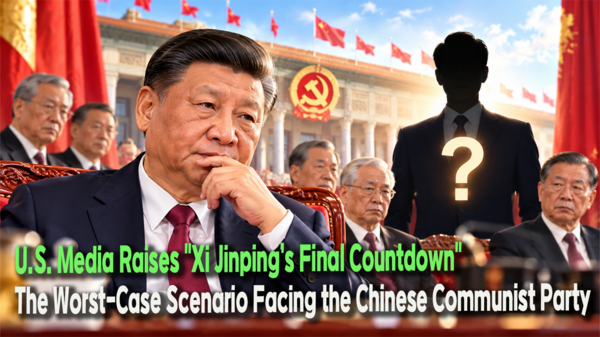
[U.S. Outlet Semafor Warns of "Xi Jinping’s Final Countdown"]
American media outlets have sounded alarm bells regarding China’s future, raising the prospect of Chinese President Xi Jinping’s "final countdown." As questions surrounding the 73-year-old leader's health, the absence of a clear heir, and relentless political purges intersect, concerns are growing that post-Xi China could be engulfed in intense power struggles akin to the era following Mao Zedong’s death. Even more critically, a power succession crisis in Beijing risks rattling global financial markets and supply chains while raising the danger of a military conflict across the Taiwan Strait. The world is watching Xi’s final countdown not out of interest in one leader's personal fate, but because of the massive political vacuum that could disrupt the global order.
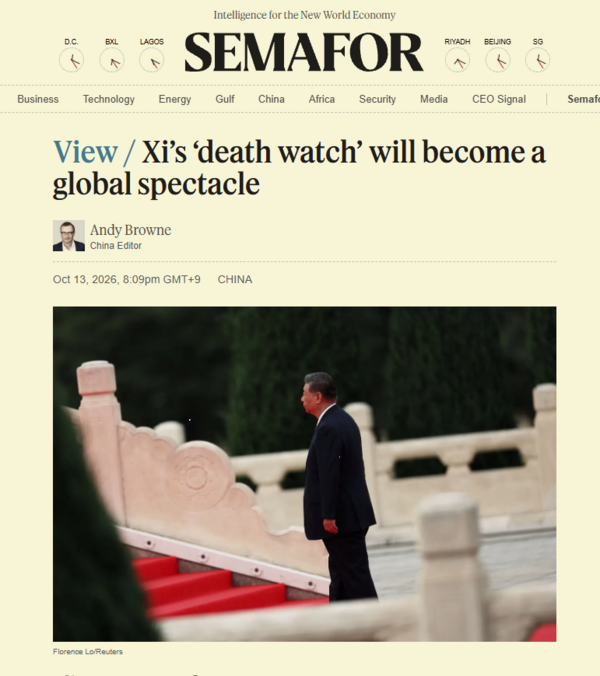
In a commentary published on October 13 (local time), Andy Browne, China Editor at the U.S. international politics news outlet Semafor, observed that "the final hours of the Xi Jinping era will become a matter of global spectacle." The column's headline itself carries significant weight: "Xi’s 'death watch' will become a global spectacle." While "death watch" literally refers to keeping vigil over someone nearing death, the article uses it as a political metaphor to describe global monitoring of a supreme leader’s final political stage and the impending power transition.
Semafor
Citing China scholar Geremie R. Barmé, Semafor noted that "autocrats and patriarchal rulers face a fateful dilemma from the moment they take power—a countdown toward their own eventual downfall." Comparing the final years of Mao Zedong and Deng Xiaoping, the article projected that Xi’s exit may resemble the turbulent power reshuffling following Mao's death rather than the orderly transition established by Deng.
Semafor warned: "Today, China is at the center of the global economy and security. Uncertainty surrounding the Chinese leader’s health and succession will move financial markets, affect investment flows, and shape defense priorities across nations."
This commentary arrives against the backdrop of persistent questions surrounding Xi’s health during recent foreign visits and international engagements. The fundamental issue lies less in his immediate health status than in China's current power structure. In a system where primary decision-making authority is concentrated in a single individual, even minor doubts about the supreme leader's physical condition can amplify system-wide instability.
[Crisis if He Appoints a Successor, Crisis if He Doesn’t: Xi’s Fatal Dilemma]
The most critical challenge facing Xi Jinping is the complete absence of a designated successor. In the past, the Chinese Communist Party (CCP) sought to manage leadership transitions through relatively predictable mechanisms. However, Xi abolished presidential term limits in 2018 and secured an unprecedented third term as General Secretary in 2022, effectively dismantling established norms of power transfer. Despite this, no figure has emerged as the recognized heir apparent.
Semafor
Semafor highlighted Xi’s fatal dilemma: "Appointing a successor now risks creating an alternative power center that could prematurely erode Xi's authority. Conversely, indefinitely postponing a nomination leaves the regime exposed to a catastrophic power vacuum in the event of a sudden crisis." The article further noted that most current members of the Politburo Standing Committee are elderly. Even if a younger figure were abruptly promoted, it remains uncertain whether they could unite the CCP’s competing factions and command the loyalty of the People's Liberation Army (PLA).
Professor Minxin Pei of Claremont McKenna College similarly pointed out that the Chinese political system lacks an established, credible procedure for transferring supreme power. Paradoxically, Xi’s choice to delay appointing a successor to safeguard his own rule presents the single greatest long-term risk to the CCP's future.
[Purging Even His Most Trusted Confidants: A Power Structure Where No Successor Can Survive]
Complicating the succession issue is Xi's ongoing campaign of political purges. Since taking power, Xi has utilized anti-corruption campaigns to remove vast numbers of high-ranking officials across the party, government, and military. Recently, internal instability has come into sharper focus as purges extended into top military commanders long considered his core loyalists.
Semafor noted, "Xi has grown increasingly paranoid about those around him, ruthlessly purging even some of his oldest and most trusted comrades. In such an environment, it is extraordinarily difficult for a potential second-in-command to build an independent political base."
Semafor
The article continued: "The military remains a paramount question. In a sudden leadership vacuum, whoever secures command and loyalty over the PLA will determine the success or failure of the power transition. While Xi's purges consolidate immediate control, they produce the paradoxical outcome of eroding the human talent pool required to fill a leadership vacuum."
Chinese history demonstrates that being designated heir offers no guarantee of safety. Liu Shaoqi, once Mao’s designated successor, was purged during the Cultural Revolution and died in solitary confinement. Deng Xiaoping similarly ousted Hu Yaobang and Zhao Ziyang before finally selecting Jiang Zemin. For Xi, the most loyal follower does not automatically become the safest successor; the moment a figure emerges as an heir apparent, they are frequently perceived as a political threat—a fundamental contradiction of personalistic autocratic rule.
Semafor
[The Nightmare of Post-Mao Coups: A Repeat Performance After Xi?]
The most jarring scenario raised by Semafor is that the end of the Xi era could trigger internal conflict mirroring the power struggles following Mao Zedong’s death. After Mao died on September 9, 1976, intense internal realignment broke out within the CCP. On October 6—less than a month later—Hua Guofeng, backed by military elders, launched a bloodless coup arresting the "Gang of Four," including Mao's widow Jiang Qing. The power structure Mao built during his lifetime was rapidly dismantled following his passing.
Semafor suggested that a similar upheaval could occur post-Xi, noting that "even during Xi’s transition to power in 2012, incidents such as the downfall of Bo Xilai and rumors of military plots exposed underlying political volatility." While rumors of tanks and gunfire in Beijing at the time were unverified internet speculation, they highlighted the system's structural fragility.
To be sure, today's CCP organizational and surveillance controls differ significantly from those of 1976, and a post-Xi coup cannot be assumed as a certainty. However, the exact form of a power struggle is secondary to the primary risk: the political equilibrium maintained by Xi’s personal authority will shatter upon his departure. Post-Xi China's greatest test will not merely be identifying a successor, but whether both the party and the military will accept that successor's authority.
[Will a Ticking Succession Clock Drive a Gamble on Taiwan?]
A primary reason Xi’s succession crisis escalates beyond an internal Chinese issue into a global danger involves Taiwan. Citing analyses by Professor Tyler Jost of Brown University and Professor Daniel Mattingly of Yale University, Semafor warned that as political transition pressures mount, the probability increases that Xi might gamble on a military adventure regarding Taiwan.
Xi has long emphasized the unification of Taiwan as his central historical mission. If he perceives his political window closing, he may face the temptation to resolve the issue directly rather than pass it to a successor. Conversely, an alternative dynamic exists: expanding military purges and leadership uncertainties could make executing a massive military operation increasingly difficult. Nevertheless, the world remains vigilant because a single political decision by Beijing would profoundly impact U.S. and Japanese security strategies, global semiconductor supply chains, and maritime trade corridors.
[China’s Internal Crisis Becomes a Global Crisis: 2027 as the First Test]
Semafor concluded that monitoring Xi’s final stage will influence global financial markets, investment flows, and international defense priorities. As the world's largest manufacturing hub and a critical link in international supply chains, political volatility inside China leading to sudden policy shifts or capital flight would immediately ripple across the U.S., Europe, South Korea, and Japan.
Semafor
Carl Minzner, a senior fellow at the Council on Foreign Relations (CFR), observed that China may be entering a "long twilight"—a prolonged period characterized by economic stagnation, social dissatisfaction, and intensified state surveillance. This does not imply an immediate exit of the leader, but rather a warning that heightened uncertainty could persist over an extended timeframe.
The immediate political benchmark to watch is the 21st National Congress of the CCP in 2027. While Xi is widely expected to seek a fourth five-year term as General Secretary, whether any next-generation candidate enters the Politburo Standing Committee will serve as a crucial indicator. However, a successor's appointment alone will not resolve China’s trajectory; military personnel shifts, party power sharing, and economic policy adjustments must be evaluated together. Ultimately, the central message of Semafor’s analysis is that even as Xi retains power, the international community has already begun calculating for a "post-Xi China."
Semafor
[Why Times Insight | Why the World Fears Xi Jinping’s Final Countdown]
What makes Xi’s final countdown concerning is not merely questions over his personal health, but the reality that a country as vast as China lacks sufficient political safeguards to handle the exit of a single leader.
Xi built absolute power by eliminating rivals and securing military control, but in doing so, he severely weakened the succession framework required to transfer power smoothly. He remains trapped in a dilemma where appointing an heir weakens his authority, while failing to do so imperils the state.
Post-Xi power struggles could exacerbate China's ongoing economic pressures. Against a backdrop of real estate downturns, local government debt, and sluggish domestic consumption, added political uncertainty could accelerate capital outflow and depress investment. Given China's economic weight, those shocks would spill over into global supply chains and capital markets.
Taiwan remains the most volatile variable. If Xi calculates that his time is running short, the risk grows that he might pursue military action to cement his historical legacy. Alternatively, hardline military factions could gain influence during internal succession struggles. While this does not guarantee war, the danger that internal political instability in Beijing leads to strategic miscalculations in East Asia is significant.
Ultimately, global attention surrounding Xi’s final countdown centers not on the exact timing of his departure, but on whether China can function smoothly after his exit—and what costs the world may bear in the transition. Xi reshaped China into a nation driven by his personal authority; consequently, predicting how a post-Xi China will operate has become fundamentally uncertain.

-중국 푸단대학교 한국연구원 객좌교수
-전 EDUIN News 대표
-전 OUR NEWS 대표
-제17대 대통령직인수위원회 정책기획팀장
-전 대통령실 홍보기획비서관
-사단법인 한국가정상담연구소 이사장
-저서: 북한급변사태와 한반도통일, 2012 다시우파다, 선거마케팅, 한국의 정치광고, 국회의원 선거매뉴얼 등 50여권