Update2026.10.24 (토)

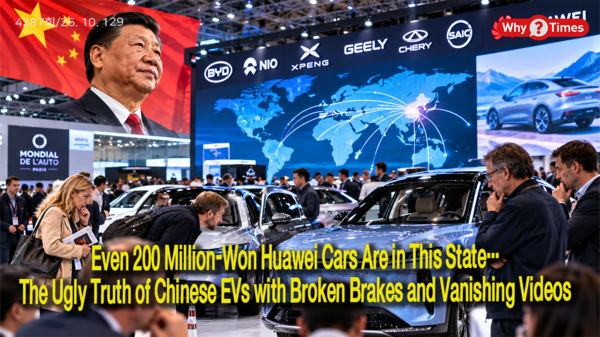
[The Ugly Truth of Huawei’s Flagship Car… All Three Vehicles Damaged in the Same Spot]
As China sweeps the global automotive market, a shocking safety issue has emerged from Huawei's 200 million-won (approx. $140,000) luxury vehicle, a symbol of its technological rise. Brake pedal supports on all three vehicles subjected to emergency braking tests fractured in nearly identical locations. While the manufacturer countered that it was a non-standard extreme test, it nevertheless promised parts improvements, and controversies surrounding the disappearance of test videos have further eroded consumer trust. Meanwhile, even the Chinese government has stepped up regulations to curb hasty new car development and insufficient safety verification, placing China's automotive industry growth model under the spotlight.
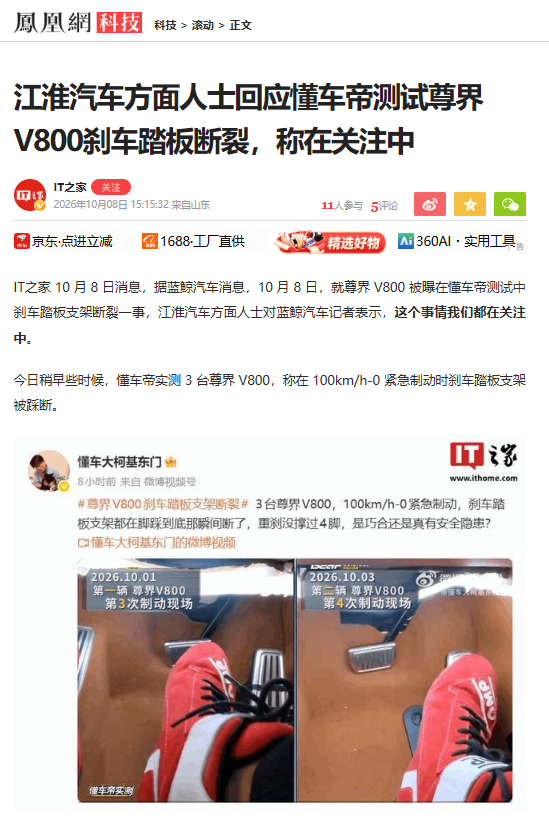
China's prominent portal and news media platform ifeng.com reported on the 8th that “the Chinese automotive specialized platform Dongchedi released a video of an emergency braking test conducted at 100 km/h on three Maestro (尊界·쭌제) V800 vehicles—ultra-luxury multi-purpose vehicles (MPVs) jointly developed by Huawei's smart car alliance Harmony Intelligent Mobility Alliance (HIMA) and Jianghuai Automobile (JAC), with top-tier models priced around 1.016 million yuan (approx. 203.98 million KRW).” The report stated, “The test results were shocking: when repeated emergency braking tests were run from 100 km/h, the component supporting the brake pedal fractured on the third braking attempt for the first vehicle and on the fourth attempt for the second vehicle.” ifeng.com added, “Even on a third vehicle purchased by the test team to re-verify, the exact same issue occurred on the second emergency braking, with all three vehicles fracturing in similar locations.”
If a problem occurred in just a single vehicle, it could be dismissed as a random defect. However, when the exact same issue repeats across three vehicles, the narrative changes. Indeed, Dongchedi noted that while it has tested over 2,000 vehicles since 2019, this was the first time it had witnessed brake pedal supports fracturing in such a manner. This raised questions as to whether the issue stems from a design flaw rather than a simple defective batch.
[What Happens When a Brake Breaks?… Stopping Distance Increases by More Than 100 Meters]
Even more concerning is the situation after the component fractures. According to the test team, while a normal vehicle stops in about 38 meters, relying on emergency braking functions after the brake pedal broke required approximately 140 meters to come to a halt—a distance over 100 meters longer. While this result occurred under specific test conditions, it could lead to severe hazards if an emergency arises on a highway.
The manufacturer argued that the test was far harsher than ordinary driving conditions. The testing side countered that the actual force applied was not at an abnormal level. However, what matters to everyday consumers is not complex numerical debates: it is whether a car can stop safely when a driver slams on the brakes in a moment of danger.
[“Why Change Parts If There Is “No Problem”?… Huawei's Contradictory Response]
According to Beijing Daily, the Maestro team released an official statement following the release of the test video. It claimed that its braking system was verified against safety standards and that no similar issues had been reported during actual driving operations, categorizing the test as a "non-standard extreme test." Simultaneously, however, it announced plans to improve the brake pedal support component and provide free replacements to existing customers.
Naturally, this leaves consumers questioning: if there is no problem with safety, why change the parts? Of course, preventive improvements do not necessarily mean admitting a defect. Yet when the exact same problem repeats across three vehicles, the manufacturer should go beyond criticizing the testing methodology and disclose the precise cause and details of the improvements.
Huawei has long flaunted China's automotive technological prowess by highlighting artificial intelligence and advanced driver-assistance technologies. Yet the most crucial attribute of an automobile is not flashy high-tech features, but its ability to stop reliably when the driver steps on the brakes in a crisis. No matter how brilliant the onboard AI, if trust in basic safety devices is shaken, the value of advanced technology inevitably fades.
[Plummeting Stock Prices and Vanishing Videos… Chinese Consumer Distrust]
Market reaction was immediate. Shares of Jianghuai Automobile plummeted by the daily limit on the 8th, the day the test video was released, and continued to drop sharply the following day. According to Chinese media reports, approximately 11.8 billion yuan (approx. 2.3 trillion KRW) in market capitalization evaporated over two days. Of course, the stock decline cannot be attributed solely to this single incident.
Even more noteworthy is the controversy surrounding the accessibility of the test video. According to Chinese media outlet Husu, Dongchedi’s test video became difficult to view normally across several video platforms. Although an official social media account for the Xinjiang Uyghur Autonomous Region government published a post criticizing the manufacturer's response, subsequent reports indicated that the post became difficult to find as well.
Admittedly, no direct evidence has confirmed that Huawei or Chinese authorities ordered the deletion of the videos. Yet when doubts regarding safety are raised, making it difficult for consumers to freely verify crucial test results inevitably deepens distrust. The best way to prove automotive safety is not by suppressing criticism, but by making objective test results transparent.
[Chinese Government Also Applies Brakes… The Dangers of 'Fast Building and Fast Selling']
A notable element in this incident is the actions of the Chinese government. Reuters reported on the 10th that “Chinese authorities have unveiled new regulatory proposals to strengthen vehicle development and safety verification.” The measures stipulate that “more detailed test data will be required for automobiles adopting new technologies, and supervision over designs that could impact safety will be intensified.”
Of course, these new regulations were not drafted solely because of the Huawei incident. Nevertheless, it is clear that concerns regarding China's automotive industry growth model are mounting. Chinese automakers have shaken global automotive markets through short development cycles, rapid new car rollouts, and aggressive price cuts. Yet a car is not a smartphone. A minor bug in a smartphone may result in inconvenience, but a minor defect in a car can threaten human lives.
The Chinese government has long nurtured electric vehicles as a strategic national industry. Through massive policy support and fierce corporate competition, China has risen to become the world's largest automotive producer and exporter. However, whether a rapidly grown industry has secured an equivalent level of competitiveness in safety and quality control remains to be verified independently. This incident poses precisely that question.
[Xi Jinping's Automotive Rise… The Greatest Barrier in the Global Market Is Trust]
The expansion of Chinese automobiles into global markets continues at a rapid pace. Reuters reported on the 9th that “20 Chinese automotive brands participating in the Paris Motor Show are exerting significant pressure on European automakers.” Chinese firms are targeting European consumers with affordable pricing, a wide variety of new models, and cutting-edge features.
However, long-term success in overseas markets requires more than just low prices. An automobile is a product to which people entrust their family's lives for years after purchase. Consumers value safety, durability, and a manufacturer's accountability when problems arise just as much as high-tech features.
If Chinese automakers secure this trust, they can compete effectively in global markets. Conversely, if safety controversies recur and information transparency remains murky, no matter how inexpensive or flashy a car is, winning consumer hearts will prove difficult.
[Why Times Insight | More Dangerous Than Brakes Is China's 'Speed Race Without Verification']
The brake fracture controversy involving Huawei’s luxury vehicle is not merely a quality issue. It poses a fundamental question: has the technological rise that China has touted as a source of national pride truly secured commensurate safety and reliability?
First, the excessive speed race of China's automotive industry is problematic. Chinese firms have succeeded in launching new cars faster and lowering prices compared to competitors. However, safety cannot be rushed by cutting corners on time. If products are released without sufficient testing and verification, the price will ultimately be paid by consumers. That said, whether actual verification was lacking in the development process of this specific vehicle requires further investigation.
Second, a culture of acknowledging mistakes and rectifying them when problems arise is crucial. If test results reveal flaws, manufacturers can counter with more rigorous testing. However, when safety controversies flare up and even the accessibility of related videos becomes problematic, consumer suspicions inevitably deepen. If an environment exists where criticism is suppressed to protect corporations, it will ultimately undermine the competitiveness of the entire industry.
Third, there is the fundamental limit facing Xi Jinping's industrial policy. China grew into an automotive powerhouse through massive support and rapid production expansion. Yet government support for corporations and inflated output figures do not automatically create world-class luxury products. Quality recognized by global consumers stems from independent verification, transparent information disclosure, and a responsible corporate culture that corrects errors.
Of course, the issue with a single Huawei vehicle model cannot be generalized as a defect across all Chinese cars. Nevertheless, the warning delivered by this incident is by no means light.
The highest barrier facing Xi Jinping’s automotive rise may not be U.S. tariffs or European regulations. It is whether consumers can trust that car when they slam on the brakes in a moment of danger—that exact trust will determine the future of China's automotive industry.

-중국 푸단대학교 한국연구원 객좌교수
-전 EDUIN News 대표
-전 OUR NEWS 대표
-제17대 대통령직인수위원회 정책기획팀장
-전 대통령실 홍보기획비서관
-사단법인 한국가정상담연구소 이사장
-저서: 북한급변사태와 한반도통일, 2012 다시우파다, 선거마케팅, 한국의 정치광고, 국회의원 선거매뉴얼 등 50여권