Update2026.10.24 (토)

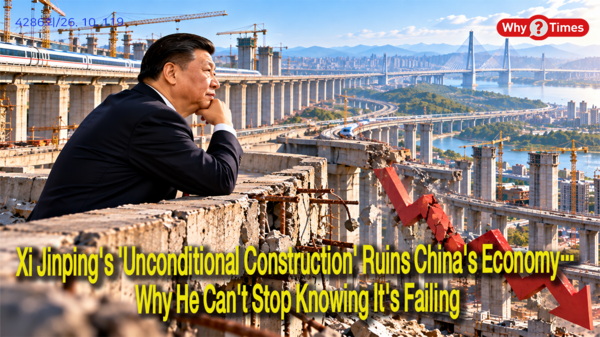
[A Debt Pile of 20 Trillion Yuan… China's 'Infrastructure Success Myth' Is Shaking]
While analysis indicates that debts accumulated across China's three major transportation infrastructures—expressways, railways, and urban subways—have reached around 20 trillion yuan, the Xi Jinping leadership is instead pushing forward with plans to expand the high-speed rail network to 60,000 kilometers by 2030. Even as the real estate slump and local government fiscal crises undermine the profitability of existing infrastructure, why can't China stop building? Behind this lies a web of economic necessities to prop up growth rates, local officials' political interests, and a political structure within the Chinese Communist Party (CCP) that makes it difficult to easily modify top leadership policies.
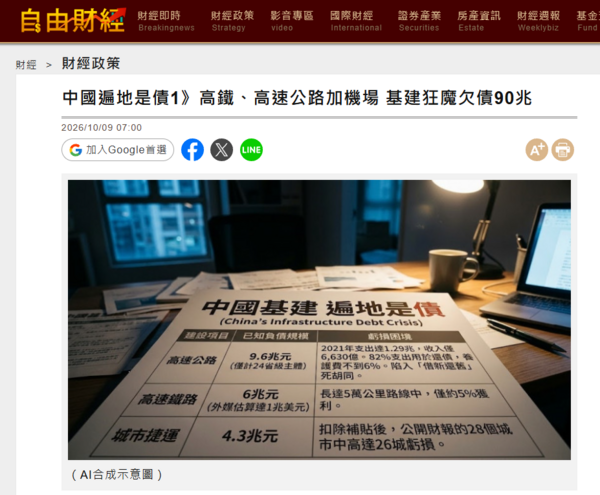
Taiwan’s Liberty Times reported on October 9 that “debts accumulated across China's three major transportation infrastructures—expressways, railways, and urban subways—stand at approximately 20 trillion yuan, a figure combining 9.6 trillion yuan in debt from provincial toll-road operating agencies, over 6 trillion yuan in railway sector debt, and 4.3 trillion yuan in urban rail transit debt.” The outlet caught attention by noting that “China's long-vaunted nickname, ‘Infrastructure Madman’ (基建狂魔), is now turning into an expression symbolizing massive debt burdens.”
According to official 2011 statistics from China's Ministry of Transport, national toll road revenue reached 663 billion yuan, but total expenditures soared to 1.2909 trillion yuan. Roughly 82% of expenditures went toward principal and interest repayments, while road maintenance accounted for less than 6%. However, the difference between total expenditures (including principal repayment) and toll revenue cannot be directly equated to an operating loss. Nonetheless, the massive financial burden undertaken to build and operate roads is undeniable. The reason for citing 2011 statistics is that as these staggering realities came to light, the publication of such data was halted.
High-speed railways present a similar picture. According to reports by Caixin, China's high-speed rail network exceeded 50,400 kilometers by the end of 2025, yet the China State Railway Group carries colossal debt. Some regional lines face profitability controversies due to a lack of passengers. Urban subways are also seeing their reliance on government subsidies and real estate development profits shake. In particular, Shenzhen Metro Group recorded massive losses due to impairment losses related to its investment in real estate firm Vanke. While this must be distinguished from the operational deficits of train services itself, it highlights the vulnerability of a business model combining subways with real estate development.
[Yet They Keep Building… High-Speed Rail to Reach 60,000 Kilometers by 2030]
Even more noteworthy is the fact that China continues to expand construction despite these debt burdens. According to the China State Railway Group, railway fixed-asset investment in 2025 hit a record high of 901.5 billion yuan. Newly opened lines totaled 3,109 kilometers, of which 2,862 kilometers were high-speed rail. China plans to expand its high-speed rail network to about 60,000 kilometers by 2030—an expansion of roughly 19% compared to the present.
Of course, building high-speed rail and expressways is not inherently wrong. The problem lies in who will bear the cost and how, especially when investments are expanded into regions lacking sufficient economic demand. To understand why China cannot stop such construction, one must look not at the profit and loss of individual railway projects, but at the CCP's state-governance model.
[Reason ① The Easiest Tool to Generate Economic Growth Rate]
The first reason is growth rate. China's growth momentum is weakening due to the real estate slump and sluggish consumption. In this situation, public infrastructure investment serves as a stimulus tool that the government can easily direct. Constructing railways and roads generates demand for steel, cement, and machinery industries while boosting construction employment. Through this process, economic value-added is created, lifting short-term growth rates.
However, the problem arises post-completion. Railways with low passenger counts and roads with low traffic volumes make recovering investment costs difficult, leaving behind constant maintenance expenses and interest burdens. Criticizing China's past railway expansion policy, Beijing Jiaotong University Professor Zhao Jian pointed out that “the government prioritizes growth rates and fails to adequately consider debt repayment burdens.”
[Reason ② 'Political Achievement Projects' for Cadre Promotions]
The second reason is political competition among local government officials. For local Chinese officials, large-scale infrastructure construction is a signature initiative to showcase administrative capability and policy implementation performance. While the opening of high-speed rail lines and mega-bridges creates visible achievements, decades-long debt obligations are left as a burden on successors and local finances.
According to the South China Morning Post (SCMP), the Chinese State Council already cautioned against local governments' 'blind competition' in high-speed rail construction back in 2021, restricting reckless projects exceeding fiscal capacities. The fact that the central government issued such warnings itself demonstrates how severe local government overinvestment is. The issue is that despite these warnings, incentives prioritizing visible construction performance do not easily disappear.
[Reason ③ Collapse of Land Finance… Borrowing More to Pay Off Old Debts]
The third reason lies in the fiscal structure of local governments. Local governments in China long funded infrastructure construction through the sale of land-use rights and real estate development. They raised funds via Local Government Financing Vehicles (LGFVs), built roads and railways, and recovered investment costs through surrounding property development. However, as the real estate market entered a prolonged slump, this structure collapsed. Land sales revenue declined, but the principal and interest repayment burdens from past projects remained intact.
The IMF analyzed in a September 25 report that debt held by local governments and LGFVs will reach approximately 90% of GDP by the end of 2025. As local governments' fiscal capacity weakens, their ability to respond to new economic crises is also restricted. Consequently, local governments should scale back new investments, but abruptly halting projects reduces work for construction firms and related companies, further worsening regional economies. They are trapped in a structural dilemma where both continuing construction and stopping it cause severe problems.
[Reason ④ Off-Balance-Sheet Debt… Buying Time Instead of Solving Problems]
The fourth reason relates to complex debt structures and debt restructuring methods. Aside from official local government bonds, Chinese local governments have raised massive funds through LGFVs. Consequently, a significant gap exists between official government 'hidden debt' and broad LGFV debt estimated by financial institutions and research organizations.
Beijing is pursuing restructuring by issuing special bonds and debt swaps to convert high-interest debt into low-interest, long-term debt. While this helps reduce immediate default risks, it provides no fundamental solution unless the profitability of the projects themselves improves. The IMF likewise pointed out that China's local government debt issues could threaten macroeconomic financial stability, calling for fiscal reforms and substantive debt restructuring rather than simple maturity extensions. Ultimately, this risks repeating the pattern of postponing the time debts must be paid instead of creating the capacity to pay them.
[Reason ⑤ The CCP's Face… Politics Takes Precedence Over Economics]
The fifth and most fundamental reason is the legitimacy of the CCP's rule. For a long time, the CCP has touted high-speed rail, expressways, and mega-bridges as symbols of national development. The sight of railways connecting remote areas and the construction of the world's longest bridges served as powerful propaganda tools demonstrating the party's governing competence to the public. To be sure, these construction projects genuinely contributed to advancing China's industrialization and regional connectivity. However, when the stage of economic development changes, investment policies must change too.
At a stage where a substantial transportation network is already established and population decline coupled with local fiscal deterioration is underway, how efficiently existing facilities are operated matters far more than how many new facilities are built. Yet under the Xi Jinping regime, another issue emerges: power concentrated in the top leader and the difficulty of modifying policies.
[The Bill for Construction Ultimately Falls on Chinese Enterprises and Citizens]
The side effects of infrastructure construction do not stay confined to local government and state-owned enterprise (SOE) balance sheets. Liberty Times reported on the September 9 analysis of financial data from China's top five infrastructure SOEs for the first half of 2026, revealing that their total accounts payable reached 3.36 trillion yuan. Large enterprises such as China State Construction Engineering, China Railway Group, China Railway Construction Corporation, China Communications Construction Company, and Metallurgical Corporation of China are saddled with massive amounts owed to subcontractors.
When payment delays by large SOEs become prolonged, weaker subcontractors and small-to-medium enterprises are squeezed first. This can have negative knock-on effects on wage payouts, employment, and private consumption. Yet, the Chinese government is simultaneously tightening debt curbs and local government fiscal reforms while expanding new construction investments.
In fact, Reuters reported on October 9 that “the government has decided to utilize 550 billion yuan in unused government debt limits to defend growth targets, allocating 250 billion yuan of it to infrastructure investment.” It is a scene of once again relying on construction investment to prop up the economy.
[Why Times Insight | Why Can't Xi Jinping's China Turn Away From the Path of Ruin?]
The most serious problem exposed by China's infrastructure construction addiction is not the scale of debt itself. It is the rigidity of a political system that fails to easily abandon past formulas for success even when the economic environment has completely transformed. Even before Xi Jinping came to power, China utilized massive infrastructure investment as an engine of growth. However, circumstances then and now are different. During a period of rapid urbanization and real estate development, new roads and railways could generate economic demand. Today, by contrast, population decline, the real estate slump, and local fiscal crises are unfolding simultaneously. This means past growth drivers can turn into causes that amplify debt burdens.
Even so, China cannot easily change direction. Halting construction causes growth rates to drop, shrinks local government project performance, and dries up work for SOEs. The finances of LGFVs that borrowed for existing projects could deteriorate further. Continuing construction swells debt, but stopping it requires enduring substantial economic shocks at the very moment of suspension.
Furthermore, Xi Jinping's centralization of power complicates matters further. In an environment where challenging the top leadership's policy direction is difficult, faithful execution risks becoming a more important evaluation criterion than economic feasibility. If the ability to push through existing policies is valued over the ability to correct flawed ones, the entire economy gets trapped in policy inertia.
The more fundamental issue is the legitimacy of the CCP's rule. The CCP has paraded high-speed rail and expressways as symbols of national development. However, a nation's true competitiveness stems not from the length of its railways or the scale of its bridges, but from citizen income, employment, corporate productivity, and fiscal soundness.
What Xi Jinping needs now is not new high-speed rail lines, but the political resolve to overhaul an outdated growth model. Yet whether such change is possible within a system where the top leader's judgment cannot be openly scrutinized and corrected remains uncertain.
Ultimately, the greatest crisis facing Xi Jinping's China is not merely a shortage of money. It is the reality that a political structure whose capacity to acknowledge and correct flawed policies has withered is threatening the future of China's economy. If roads and railways keep multiplying without a corresponding improvement in people's lives, the construction achievements boasted by the CCP may instead turn into evidence of governance failure.


-중국 푸단대학교 한국연구원 객좌교수
-전 EDUIN News 대표
-전 OUR NEWS 대표
-제17대 대통령직인수위원회 정책기획팀장
-전 대통령실 홍보기획비서관
-사단법인 한국가정상담연구소 이사장
-저서: 북한급변사태와 한반도통일, 2012 다시우파다, 선거마케팅, 한국의 정치광고, 국회의원 선거매뉴얼 등 50여권