Update2026.10.24 (토)


[The U.S. Hit the C919 Exactly Where It Hurts Most]
The most vulnerable point of China’s "homegrown passenger jet," the C919—hyped as a direct challenger to Boeing and Airbus—has been exposed once again. As the United States slows down export licenses for civil aviation components bound for China and makes it increasingly difficult for state-owned Commercial Aircraft Corporation of China (COMAC) to stockpile parts, C919 mass production schedules, which were already falling far short of targets, have hit another major alarm.
However, the core issue of this crisis extends beyond a simple shortage of parts. It lies in the fact that China’s "illusion of aviation self-reliance"—which effectively treated the capability to design and assemble a finished aircraft as equivalent to maintaining an independent, proprietary edge over core technologies like engines, avionics, and hydraulics, as well as their supply chains—was completely laid bare by a single stroke of U.S. pressure.
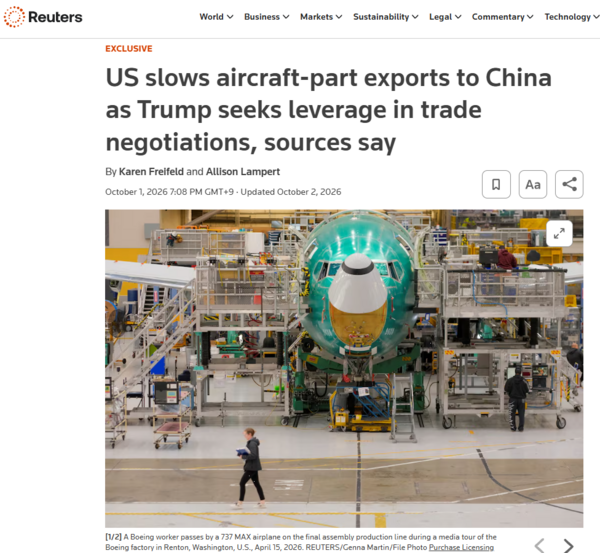
On October 1 (local time), Reuters reported that "the Trump administration has in recent weeks slowed the processing of export licenses for civil aviation parts bound for China," noting that "the objective is clear: to enhance U.S. leverage in upcoming trade negotiations with Beijing."
Reuters further pointed out that "what Washington is specifically targeting is COMAC's stockpiling of components, restricting approvals to prevent COMAC from hoarding parts ahead of future regulatory moves, while aviation hydraulic fluids and landing gear are also being cited as pressure points." In response to Beijing’s controls on rare earth metals, Washington has begun leveraging its dominant position in the civil aviation supply chain as a critical choke point against China.
The following day, Hong Kong’s South China Morning Post (SCMP) analyzed that "this measure could pose another severe bottleneck for C919 production." The reason is straightforward: "A significant portion of the core components currently going into the C919 cannot easily be replaced by other suppliers in the short term." In effect, without having to directly sanction the C919, the U.S. can exert intense pressure on China’s prized "aviation rise" simply by controlling the flow rate at the component faucet.
[Why Can the U.S. Rattle a 'Chinese-Made Passenger Jet'?]
It is precisely at this junction that the structural vulnerabilities of the C919 come into view. To be sure, the C919 was developed by China and undergoes final assembly in Shanghai; it even successfully launched commercial flights in 2023. Therefore, there is no need to deny the fact that China has acquired the capability to design and produce large civil airliners.
However, a look inside the aircraft tells a completely different story. Its vital heart, the LEAP-1C engine, is supplied by CFM International—a joint venture between GE Aerospace of the United States and Safran of France. Beyond the engine, American and Western technology and products are deeply embedded across major systems, including avionics, flight controls, and hydraulics.
In fact, just last year, when China restricted exports of critical minerals to the United States, Washington halted sales of certain key technologies to COMAC, including jet-engine-related expertise. At the time, the U.S. Department of Commerce stated that it was reviewing strategically sensitive exports to China, revoking some existing licenses or imposing additional licensing requirements. Reuters explicitly highlighted then that China had yet to secure a suitable indigenous airliner engine and remained dependent on imports.
[‘Made in China’ Proved to Be Entirely Different from ‘China Technology’]
Here lies the biggest fallacy Beijing committed regarding the C919: being able to conduct final assembly of an aircraft in China and being able to continuously manufacture that aircraft using exclusively Chinese technology are entirely different matters.
For decades, Chinese manufacturing grew by importing foreign technologies and equipment, then leveraging its massive domestic market and high-volume production to narrow technology gaps and gradually raise domestic content ratios. This strategy achieved remarkable success in electric vehicles, batteries, and solar energy. Civil aviation, however, is a different beast entirely.
Aviation is not an industry where mastering a component’s architecture and manufacturing a similar clone marks the end of the line. An engine, in particular, cannot simply be installed on a passenger jet carrying hundreds of lives just because it generates thrust and fuel efficiency. It demands thousands to tens of thousands of hours of testing, durability validation, airworthiness certification, establishment of maintenance ecosystems, parts lifecycle management, quality control, and the accumulation of operational reliability in real-world flights.
A massive technological wall sits between "we can build it" and "we can fly it safely for decades." This was precisely the parameter Beijing underestimated during the development of the C919.
[Over 1,000 Orders Received… Yet Only 15 Delivered Last Year]
The gulf between the ambitions of China’s aviation rise and harsh reality is most evident in its production figures. According to SCMP’s latest analysis, the C919 suffered severe production delays last year, resulting in actual deliveries reaching a meager 15 aircraft. Given the massive backlog of orders accumulated primarily from Chinese airlines, this indicates that manufacturing capacity is failing to keep pace with demand growth.
More importantly, this production slump cannot be blamed on the recent U.S. export restrictions. Washington’s slowdown of export license processing is a development of recent weeks, whereas operational disruptions in C919 production have been persistent long before that. The U.S. did not create the C919's weakness; rather, it accurately identified an already existing vulnerability in China’s aviation production and supply chain and began employing it as tactical negotiation leverage.
The true competitiveness of an aviation industry is judged not by whether an aircraft completes its maiden flight, but by whether it can consistently roll out dozens of identical, high-quality jets month after month. On this front, a substantial gap still separates COMAC from the likes of Boeing and Airbus.
[Vowing to Catch Boeing and Airbus… Only to Hit the Higher Wall of the Global Market]
Volume is not the only hurdle facing the C919. China’s original motivation for developing the aircraft was never merely to dominate its domestic routes, but to challenge Boeing and Airbus, the duo that duopolizes the global commercial aircraft market. Entering the international market, however, requires far more than Chinese domestic certifications alone.
Reuters noted that "although COMAC worked to pursue European Union Aviation Safety Agency (EASA) certification for the C919 last year, the European certification process could take up to six years." At the time, COMAC presented a goal to ramp up C919 annual output to 200 units by 2029—a target that, even if achieved, represents less than a third of Airbus’s output during that same period.
While a few nations, such as Nigeria, have shown interest in C919 certification, the absence of approvals from Western regulatory bodies remains a formidable barrier to global expansion. In reporting Nigeria’s certification review last September, Reuters similarly pointed out the ongoing absence of Western regulatory approvals. In the end, Beijing must contend with a second structural wall: the gap between "building an airplane" and "building an airplane the world trusts and buys."
[Domestic Production of Chinese Engines?… That Is Where the Highest Wall Lies]
To be sure, Beijing is not oblivious to these vulnerabilities. China is accelerating efforts to replace Western-supplied components on the C919—including developing indigenous aero-engines—with domestic alternatives. As U.S. pressure intensifies, the pace of import substitution is likely to accelerate.
However, developing a new engine is a daunting task in itself, and even if an engine is successfully built and test-flown, the challenges do not end there. It must endure tens of thousands of takeoffs and landings to prove durability, failure rates, maintenance cycles, component lifespans, and stability under extreme environments—building real-world trust through commercial service. Furthermore, domesticating a single engine does not equate to domesticating the entire C919. Countless interconnected systems—avionics, communications, navigation, flight controls, hydraulics, and advanced materials—must be replaced and certified simultaneously.
What Beijing faces right now is not the failure of a single isolated component, but the "technological ecosystem wall" built over decades by the global civil aviation industry centered around Boeing, Airbus, GE, and Safran.
[Why Times Insight | What China Miscalculated Was Not the ‘Airplane,’ but the ‘Tech Ecosystem’]
To view the C919 crisis as merely another episode in the U.S.-China trade war is to miss the core point. China did, in fact, develop, produce, and commercially operate the C919. But Beijing overestimated one critical assumption: the confidence that once final assembly and design capabilities were established, it would be only a matter of time before everything—from engines to avionics, flight controls, hydraulics, and materials—could be swapped out for Chinese substitutes.
Commercial aviation is far more than simple assembly manufacturing. It is a massive, living technological ecosystem where thousands of components, software, advanced materials, and engines must integrate seamlessly alongside airworthiness certifications, maintenance networks, quality control regimes, and decades of accumulated operational trust. It is precisely this "ecosystem wall" that China has slammed into. What makes this realization even more painful is that the C919 was touted as the paramount symbol of China’s "technological self-reliance."
Without resorting to a direct embargo on the C919, the United States is demonstrating its ability to inject acute uncertainty into Beijing’s production roadmap simply by modulating the velocity of component export licenses and curtailing COMAC's ability to stockpile parts ahead of time. In the final analysis, Washington did not engineer the C919's crisis; it simply identified the pre-existing weaknesses in China’s aviation technology, production, and supply chain, and began utilizing them as decisive leverage in trade negotiations.
It remains possible that China may eventually succeed in domesticating a substantial portion of these core technologies.
However, the real question is not simply: "Can China build an airplane?"
The real question is this: "Without critical Western technologies and components, can China build an independent aviation ecosystem capable of producing dozens of these airliners every month, operating them safely for decades, and convincing global airlines to buy them with confidence?"
Based on the reality demonstrated so far, the answer to that question remains a resounding "NO!" That is the most painful limitation of China’s "aviation rise" exposed by the C919.

-중국 푸단대학교 한국연구원 객좌교수
-전 EDUIN News 대표
-전 OUR NEWS 대표
-제17대 대통령직인수위원회 정책기획팀장
-전 대통령실 홍보기획비서관
-사단법인 한국가정상담연구소 이사장
-저서: 북한급변사태와 한반도통일, 2012 다시우파다, 선거마케팅, 한국의 정치광고, 국회의원 선거매뉴얼 등 50여권