Update2026.10.24 (토)

[Gwadar illustrates the dream and reality of Xi Jinping]
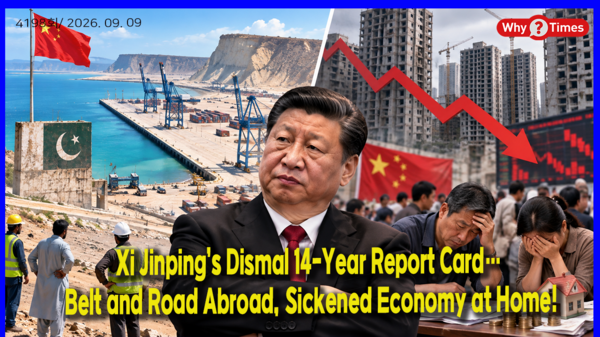
It has been approximately 14 years since Chinese President Xi Jinping took power. Two distinct scenes symbolically show where he has led China. Abroad, Gwadar—the central stronghold of the Belt and Road Initiative (BRI) launched as a springboard for global hegemony—is still searching for cargo volume and investors. At home, a prolonged real estate slump and weak domestic demand are weighing down the Chinese economy. The two wings Xi dreamed of—a China expanding outward and a China growing internally—are shaking simultaneously.
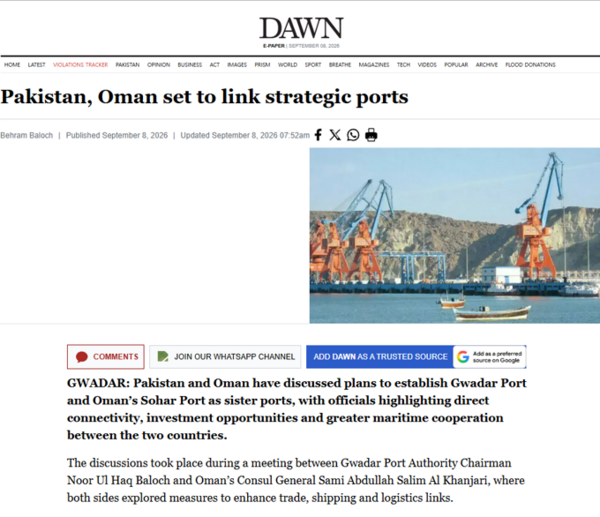
On September 8, Dawn, Pakistan's oldest and most influential major media outlet, reported: "After Xi Jinping introduced the Belt and Road Initiative (BRI) in 2013, China built the China-Pakistan Economic Corridor (CPEC) into a flagship project, and Gwadar drew attention as a strategic outlet running from western China through Pakistan to the Arabian Sea." It added, "The vision was that once China secured port operation rights and connected the port, highways, special economic zones, and an airport, Gwadar would transform into a massive logistics and industrial hub linking China to the Middle East and Africa. Chinese CPEC materials to this day define Gwadar as a key node of the 21st Century Maritime Silk Road and a regional economic hub, but after more than a decade of development, its report card is dismal."
Gwadar is not merely a Pakistani port. It is the birthplace and beating heart of the Belt and Road Initiative, presented as Xi's most representative legacy achievement. Yet despite President Xi investing vast amounts of capital and time into this priority project, Gwadar remains desolate today. Cargo volume is virtually non-existent, yielding negative results for Pakistan's economy as well.
Regarding this, Asia Times noted in July: "Strategic research data from the Pakistani government reveals Gwadar's shocking performance metrics. While Gwadar Port has an annual container handling capacity of 240,000 TEUs, its cumulative container traffic over the 19 years since operations began in 2007 totals a mere 4,789 TEUs." Asia Times continued, "The occupancy rate of its Free Trade Zone stands at just 1.2% out of a total 2,323 acres. While the master plan anticipated 38,140 jobs, fewer than 300 were actually created." It also pointed out, "Out of the $1.2 billion promised by the port operator, actual capital injected was around $250 million. These figures are not external estimates, but data reported by the Chairman of the Gwadar Port Authority to Pakistan's Minister for Planning and Development."
[The illusion that 'If you build the port, ships will come']
Even more painful is the point of comparison. The Pakistani government data introduced by Asia Times compared Gwadar with Morocco's Tanger-Med Port, which similarly started from a barren coastline. Asia Times noted, "Tanger-Med processed 10.2 million TEUs annually within 15 years and attracted over 1,100 export companies to its free trade zone. Conversely, Gwadar failed even to secure regular calling routes from major global shipping lines." It highlighted, "The primary factor was that while the port was built, the surrounding industries, businesses, rail and road networks, and reliable power and water supplies needed to sustain it failed to grow alongside it." The limitations of a state-led development model—assuming that building massive infrastructure first will cause industry and demand to follow—were exposed precisely at Gwadar.
[China and Pakistan try to revive Gwadar, but...]
China and Pakistan are not unaware of these issues. At the 9th CPEC Gwadar Working Group meeting held on August 28, discussions spanned not only the port, free trade zone, new international airport, and water facilities, but also new projects including a seafood landing site, a fishing port, and shipbuilding. The Pakistani government is also pushing for channel dredging and the modernization of cargo-handling facilities. The sister-port concept with Oman's Sohar Port announced on September 8 falls under the same context. Paradoxically, rather than expanding because Gwadar is already a successful hub, new network connections are continuously being attached in a bid to resurrect a hub that remains incomplete.
[As Gwadar falters abroad, real estate collapses within]
Xi's report card carries an even heavier weight because the problems are not confined to China's exterior. Reuters noted, "New home prices across 70 major Chinese cities fell 0.1% in July from the previous month and 3.2% from a year earlier," adding, "Out of the 70 cities, only 17 saw month-on-month gains in new home prices, while real estate sales, investment, and construction continued their weakness this year." Reuters pointed out, "The real estate market—which once simultaneously buoyed household wealth, local government finances, and construction investment—has turned from China's growth engine into a drag weighing on consumption and investment sentiment."
[Is deflation over? The numbers are not so simple]
Prices also require precise framing. China's National Bureau of Statistics stated, "July CPI rose 0.5% year-on-year while dropping 0.1% month-on-month, and core CPI rose 0.9% year-on-year. Thus, concluding that the entire Chinese economy is literally 'trapped in deflation' is inaccurate." Regarding this, Reuters commented, "However, considering falling real estate asset prices, weak consumer confidence, and fierce price competition among firms, it is difficult to say that internal deflationary pressures in China have been completely resolved. In particular, the fragility of the domestic demand sector continues to be evaluated as the Achilles' heel of the Chinese economy."
[Yet on September 8, Chinese exports surged 25%]
There is a figure that must be highlighted here. Reuters noted, "Today, on September 8, China's August export data showed a staggering 25% surge from the same month last year. Imports also rose 28.2%, expanding the trade surplus to $119.09 billion." It added, "Advanced manufactured goods such as semiconductors and electric vehicles drove export growth. Therefore, evaluating the Chinese economy as 'beyond recovery' or claiming all industries have collapsed contradicts facts; Chinese manufacturing and export competitiveness remain formidable."
Paradoxically, however, this export surge exposes another flaw in the Chinese economy. Reuters analyzed, "In contrast to robust exports, China's domestic demand remains fragile." It continued, "The automobile market presents an even more dramatic picture: August passenger car exports surged 77.5% year-on-year to 894,000 units, but domestic sales fell 23.7% to 1.55 million units, marking an 11-month consecutive decline. Overseas exports of EVs and plug-in hybrids surged 154.7%, whereas domestic sales contracted by 10.1%." Selling massively outward while consumers inside refuse to open their wallets—this is the most peculiar dual reality of the Chinese economy today.
[Gwadar and Chinese real estate: Strikingly similar]
This is where Gwadar and China's internal economic troubles intersect. Though thousands of kilometers apart, their underlying growth philosophy is strikingly similar: a state-led development approach that assumes building first, investing first, and pouring in massive state capital will inevitably attract demand and growth. At Gwadar, ports, airports, and roads were built first, but the expected industries, cargo, and jobs failed to follow. Inside China, massive construction of apartments, new cities, roads, and infrastructure drove rapid growth, but the bill has arrived in the form of a real estate slump and weak domestic demand. Placing Gwadar's 19-year track record side by side with the long-term decline in Chinese real estate makes this commonality even clearer.
[Xi Jinping's 14-year report card… Both wings are shaking]
Ultimately, the issue defining the Xi Jinping era is not merely a matter of growth percentages. Reuters noted, "Xi expected that deploying vast Chinese capital overseas to construct ports, railways, roads, and power plants would form a new China-centric economic zone. Domestically, he sought to sustain growth and employment through real estate, infrastructure, and manufacturing investments, using that economic power to compete with the US for global hegemony." It added, "However, Gwadar proved that 'simply building does not automatically create an economy,' while Chinese real estate demonstrated that 'investing does not mean growth lasts forever.'"
[Why Times Insight]
Gwadar Port is not merely a story about a single harbor in Pakistan. Zoom out on Gwadar, and the issues of the Belt and Road Initiative come into focus; turn that same development model inward, and the structural problems afflicting today's Chinese economy become visible. Built to serve as a foothold for global hegemony, Gwadar failed to create its expected commercial ecosystem over 19 years. Within China, the real estate and investment-driven growth model that supported the economy for so long is losing steam.
This does not mean one must conclude that the entire Belt and Road Initiative has completely failed or that the Chinese economy has collapsed. As demonstrated by the 25% export surge reported on September 8, China retains world-class manufacturing and export competitiveness. The problem is that this immense productive capacity fails to translate into consumer spending, asset value recovery, or sustainable domestic growth for its citizens. The power to push goods outward grows stronger, while the power to consume internally weakens. This imbalance is the core of the economic report card handed to Xi Jinping.
Thus, the question evaluating Xi Jinping's roughly 14-year tenure is not how many ports, airports, apartments, and roads China built, but whether that vast investment generated sustainable wealth, jobs, consumption, and influence. The 4,789 containers processed at Gwadar and its 1.2% Free Trade Zone occupancy rate represent an uncomfortable answer to that question. China's internal long-term real estate slump and weak domestic demand pose the exact same question.
Abroad, Gwadar—the symbol of the Belt and Road—must still hunt for cargo and investors; at home, real estate and domestic demand cannot recover their former growth momentum. While Xi Jinping dreamed the 'Chinese Dream,' his exam sheet approximately 14 years later clearly records heavy costs that cannot be explained by success alone. Gwadar serves as a symbolic snapshot encapsulating the report card of the Xi Jinping era.

-중국 푸단대학교 한국연구원 객좌교수
-전 EDUIN News 대표
-전 OUR NEWS 대표
-제17대 대통령직인수위원회 정책기획팀장
-전 대통령실 홍보기획비서관
-사단법인 한국가정상담연구소 이사장
-저서: 북한급변사태와 한반도통일, 2012 다시우파다, 선거마케팅, 한국의 정치광고, 국회의원 선거매뉴얼 등 50여권