Update2026.10.24 (토)

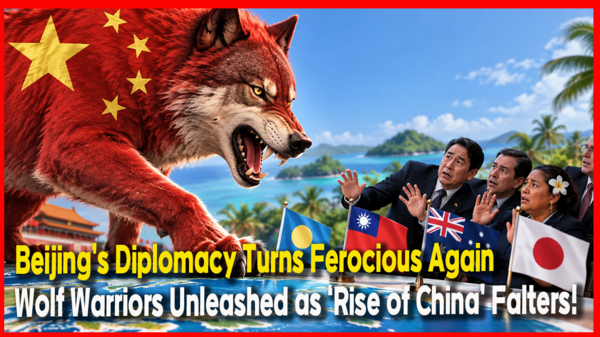
[A single line uttered in Palau… “There are always consequences”]
Chinese diplomacy is growing harsh once again. In Palau, Beijing publicly warned that “there will be consequences” over Taiwan’s participation in the Pacific Islands Forum (PIF). At the venue, controversy erupted over plainclothes personnel—suspected of being affiliated with China—photographing and monitoring attendees. To Australia, China dispatched Liu Jinsong as its new ambassador, a figure known for his tough image during bilateral friction with Japan. When a Japanese parliamentary delegation visited Beijing to improve ties, China pressured them instead to first change their position on the Taiwan issue. China’s "Wolf Warrior diplomacy," which seemed to have briefly retreated behind a mask of "smile diplomacy," is resurfacing at the forefront.
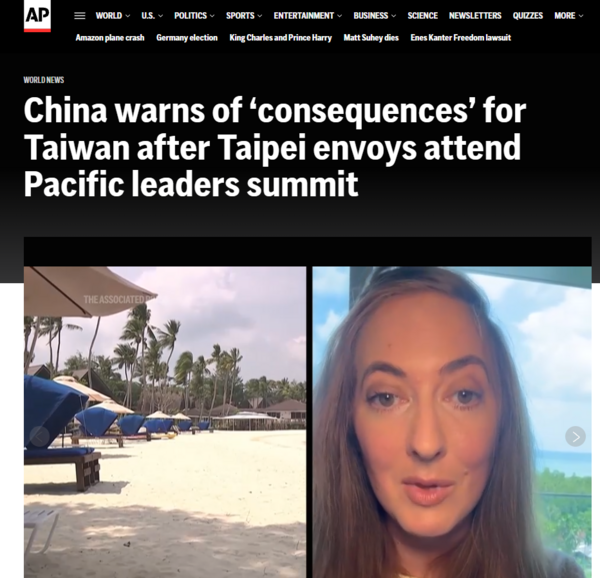
On September 3, the AP reported that "the venue of the Pacific Islands Forum (PIF) in Palau was the most symbolic manifestation of the recent return of China's Wolf Warrior diplomacy." It added, "Taiwan's Foreign Minister Lin Chia-lung directly criticized China's actions as 'Wolf Warrior diplomacy,' alleging that Chinese personnel engaged in intelligence-gathering at the PIF event. Claims were also raised that unidentified individuals photographed attendees at Taiwan-related side events."
While it has not been independently verified whether these individuals were Chinese government agents, the Taiwanese side raised issues over the plainclothes activities. Suspicions arose that these actions were intended not as mere diplomatic rhetoric, but as psychological pressure to convey the message: "We are watching you."
[China’s pressure in the Pacific triggers a counter-backlash]
However, China's heavy-handed tactics yielded unexpected results. Reuters reported, "At this year's PIF, China's July test-launch of an intercontinental ballistic missile toward the Pacific became a point of contention," adding, "Several Pacific nations demanded transparency and adherence to international norms, citing a lack of sufficient prior notification." In the very ocean where Beijing seeks to expand its influence, China's actions themselves became a source of security concern.
Reuters continued, "Furthermore, taking advantage of the PIF, the United States and Australia unveiled a combined $580 million support package for Pacific island nations," noting, "While China increases pressure using the Taiwan issue, the US and Australia are stepping into the breach with funding, infrastructure, and security cooperation." The more China pushes with brute force, the more it creates the paradox of pulling the US and Australia back into the Pacific.
[Why send Liu Jinsong to Australia of all places?]
Against this backdrop, China’s choice of Liu Jinsong as its new ambassador to Australia is noteworthy. Introducing Liu on August 28, the Australian Broadcasting Corporation (ABC) used the phrase "Wolf warrior?" right in its headline. ABC noted, "During his tenure as Director-General of Asian Affairs at China's Ministry of Foreign Affairs, Liu met with a senior Japanese Foreign Ministry official as Sino-Japanese tension escalated. Images of him confronting the Japanese representative with both hands in his pockets went viral."
What matters more than a single photograph is why Beijing assigned a diplomat with such a background and image to Australia at this juncture. ABC analyzed, "China officially announced Liu's arrival in Australia on August 24," pointing out, "China and Australia had managed to stabilize ties after years of trade retaliation and diplomatic clashes. Deploying a diplomat with a strong 'Wolf Warrior' image to Canberra at this moment serves as a signal that Beijing's future diplomacy toward Australia could move in a far more aggressive direction than before."
[Japanese lawmakers visited to improve ties… "Change your stance first"]
Beijing’s attitude toward Japan is even more direct. After then-Prime Minister Sanae Takaichi remarked last year that a Taiwan contingency could constitute a 'survival-threatening situation' for Japan, Sino-Japanese relations chilled rapidly. Xue Jian, China's Consul General in Osaka, went so far as to use extreme language on social media targeting Prime Minister Takaichi, suggesting 'severing a filthy neck.' The Royal United Services Institute (RUSI) evaluated this incident as a representative scene illustrating the return of China's 'Wolf Warriors' this year.
In response, three cross-party Japanese lawmakers headed to Beijing on August 24 in an attempt to thaw frozen relations. However, Liu Kang, Vice Minister of the International Department of the Chinese Communist Party, made it clear to the delegation, stating, "The root cause of the severe difficulties in Sino-Japanese relations is clear." He implied that unless Japan revises its stance on the Taiwan issue, China will not change its policy toward Japan. In essence, Beijing presented a pre-condition to a guest seeking dialogue: "Yield first if you want to resolve relations."
[China never abandoned Wolf Warrior diplomacy]
Why is China turning rough around the edges again? Regarding this, the diplomatic magazine The Diplomat analyzed in July, "To be precise, China never fully abandoned Wolf Warrior diplomacy," adding, "Rather than scrapping it, China shifted to using it far more selectively depending on the counterpart, the issue, and strategic objectives." In short, "It offers smiles to counterparts like the US with whom it has much to gain through negotiation, but reveals the face of a wolf at any moment when 'core interests' such as Taiwan, Japan, or the Pacific are at stake."
[A more crucial cause… Lies within, not without]
Interpreting the revival of Wolf Warrior diplomacy purely as a sign of Chinese confidence misses a crucial dimension. In January this year, the Royal United Services Institute (RUSI) analyzed, "The recent return of Wolf Warrior diplomacy reflects internal political pressures within China rather than external challenges." It explained, "Under the Xi Jinping regime, while the Foreign Ministry's autonomy has diminished, diplomats face stronger demands to align with the Party Central's line and 'dare to struggle.' Consequently, hawkish rhetoric itself functions as a mechanism to prove loyalty and combativeness to the leadership."
Academic research supports this view. A 2026 quantitative analysis of Chinese Foreign Ministry press conferences published in the Journal of Contemporary China noted, "Chinese diplomatic language shifted aggressively starting in July 2019, with the strongest explanatory variable being the Chinese Communist Party's tightened political intervention in the Foreign Ministry rather than nationalism or international conflict itself." This suggests that Wolf Warrior diplomacy is not an aberration by a few hot-headed diplomats, but a structural phenomenon manufactured by the diplomatic system under the Xi regime.
[The widening gap between propaganda of 'China’s Rise' and reality]
There is another contributing factor. The Financial Times (FT) pointed out, "The gap between the long-boasted image of a 'China equal to the US' and its actual capabilities acts as an important factor," noting, "While China's technological catch-up is real, it still relies on foreign technology for key components, and anxiety often stems from the realization that reaching the world's top level will take significant time."
Epoch AI, a research organization specializing in semiconductors, estimated in a report on September 4, "The gap is even more distinct in AI semiconductors, with Huawei's AI computing power output this year projected to reach less than 4% of Nvidia's." Epoch AI added, "If using only domestic Chinese HBM, the level will remain at roughly 1% even by 2028, and a performance gap of 3 to 4 years per individual chip is likely to persist through 2030." It analyzed, "It is not that China is failing to progress, but rather that political propaganda claiming 'equality with the US' has far outpaced technological reality."
Moreover, Huawei—the symbol of China's tech rise—is currently facing criminal trial in a US court over long-standing allegations of trade secret theft, sanctions evasion, and bank fraud. On September 7, the FT summarized this with the question: "Was Huawei's rise built on crime?" What is clear is that the very fact that the flagship firm of China's technological rise stands on trial in a US court over its growth process poses a substantial burden to Beijing's 'tech powerhouse' narrative.
[The fatal paradox of Wolf Warrior diplomacy… It can strike fear, but it cannot win respect]
The core question is whether Wolf Warrior diplomacy actually works. In a survey experiment conducted this year by a research team at Waseda University across South Korea, Japan, and Taiwan, public perception of China worsened among respondents exposed to Wolf Warrior-style messaging. The negative shift was particularly prominent and consistent in South Korea. The more aggressively China asserted its superiority, the less respect it commanded, stoking deeper hostility instead.
This is the fatal paradox of Wolf Warrior diplomacy. A true superpower compels others to seek reasons for cooperation on their own, without diplomats needing to snarl at every turn. Resorting to economic retaliation, warning of "consequences," and insulting foreign politicians whenever demands are unmet may display power, but it simultaneously confesses the limitations of persuasive power and soft power.
[Why Times Insight]
The essence of the shift unfolding in Chinese diplomacy is not a simple regression from "Panda diplomacy" to "Wolf Warrior diplomacy." It represents a more explicit "selective coercive diplomacy"—deploying pandas when necessary and unleashing wolf warriors when counterparts prove uncooperative. Behind this lie two simultaneous pressures: externally, strategic competition with the US, advanced technology gaps, and growing Western containment in the Pacific; internally, the centralization of power under the Xi Jinping regime and political pressure to become "struggling diplomats." Wolf Warrior diplomacy is re-emerging precisely at the intersection of these two pressures.
There is a famous quote attributed to John F. Kennedy:
"Domestic policy can only defeat us; foreign policy can kill us."
While this is a warning China should heed, it applies beyond Beijing alone. In diplomacy, coercing a counterpart into submission and earning their respect are fundamentally different matters. While threats may extract a single concession, repeated intimidation forces neighboring nations to view China not as a 'partner for cooperation,' but as a 'risk to prepare against.'
The moment Beijing warned of "consequences" in Palau, it threatened more than just Taiwan. It sent a message to all surrounding nations: "If you reject China's demands, you could be next."
That is the most dangerous self-defeating move inherent in Wolf Warrior diplomacy.
And this is precisely the lesson South Korea must draw from the failures of Chinese diplomacy. A nation's power is not measured solely by its ability to strike fear into others. Creating a country that others genuinely want to stand alongside—that is true national strength in diplomacy.
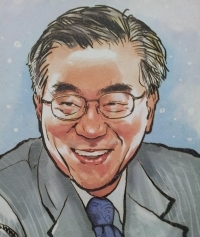
-중국 푸단대학교 한국연구원 객좌교수
-전 EDUIN News 대표
-전 OUR NEWS 대표
-제17대 대통령직인수위원회 정책기획팀장
-전 대통령실 홍보기획비서관
-사단법인 한국가정상담연구소 이사장
-저서: 북한급변사태와 한반도통일, 2012 다시우파다, 선거마케팅, 한국의 정치광고, 국회의원 선거매뉴얼 등 50여권