Update2026.10.24 (토)

[Epoch AI Poses a Shocking Question: "Can China Catch Up by 2030?"]
A major alarm has been raised for China's artificial intelligence (AI) and semiconductor self-reliance strategy—a sector where the Beijing regime has placed its high-stakes geopolitical bet to surpass the United States. The critical issue is not simply that China currently lags behind. Even if Huawei manages to nearly double its AI chip production, its total compute capacity gap compared to Nvidia will remain at approximately 25-fold. Furthermore, analysis indicates that the single-chip performance lag of 3 to 4 years will hardly narrow. Predictions even suggest that if forced to rely solely on domestically produced High Bandwidth Memory (HBM), Huawei's AI compute output through 2028 could remain at a mere 1% of Nvidia's.
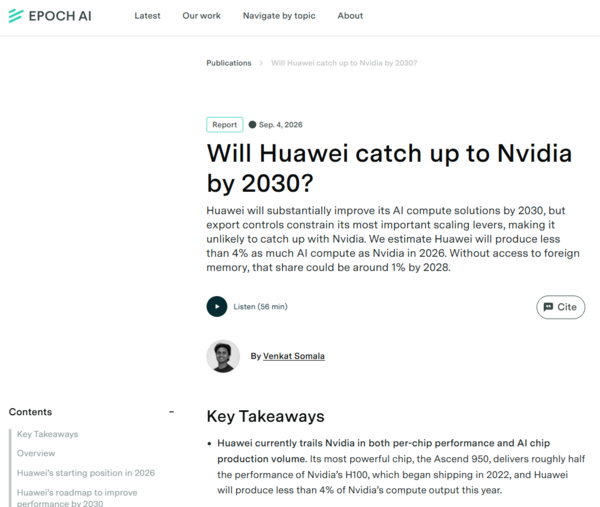
On September 4, the non-profit AI research organization Epoch AI published a report titled "Can Huawei Catch Up with Nvidia by 2030?" The conclusion was definitive: even if Huawei advances its AI computing technology significantly, U.S. export controls simultaneously restrict the key mechanisms needed to scale both performance and production volume, making it highly unlikely that Huawei can catch up to Nvidia by 2030. The report emphasized that when comparing Huawei’s public semiconductor roadmap with Nvidia’s future development plans, Huawei’s AI chips will remain at least 3 to 4 years behind Nvidia through at least 2030.
The real challenge for Beijing is not just the present margin of defeat, but the reality that as Huawei runs forward, Nvidia is accelerating at an even faster pace.
[880,000 vs. 23 Million: A Staggering 25-Fold Compute Gap]
Epoch AI’s projections for 2026 present a striking contrast. Huawei is estimated to have produced approximately 800,000 Ascend AI chips last year and is expected to expand output to roughly 1.5 million units this year. In terms of raw chip counts, this marks a near-doubling of production in a single year.
However, converting these figures into actual AI compute capacity measured in Nvidia H100-equivalent (H100e) terms paints a vastly different picture. Epoch AI estimates Huawei’s total 2026 compute production at approximately 880,000 H100e, whereas Nvidia is expected to reach roughly 23 million H100e.
While Huawei's physical chip production reaches roughly one-fourth of Nvidia's output volume, its theoretical AI compute output drops to merely 1/25th when individual chip performance is factored in. This led Epoch AI to conclude that Huawei's AI compute output in 2026 will account for less than 4% of Nvidia's total capacity. Furthermore, the report notes that the real-world performance gap may be even wider than theoretical metrics indicate, as Huawei's CANN software stack remains far less mature than Nvidia’s dominant CUDA ecosystem.
[The Terrifying "17.5x" Factor: Why the Technology Gap Is Widening]
Particularly troubling for Xi Jinping’s strategic ambitions is that the assumption of the performance gap naturally closing over time is unraveling. Epoch AI's analysis notes that the theoretical compute performance of Nvidia’s B300 is already roughly 7 times higher than Huawei's Ascend 950 series. As Nvidia transitions from its Blackwell platform to Rubin and subsequently to Rubin Ultra, the theoretical performance gap at a given point in time could expand to as much as 17.5-fold next year.
Huawei’s Ascend 970 is projected to reach performance levels comparable to Nvidia’s B200 only by late 2028. The core issue is that the B200 was launched in 2024. This means that where Huawei expects to be in 2028, Nvidia was already present in 2024. This underlying lag forms the basis for Epoch AI's assessment that Huawei will remain 3 to 4 years behind Nvidia through 2030.
[The Critical Bottleneck: Domestic HBM Dependencies Could Cap Output at 1% Through 2028]
An even greater hurdle lies in manufacturing and scaling. No matter how advanced a chip design Huawei creates, mass production requires not only advanced logic semiconductors but also vast supplies of HBM. Epoch AI identifies HBM availability as Huawei's most immediate production bottleneck. With access to state-of-the-art foreign HBM severely restricted by U.S. export controls, the consequences become far more acute if Huawei is forced to rely exclusively on Chinese domestic HBM supply chains to support Ascend production.
The report estimates that if restricted solely to Chinese-made HBM, Huawei’s AI compute production capacity could remain capped at approximately 1% of Nvidia's through 2028. While stockpiling, smuggling, or alternative memory architectures may offer marginal relief, Epoch AI concludes these workarounds cannot close the fundamental gap by 2030. U.S. semiconductor export controls have not halted China's AI industry, but they effectively restrict both critical engines needed for Huawei to close the distance: performance and volume.
[Huawei’s Paradox: Rising Production, Unchanging Relative Gap]
This situation highlights a central paradox in China’s AI drive. Huawei has not failed as an enterprise; despite severe U.S. sanctions, it has continued internal AI chip development and rapidly expanded production, backed by China’s domestic market and government support. If Huawei’s Ascend chip output reaches 1.5 million units this year as Epoch AI projects, it will represent a near 100% increase from the 800,000 units produced last year.
Yet, the total compute output gap with Nvidia remains at roughly 25-fold. This structural reality presents a major strategic hurdle for Beijing: China’s lag is not due to stagnation, but rather because the U.S. innovation cycle is progressing at a rate that prevents the gap from narrowing.
[2030: Beijing's Self-Imposed Deadline]
The 2030 timeline carries specific political weight. In 2017, China's State Council issued the "Next Generation Artificial Intelligence Development Plan," officially setting a target to reach a "world-leading level" across AI theory, technology, and application by 2030, establishing China as a primary global AI innovation center. The policy also aimed to elevate core AI industrial competitiveness to international leadership standards and expand the scale of the core AI industry beyond 1 trillion yuan. This benchmark stands as an official national strategic commitment.
Yet, with just four years remaining before the 2030 deadline, Huawei—the flagship of China’s semiconductor self-reliance—produces less than 4% of Nvidia’s compute capacity and is projected to remain 3 to 4 years behind in chip performance through 2030. Thus, the core question raised by Epoch AI's report extends beyond whether Huawei can surpass Nvidia; it directly questions whether China can meet its self-declared objective of becoming the world's leading AI power by 2030.
[Why Times Insight]
Interpreting this report as a definitive end to China’s AI industry would be inaccurate. Huawei continues to scale production, and Beijing is directing substantial national resources into domestic semiconductor and HBM localization. U.S. export controls have also incentivized domestic technology substitution within China. Nevertheless, progressing technology and closing a gap with the market leader remain two distinct challenges.
Even as Huawei’s Ascend production doubles, a 25-fold total compute gap with Nvidia remains. As Nvidia rolls out next-generation architectures, maintaining a 3-to-4-year performance lag through 2030 challenges the assumption that time alone will enable China to catch up. This bears directly on the technology self-reliance strategy driven by Xi Jinping ahead of the 2030 benchmark.
The key metric for Beijing extends beyond the 4% compute figure: it lies in the structural reality that despite full-scale domestic acceleration, the relative gap with the industry frontier remains substantial. This reality presents a major strategic consideration for China’s AI strategy and its 2030 objectives.


-중국 푸단대학교 한국연구원 객좌교수
-전 EDUIN News 대표
-전 OUR NEWS 대표
-제17대 대통령직인수위원회 정책기획팀장
-전 대통령실 홍보기획비서관
-사단법인 한국가정상담연구소 이사장
-저서: 북한급변사태와 한반도통일, 2012 다시우파다, 선거마케팅, 한국의 정치광고, 국회의원 선거매뉴얼 등 50여권