Update2026.10.24 (토)

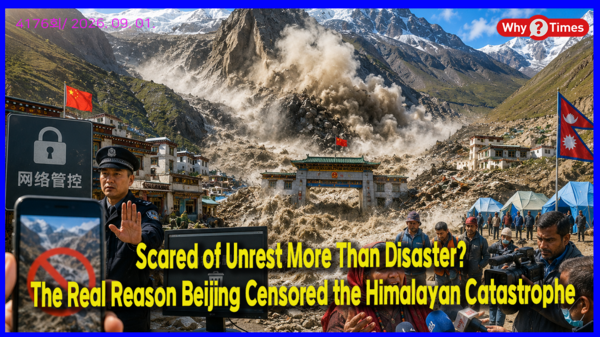
[First Thought to Be an Earthquake: Mountain and Glacier Collapses Unleashed Chaos]
A strange silence followed the catastrophic Himalayan disaster in Tibet. Video footage showing a massive torrent swallowing a border checkpoint briefly surfaced on Chinese social media before being scrubbed. Articles featuring local resident interviews published by Chinese outlets vanished within hours, while foreign journalists requesting entry into the affected zone were denied access. Yet across the border in Nepal, the situation was the exact opposite: victims' families spoke freely to reporters, and foreign media actively documented the devastation. Why are voices and footage being erased solely within Chinese Tibet? What drives Beijing to seal off a natural disaster site, and what makes the leadership enforce such stringent information control?
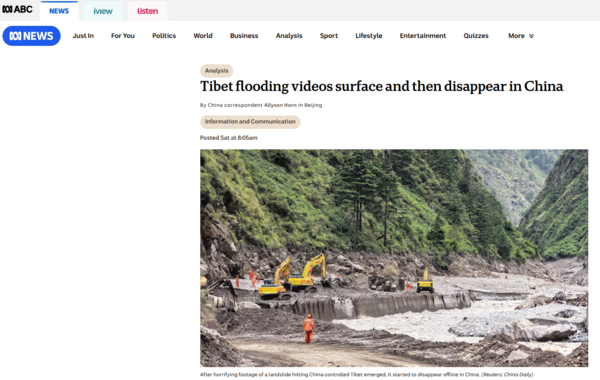
ABC News reported on August 31 that China was actively censoring information regarding the Tibetan landslide disaster while barring foreign journalists from conducting independent reporting. Consequently, establishing the true scope of the tragedy and the welfare of Tibetan residents has proven exceedingly difficult. Meanwhile, international media face no such restrictions in neighboring Nepal.
Scientific evidence indicates that the disaster was triggered by a massive collapse of glacial ice and rock in the Himalayas. However, how a government manages post-disaster information is a matter of political choice. This crisis illustrates how rapidly the Chinese Communist Party's (CCP) information control framework activates even in the face of major natural catastrophes.
[Online Footage Vanished Rapidly: A Peculiar Reality Inside China]
The initial response was highlighted by footage capturing the early moments of the disaster. The video depicted a torrent of ice, mud, and water sweeping across the China-Nepal border region, destroying buildings and vehicles as people fled. Outside China, the clip circulated widely as crucial documentation of the event.
Inside China, however, the footage quickly vanished. Reports noted that numerous posts and media reports detailing local damage were taken down within hours of publication. Beyond removing video content, authorities released minimal specific data regarding which villages sustained destruction or the identities of missing residents, even while acknowledging hundreds of missing individuals in Tibet.
[As Global Media Covered the Tragedy: CCTV's Top Story Featured Xi Jinping's New Book]
The difference in media coverage was stark. On the evening of August 27, while international news networks covered the Himalayan disaster as a top story, CCTV's flagship broadcast led with the release of President Xi Jinping's latest book.
The People's Daily similarly prioritized the book release on its front page the following morning, placing disaster coverage near the bottom with a focus on state recovery efforts, such as the restoration of an 800-meter stretch of road. While official media covered rescue operations and troop deployments, coverage omitted accounts of victim experiences or inquiries into why the damage was so extensive, shifting the focus from the victims to the state's crisis management response.
[A Striking Contrast Across the Border]
The contrast between the two sides of the border was sharp. The Nepalese government promptly published details regarding missing tourists and tour operators. Relatives spoke with reporters holding photographs of missing family members, and survivors recounted their experiences. Foreign correspondents, including teams from ABC, entered affected zones directly.
Across the border in Tibet, individual accounts were largely absent. It remained difficult to ascertain which villages were destroyed, who had lost family members, or how residents evaluated the government's response.
[Independent Journalism Blocked]
Foreign journalists faced complete restriction from independent reporting. Requests by international media outlets to visit the disaster zone in Tibet were rejected by Chinese authorities, who cited ruined infrastructure and secondary disaster risks.
While the physical risks at the site were undeniable, journalists routinely operate in high-risk zones globally, such as active conflict areas, wildfires, and disaster sites. In Nepal, reporters navigated broken infrastructure and ongoing landslide threats to cover the story, raising questions about why similar access was denied in Tibet.
[Restricted Communication for Local Residents]
Local residents also faced difficulties communicating outward. Foreign media access to Tibet has been heavily restricted since 2007, and local digital communications remain under close monitoring.
Advocacy groups noted that fear of official reprisal prevents residents from sharing information on social media, hindering organic assessments of where people might be trapped or which areas suffered the worst damage. In one instance, a relative of a construction worker in Tibet sought help from internet users outside China to confirm their family member's safety; satellite imagery later reviewed externally indicated that the construction site had been swept away by the floodwaters.
[Why Does Beijing Enforce Such Strict Censorship?]
The tight control over information reflects Tibet's position as a sensitive political region for the CCP, where matters involving governance, autonomy, and local stability are strictly managed.
In this context, a major disaster resulting in significant casualties poses political risks if public frustration over emergency preparedness or response spreads. For Beijing, unmonitored narratives surrounding the disaster are viewed as a potential catalyst for broader dissatisfaction. As a result, authorities prioritized controlling local coverage and restricting foreign media access.
[The Critical Question of Data Sharing]
The incident also highlights broader questions regarding transboundary data sharing. Prior to the disaster, Nepalese officials had requested more comprehensive hydrological and glacial data from China.
Nepal and China held discussions in Kathmandu in May regarding glacier monitoring and early warning coordination, with Nepal seeking timely updates on glacier movements and river changes originating on the Chinese side of the Himalayas. The rapid velocity of the collapse meant that any early warning window would have been extremely narrow, regardless of data flows; nevertheless, the disaster emphasizes the strategic importance of real-time data sharing for cross-border hazard management.
[Why Times Insight]
The post-disaster environment in Tibet illustrates how state-controlled narratives function during major crises. While open reporting and survivor accounts emerged from Nepal, information inside Tibet was replaced by official updates highlighting state recovery milestones.
Because Himalayan water systems cross national boundaries, natural hazards in the region inevitably carry international implications. Effective management of transboundary environmental risks depends on accessible hydrological data, transparent communication, and open reporting. The response to this disaster demonstrates that during major events, information access remains tightly regulated within the region.


-중국 푸단대학교 한국연구원 객좌교수
-전 EDUIN News 대표
-전 OUR NEWS 대표
-제17대 대통령직인수위원회 정책기획팀장
-전 대통령실 홍보기획비서관
-사단법인 한국가정상담연구소 이사장
-저서: 북한급변사태와 한반도통일, 2012 다시우파다, 선거마케팅, 한국의 정치광고, 국회의원 선거매뉴얼 등 50여권