Update2026.10.24 (토)

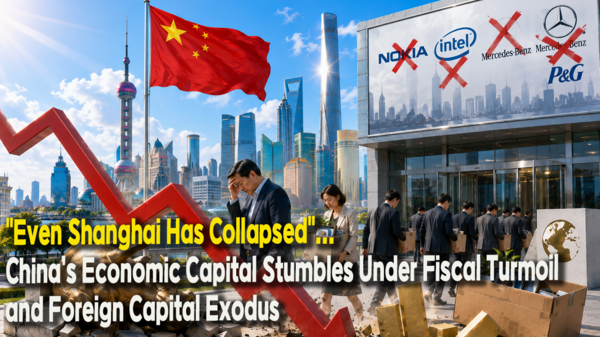
[Fiscal Self-Sufficiency Rate Plunges Below 100% for the First Time… Nokia and Others Pull Out]
Figures from China's Ministry of Finance reveal that all 31 provincial-level regions across the country, including Shanghai, failed to cover their expenditures with their own revenues alone, indicating that even the fiscal foundation of China's premier economic hub is shaking. The fiscal shift in Shanghai is nothing short of shocking. This demonstrates that the very groundwork of the Chinese economy is cracking, presenting a critical juncture that could potentially unsettle Xi Jinping's governance base.
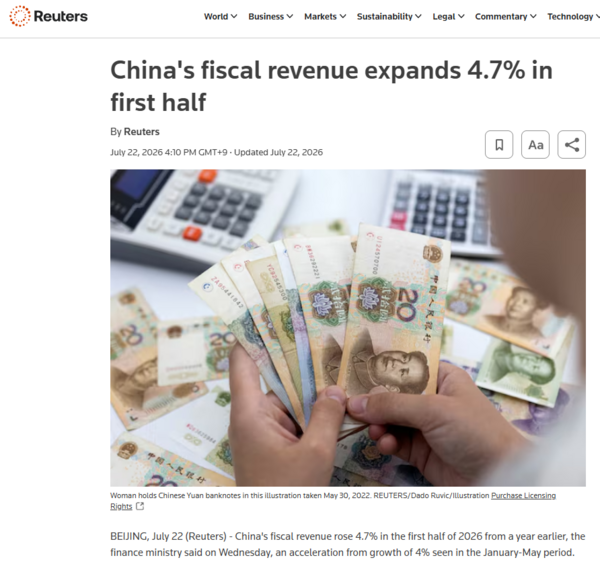
Reuters recently cited announcements from the Shanghai Municipal Finance Bureau, reporting that "an unusual alarm bell has been sounded across the fiscal system sustaining China’s local economies." Reuters noted, "The issue is no longer confined to impoverished inland provinces. Even Shanghai, hailed as the beating heart of the Chinese economy, failed to cover its expenditure scale with its own general public budget revenue in the first half of this year. Adding to this, land sale revenues—the vital cash cow for local governments—plummeted by over 30% once again, while global technology firms like Nokia are shuttering their R&D hubs in China. Warning signs are emerging simultaneously across all three pillars of the Chinese growth model: real estate, local finance, and foreign enterprises."
[All 31 Chinese Local Governments Recorded 'Higher Expenditures Than Revenues']
According to Reuters, a symbolic milestone was recorded in China's local finance during the first half of this year. An analysis comparing standalone general public budget revenues against general public budget expenditures across 31 provinces, autonomous regions, and municipalities revealed that not a single region generated internal revenues exceeding its expenditures, yielding a combined fiscal self-sufficiency rate of roughly 56.3%. This indicates a nationwide structural reality where local governments struggle to handle their current expenditure levels using locally collected resources alone.
Shanghai demands even closer attention. According to the Shanghai Municipal Finance Bureau, general public budget revenue in the first half stood at 494.33 billion yuan against expenditures of 530.21 billion yuan. A straightforward calculation yields a ratio of roughly 93.2%, leaving standalone revenue approximately 35.9 billion yuan short of expenditures. Even Shanghai—China’s largest economic powerhouse and traditional 'fiscal honor student'—saw its current standalone revenue fall behind its spending footprint.
However, caution is needed against immediately interpreting this figure as a total 'fiscal breakdown of Shanghai.' Shanghai’s standalone general public budget revenue in the first half actually grew by 5.5% year-on-year, while expenditures increased by 10.7%. The core of the issue is that even in Shanghai, one of China's economically strongest cities, the burden of fiscal expenditure is expanding at a faster pace than the growth rate of standalone fiscal revenue.
[The Real Bomb is 'Land Finance'… Local Governments’ Top Cash Cow Dries Up]
Regarding this issue, Reuters noted, "A more severe problem is the collapse of the so-called 'Land Finance' (土地財政) that sustained Chinese local governments for decades." Reuters explained, "Local governments secured massive fiscal resources by selling land-use rights to property developers, using those funds to construct infrastructure such as roads, subways, and new towns, which in turn drove up land prices—a self-sustaining growth model. However, as the real estate slump dragged on since 2021, this machinery began running in reverse."
The situation has grown even more acute this year. According to data from China's Ministry of Finance, revenues from the transfer of state-owned land-use rights plunged by 31.5% year-on-year to 977.8 billion yuan in the first half of 2026. Furthermore, 2.07 trillion yuan in local government special bonds were issued during the same period. Unless the property market recovers, local governments will find it increasingly unsustainable to bridge fiscal deficits by selling land as they did in the past.
This represents a blow to Chinese local finances far beyond simple tax revenue losses. Reuters highlighted, "This risks triggering a vicious cycle: real estate slump → falling land prices → declining land sales → deteriorating local government finances → reduced infrastructure investment → slowing regional economies." Reuters added, "Given the massive share that property and infrastructure investments have historically claimed in economic expansion, the erosion of land finance is a structural issue that destabilizes the Chinese economy's traditional growth equation itself." Indeed, China’s fixed-asset investment dropped by 6.7% year-on-year from January to July.
[Beijing Forced to Transfer Over 10 Trillion Yuan to Local Governments]
The sheer intensity of the fiscal pressure on local authorities is confirmed by the central government's response. The 2026 central-to-local transfer payment budget arranged by China's Ministry of Finance reached 10.415 trillion yuan, up 2.2% from last year's executed amount. Out of this total, general transfer payments alone account for 9.4779 trillion yuan.
In particular, the central government is stepping up support to help local governments maintain the so-called 'Three Guarantees' (三保): guaranteeing basic livelihoods, public sector wages, and basic administrative operations. This year, county-level basic fiscal guarantee support funds alone rose to 489.5 billion yuan, an increase of 10 billion yuan over last year. This highlights a persistent reality where Beijing must financially underwrite even the basic administrative and civic operations of local governments.
[To Make Matters Worse… Nokia Closes Its Largest R&D Center in China]
Compounding these fiscal woes is the scaling back of operations by global corporations in China. A prominent case is the Finnish telecommunications equipment maker Nokia. Nokia plans to close its large-scale research and development center in Hangzhou this year, a move expected to result in the loss of approximately 1,600 jobs. Nokia confirmed its closure plans to Light Reading, a U.S. B2B telecommunications outlet, stating, "Nokia's business in China has consistently declined over the past several years," and that it is "aligning its operational footprint in China with its global operating model."
The scale of Nokia’s workforce reduction in China is telling. The average number of Nokia employees across 'Greater China'—including Hong Kong and Taiwan—dropped by nearly half, from 13,700 in 2020 to 7,200 in 2025. Operations in Beijing, Chengdu, Qingdao, and Shanghai, alongside Hangzhou, are also being cited as targets for restructuring.
Behind this shift lies an issue deeper than simple cost-cutting. With the arrival of the 5G era, Chinese telecom operators pivoted toward domestic vendors like Huawei and ZTE for equipment procurement, causing the market presence of Nokia and Ericsson in China to shrink drastically. Light Reading analyzed that "Nokia and Ericsson have cut approximately 8,500 jobs in China since 2021," noting that "such moves align with the broader fragmentation of the global telecom ecosystem tied to U.S.-China tensions."
[Financial Capital Also Shows Signs of 'Re-evaluating China']
Similar signals are surfacing across financial markets. Reuters reported that "global asset manager Fidelity International is weighing a complete exit from its wholly-owned onshore fund business established in China." Reuters noted, "Although Fidelity invested approximately $218 million, its assets under management hovered around just 4.5 billion yuan, falling far short of initial targets."
Reuters further pointed out, "Moreover, this is not an issue unique to Fidelity." Overseas financial institutions such as Schroders, Legal & General, and Vanguard have also scaled back or recalibrated their China strategies. While it would be premature to label this a 'full-scale exodus' of all foreign capital from China, it is clear that global financial firms that once aggressively pursued expansion in the Chinese market are now recalculating their footprints due to profitability, regulatory hurdles, and market competition.
[Yet Shanghai’s Economy Has Not Collapsed Overnight]
A clear distinction must be made here: it cannot be concluded that Shanghai has entered an immediate state of economic collapse. According to the Shanghai Municipal Bureau of Statistics, general public budget revenue in the first half grew by 5.5% year-on-year, while financial market transaction volumes expanded by 24.1%. Deposit balances at financial institutions at the end of June also rose by 10.9% year-on-year. Shanghai remains China's most formidable economic and financial hub.
Yet this is precisely why these fiscal metrics demand greater scrutiny. If even Shanghai—boasting China's strongest tax base, financial infrastructure, and corporate ecosystem—saw its expenditures of 530.21 billion yuan outstrip its standalone revenue of 494.33 billion yuan, the pressure felt by economically weaker central and western local governments must be exponentially greater. Shanghai’s figures serve as a symbolic indicator that local fiscal strains are not confined to underdeveloped regions.
Furthermore, downside pressure on the broader Chinese economy is mounting. Second-quarter GDP growth slowed to 4.3%, marking the lowest level in over three years, while fixed-asset investment from January to July declined by 6.7%. Beijing's recent activation of an 800 billion yuan policy financing facility is interpreted as a move to defend against slumping local government investment and broader economic deceleration.
[Why Times Insight] A Warning from Shanghai: The 'Chinese Growth Equation' is Breaking!
What matters in this development is not whether "Shanghai has gone broke." The critical question is why even China’s most powerful economic metropolis recorded higher expenditures than standalone general public budget revenues. Shanghai’s first-half revenue stood at 494.33 billion yuan against 530.21 billion yuan in spending. Concurrently, land sale revenues—a core resource for local governments nationwide—plunged by 31.5% in the first half. These two numbers must be analyzed together to decipher the structural shift occurring within Chinese local finance.
The formula that enabled China’s rapid growth was relatively straightforward: as property values rose, local governments sold land at premium prices → used those proceeds to construct infrastructure → attracted enterprises and capital, boosting employment and tax revenues → driving land prices even higher. However, as the real estate downturn persists, the starting link of this chain—land sale revenue—is rapidly deteriorating.
Now, there is a heightened risk of this formula operating in reverse: property slump → declining land sales → deteriorating local finances → shrinking government investment capacity → regional economic slowdown → eroding tax bases. In fact, China's fixed-asset investment contracted by 6.7% from January to July, prompting Beijing to mobilize an 800 billion yuan policy financing tool to cushion the fall.
Even more telling is that Beijing has already allocated 10.415 trillion yuan in central-to-local transfer payments this year to prop up local authorities. The less local governments can cover their fiscal shortfalls internally, the more the central government must absorb that burden. The fact that Beijing explicitly designates basic livelihoods, public wages, and agency operations as targets for support underscores the severity of the fiscal pressure on local governments.
Added to this is the restructuring of operations by global firms. Nokia confirmed the ongoing contraction of its Chinese footprint by deciding to close its Hangzhou R&D center, while Fidelity International is evaluating an exit from its onshore fund business. Because individual corporate motives vary, this should not be oversimplified as a single "foreign capital mass exodus." However, the accumulation of cases where global companies shift their China strategies from "expansion" to "contraction, re-evaluation, and selective investment" is a trend that cannot be overlooked.
Thus, Shanghai’s recent numbers hold significance far greater than a mere 35.9 billion yuan revenue-expenditure gap. Poor provinces receiving central government subsidies is nothing new in China. But when China's top economic city sees its current spending surpass its own fiscal revenue against a backdrop of rapidly eroding national land finance, the narrative changes entirely.
The greater threat facing the Chinese economy is not a sudden, single-day national bankruptcy. It lies in a prolonged structural trap where local fiscal capacity erodes, the property growth engine loses momentum, corporate investments contract, and the central government is forced to continually plug local fiscal vacuums.
Shanghai’s figures do not prove that the Chinese economy has already collapsed. However, they serve as a loud warning that the methods that brought China to this point can no longer deliver growth as they did in the past. That is the true meaning behind the phrase, "even Shanghai."


-중국 푸단대학교 한국연구원 객좌교수
-전 EDUIN News 대표
-전 OUR NEWS 대표
-제17대 대통령직인수위원회 정책기획팀장
-전 대통령실 홍보기획비서관
-사단법인 한국가정상담연구소 이사장
-저서: 북한급변사태와 한반도통일, 2012 다시우파다, 선거마케팅, 한국의 정치광고, 국회의원 선거매뉴얼 등 50여권