Update2026.10.24 (토)

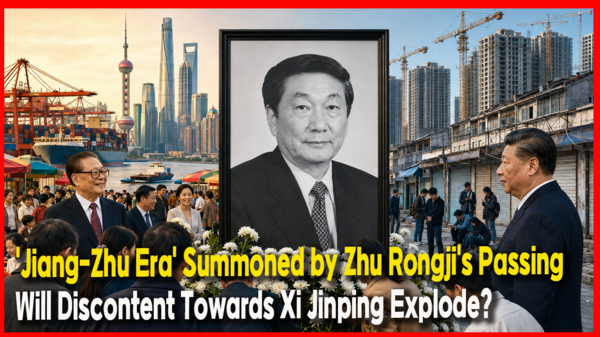
[Sharp Contrast Between Two Eras Brought Forward by an Elder's Death]
Former Premier of the State Council Zhu Rongji, often dubbed the "Chief Economic Architect" of China's reform and opening-up, passed away in Beijing on August 12 at the age of 97. However, his death signifies much more than the departure of a single senior politician. Voices inside and outside China are rapidly growing, drawing comparisons between the Jiang Zemin-Zhu Rongji era—the so-called "Jiang-Zhu Era" that led China into the World Trade Organization (WTO) and opened the doors of the market economy wide—and the Xi Jinping era, where the state has reclaimed control over the market.
Particularly for Chinese citizens who directly experienced the era of economic reform, Zhu Rongji symbolizes a period when people could expect a better tomorrow than yesterday. Conversely, the Xi Jinping era is defined by the simultaneous convergence of a shrinking private economy, youth unemployment, a collapsing real estate market, local government debt, and the flight of foreign capital. Consequently, as public mourning for Zhu Rongji deepens, it paradoxically risks triggering implicit criticism of the Xi Jinping regime, accompanied by the fundamental question: "Why has China backtracked on the path of reform?"
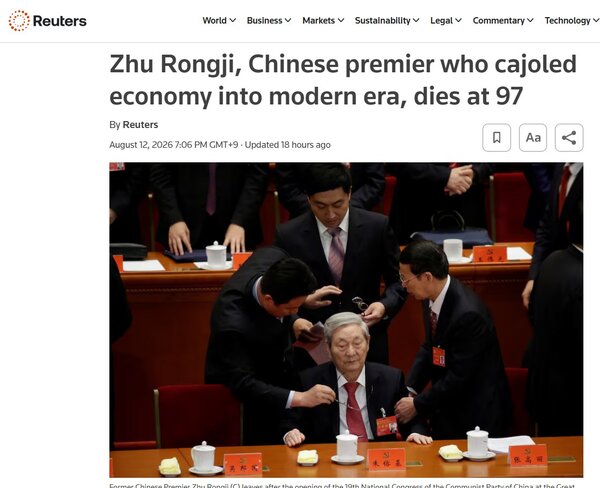
Reuters reported citing state-run Xinhua News Agency that "Zhu Rongji passed away around 11:00 a.m. on August 12 in Beijing due to illness." The agency noted that "Born in Changsha, Hunan Province in 1928, he became Mayor of Shanghai in 1987, served as Shanghai Party Secretary and Vice Premier of the State Council, and held office as Premier of the State Council from 1998 to 2003."
In its official obituary, the Chinese Communist Party (CCP) lauded him as a "time-tested and loyal communist fighter" and an "outstanding proletarian revolutionary." Yet the international community remembers Zhu Rongji less as a Party elder and more as a formidable technocrat who fundamentally reshaped China's economic framework.
The Washington Post characterized Zhu Rongji as an "economic czar" who spearheaded China's transition from a planned economy to a market-friendly system. The publication noted that "he suppressed chronic inflation, restructured state-owned enterprises (SOEs) and financial institutions, and personally led China's WTO accession negotiations." The late former U.S. Secretary of State Henry Kissinger also evaluated Zhu during his lifetime as a razor-sharp intellect grappling with the most consequential reform program in modern history. This is why analysts observe that Zhu's passing marks not merely the end of a life, but the complete fading of China's era of reformist economic optimism.
["We Believed in the Future Back Then"… The Jiang-Zhu Era Summoned Again]
Following the news of Zhu Rongji's passing, the 1990s and early 2000s—when Jiang Zemin and Zhu Rongji led China—are re-emerging in the collective memory of the Chinese public. Political repression following the Tiananmen Square protests, strict media censorship, and severe corruption certainly existed during that time as well. The Jiang-Zhu era cannot be idealized as an epoch of freedom or democracy. Nevertheless, for many Chinese, this period is remembered as a time when the economy grew rapidly, doors to the world widened, and the expectation that individual effort could transform one's life remained alive.
This nostalgia has grown even more pronounced since Xi Jinping assumed power in 2012. Jiang Zemin was re-evaluated on the Chinese internet with friendly nicknames or referred to as the "elder," while Zhu Rongji has been remembered as a leader who spoke the truth even before those in power and the establishment. This sentiment stems not from a belief that the two leaders were democratic, but from the perception that collective leadership functioned better than it does today, professional technocrats drove policy, and economic pragmatism alongside opening up to the outside world were respected.
Furthermore, during the Jiang-Zhu era, policy debates and dissenting opinions were tolerated to a degree within the Communist Party. The Premier voiced substantial responsibility for economic policy, and government ministries alongside economic technocrats had operational autonomy. In contrast, under the Xi Jinping era, as various Party central leadership small groups were elevated to commissions, almost all major decision-making spanning economy, finance, technology, and national security became centralized under Xi Jinping. Zhu Rongji's death serves as a catalyst contrasting an era when expert technocrats ran the economy with an era where the supreme leader's sole political judgment dominates it.
In his inaugural press conference as Premier in 1998, Zhu Rongji declared his resolve to press forward without hesitation, even if a minefield or a deep abyss lay ahead. His stance on eradicating corruption—famously ordering "100 coffins, including one for myself"—forged his image as an uncompromising leader. Compared to the current Chinese political culture of avoiding responsibility or attributing all achievements solely to the supreme leader, this image presents a stark contrast.
['Painful Reforms' That Entailed Tens of Millions of Layoffs]
To be sure, not all of Zhu Rongji's reforms were successful or benevolent. NPR pointed out that "Under the principle of 'grasping the large and letting go of the small,' Zhu maintained large state-owned enterprises while selling off or closing unprofitable small and medium-sized SOEs." In the process, anywhere from 30 million to an estimated 60 million workers lost their jobs.
NPR explained that "At a time when social safety nets were severely lacking, a job at an SOE was not merely a workplace for laborers." Losing a job meant losing housing, medical benefits, pensions, and educational support for children all at once. NPR noted that "Massive Xiagang (layoffs) led to worker protests across China, and Zhu Rongji could not escape criticism for forcing sacrifices upon workers in the name of reform."
Nonetheless, Zhu took on political burdens to perform surgical restructuring on inefficient SOEs and banks. Associated Press highlighted that "In 1998, he accelerated the privatization of urban housing by selling state-owned enterprise housing to residents, and in 2001, he achieved China's accession to the WTO despite pushback from conservatives and SOEs." The crucial foundation enabling China to leap forward as the 'factory of the world'—combining cheap labor with foreign capital and technology—was laid during this period.
[Zhu Rongji Who Expanded the Market vs. Xi Jinping Who Controlled It]
The fundamental dividing line between the Zhu Rongji era and the Xi Jinping era lies in the relationship between the state and the market. Zhu Rongji's line was to maintain the Communist Party system while expanding the role of the market, reducing government and SOE inefficiencies to create space for private enterprises and foreign capital to grow. Conversely, since taking power in 2012, Xi Jinping has expanded Party control across the entire economy and reinforced the dominant position of SOEs.
The sweeping crackdowns on tech giants like Alibaba and Didi Chuxing, the dismantling of the private tutoring industry, the expansion of Party cells inside corporations, and aggressive regulations on the real estate sector are summarized by the phrase Guojin Mintui ("the state advances, the private sector retreats"). As national security and Party control took precedence over private enterprise creativity and market autonomy, Chinese entrepreneurs became hesitant to invest, and foreign capital began diversifying production bases away from China to avoid policy uncertainty.
This forms the backdrop for criticism that while Zhu Rongji fought against internal Communist Party vested interests to revive the economy, Xi Jinping controlled the market to consolidate the Party's grip on power. While economic growth previously underpinned the legitimacy of Communist Party rule, the Xi Jinping era has shifted to a system where political loyalty and national security override economic expansion.
Consequently, mourning for Zhu Rongji naturally leads to fundamental questions about present-day China: Why has a China that was expanding globally pivoted back toward closure and self-reliance? Why have private entrepreneurs lost the drive to invest while foreign firms leave China? Why are college graduates unable to find jobs while local governments are weighed down by debt? At the end of these questions lies accountability regarding Xi Jinping's economic trajectory and concentration of power.
[Facing the Shadows of Reform Left by Zhu Rongji]
Not all problems facing China today can be attributed to Xi Jinping alone. The tax-sharing system reform (Fensezhi) pushed by Zhu Rongji in 1994 significantly increased central government revenues but left local governments with disproportionate expenditure responsibilities. The structural reliance on 'land finance'—filling revenue gaps through land sales and real estate development—was solidified at this time, laying the groundwork for local government debt and the real estate bubble.
In this context, Reuters analyzed that "While WTO accession brought explosive export growth, it also heightened structural imbalances by relying excessively on external demand and manufacturing investment." The agency added that "Zhu Rongji's reforms elevated China into an economic superpower, but simultaneously left structural vulnerabilities in local finance and export dependency." Thus, Zhu Rongji cannot be deemed entirely free from the seeds of today's Chinese economic troubles.
However, the decisive difference between the Zhu Rongji era and the Xi Jinping era is not the absence of problems, but the direction chosen to solve them. Zhu Rongji sought breakthroughs by expanding the market and connecting with the world. In contrast, Xi Jinping is reinforcing Party control and the state sector while treating economic issues through the lens of national security. This explains the criticism that rather than completing the imperfect reforms left by Zhu, China is reverting to a pre-reform era.
[Why Times Insight]
The true political shock that Zhu Rongji's death delivers to Chinese politics lies not in mourning a past leader, but in prompting the Chinese public to ask: "Which era offered more hope—the Jiang-Zhu era or the Xi Jinping era?" Though the Jiang-Zhu era was also marked by repression, mass layoffs, corruption, and inequality, it was nevertheless a time when China opened its doors to the world and sustained economic reform.
Conversely, China under Xi Jinping is losing its growth momentum amid power concentration, state capitalism reinforcement, private sector contraction, and foreign friction. Therefore, nostalgia for the Jiang-Zhu era is not mere romanticization of the past. It represents an indirect political act by Chinese citizens who, unable to criticize the present directly, express dissatisfaction with the current supreme leader by praising a past one.
This exact point poses a heavy burden for the Xi Jinping regime. Suppressing public mourning for Zhu Rongji risks provoking backlash for denying the legacy of the reform era; allowing it unfettered risks spreading public comparisons between the Jiang-Zhu era and the Xi Jinping era. This implies that Zhu Rongji's funeral could become a political space that summons China's lost era of reform, rather than a mere state memorial event for a senior figure.
No matter how extensively Chinese authorities praise Zhu Rongji as a loyal communist, they cannot erase the difference between the marketization, opening-up, and technocracy he symbolized and the state control, self-reliance, and one-man rule pushed by Xi Jinping. With Zhu Rongji's passing, what the Chinese people mourn is not just a former premier, but the end of an era when people believed tomorrow would be better through reform, and that China would grow stronger the closer it got to the world.
As that collective mourning deepens, the question ultimately converges on one point: Who holds the responsibility for turning back China's reform clock and halting an era of growth and hope? Zhu Rongji's death re-poses to Chinese society the exact question Xi Jinping least wants to hear.

-중국 푸단대학교 한국연구원 객좌교수
-전 EDUIN News 대표
-전 OUR NEWS 대표
-제17대 대통령직인수위원회 정책기획팀장
-전 대통령실 홍보기획비서관
-사단법인 한국가정상담연구소 이사장
-저서: 북한급변사태와 한반도통일, 2012 다시우파다, 선거마케팅, 한국의 정치광고, 국회의원 선거매뉴얼 등 50여권