
Update2026.07.24 (금)

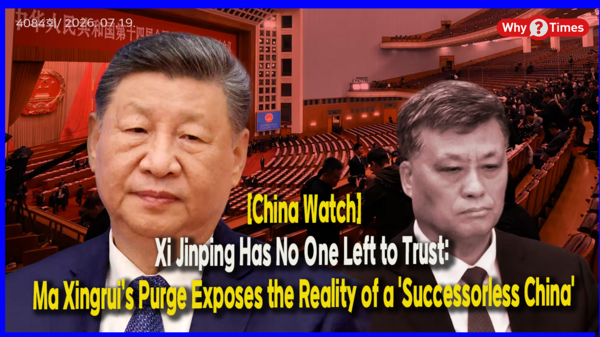
[Even a Politburo Member Handpicked by Xi Purged in 3 Years—The Growing Risk of a 'Succession Vacuum']
Chinese President Xi Jinping has purged yet another high-ranking official. However, this incident is fundamentally different from previous anti-corruption purges. The ousted figure was neither a political rival nor a member of a competing faction; he was a core loyalist handpicked and elevated to the Politburo by Xi himself. Consequently, this development is viewed not merely as the downfall of an individual politician, but as a stark exposure of the structural dilemma facing the Xi regime—a leadership defined by deep-seated distrust and an inability to groom a successor.
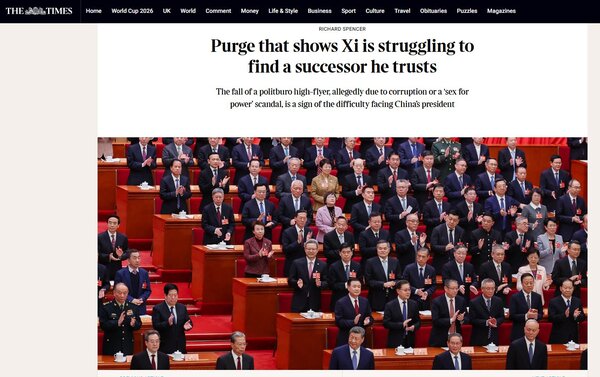
On July 18, the British newspaper The Times published an analytical piece titled "Purge highlights Xi Jinping’s struggle to find a successor," framing Ma Xingrui’s downfall as a symbol of the fundamental vulnerability inherent in Xi’s personalized personnel system. The Times noted that "Ma’s ouster, just three years after his promotion to the Politburo, is as shocking and unexpected as any of the Chinese leader’s other purges."
At the heart of this analysis is an interview with Joseph Torigian, a professor at American University and author of Prestige, Solidarity, and Power: Leadership Stability under Xi Jinping and His Father, a book exploring the relationship between Xi Jinping and his father, Xi Zhongxun. In his interview with The Times, Professor Torigian pointed out: "Ma Xingrui was Xi’s own creation. If even someone vetted to that extent falls apart, who can he trust now?" This single observation captures the very essence of this incident.
[The Downfall of 'Xi Jinping’s Own Creation' Who Rose to the Politburo]
On July 14, the Central Commission for Discipline Inspection (CCDI) announced via the state-run CCTV that Ma Xingrui had been expelled from the party and dismissed from public office. He faces an array of charges, including bribery, abuse of power, illicit interference in official appointments, securing undue benefits through his family, and political transactions involving sex.
While purges of high-ranking officials have become commonplace in China, this case is uniquely jarring because Ma was not part of the old political establishment or an opposition faction. On the contrary, he was one of the most successful products of the Xi Jinping era.
An aerospace expert with a background in mechanical engineering, Ma served as vice president of the Harbin Institute of Technology and general manager of the China Aerospace Science and Technology Corporation (CASC) before entering the political core as deputy party secretary of Guangdong Province and later as party secretary of the Xinjiang Uyghur Autonomous Region. His appointment to the top post in Xinjiang in 2021, in particular, would have been impossible without Xi’s absolute trust.
At the time, Xinjiang was China's most politically sensitive region, facing intense international criticism over Uyghur human rights issues. Xi selected Ma as an official capable of simultaneously executing iron-fisted control and maintaining economic stability, a task Ma managed relatively smoothly. As a result, he was promoted to the Politburo at the 20th Party Congress in 2022. At the time, he was widely considered a leading contender for the next-generation top leadership. Yet, just three years later, he has lost everything.
[The Core of the Incident: Not the Purge, but the 'Collapse of Trust']
While many media outlets reported this incident as just another anti-corruption purge, the core issue is not the corruption charges themselves. The crucial takeaway is that Xi Jinping could not bring himself to fully trust an official whom he had personally vetted and groomed.
Ma Xingrui did not hail from an adversarial faction. As a technocrat who rose through both central and regional positions, he was the quintessential "Xi loyalist." His downfall just three years after entering the Politburo signifies not just an individual failure, but the unraveling of Xi’s personalized institutional apparatus for personnel management.
Professor Torigian similarly assessed that "Ma Xingrui was the perfect person on paper, but he failed." Consequently, Xi Jinping is now confronted with an even greater dilemma: "Who is left to trust?"
[It’s Not That There Is No Successor; The System Itself Prevents One From Being Made]
This incident is drawing heightened scrutiny because the 21st Party Congress in 2027 is now only about a year away. Currently, the most anomalous feature of Chinese politics is the total absence of a visible successor. More accurately, however, it is not that a successor does not exist, but rather that the current system makes it impossible to cultivate one.
Historically, the Chinese Communist Party (CCP) maintained a succession system where future top leaders were elevated early to the Politburo Standing Committee to undergo long-term grooming and vetting. Jiang Zemin prepared Hu Jintao in this manner, and Hu likewise prepared Xi Jinping for transition.
Since Xi assumed power, however, this tradition has effectively been dismantled. The reason is simple: the moment a successor is designated, power naturally begins to gravitate toward that individual. Politburo members begin aligning themselves with the future ruler, inevitably eroding the incumbent leader's absolute authority.
Xi Jinping tolerates no such dilution of his power, which is why he refuses to name a successor. Paradoxically, the absence of an heir turns every Politburo member into a potential competitor. The top leader is left unable to fully trust anyone—the ultimate systemic dilemma currently plaguing Chinese politics.
[Power That Spares Not Even the Loyal]
The Ma Xingrui affair sends a chilling message to the Chinese bureaucracy. In the past, there was an unwritten rule that absolute loyalty to the top leader guaranteed political survival. Today, that formula has collapsed. If an official handpicked by Xi can be purged overnight, no bureaucrat will dare to proactively drive policy initiatives. Naturally, officials conclude that keeping a low profile and avoiding decisions that carry risk is the safest strategy for survival.
This bureaucratic inertia is increasingly cited as a primary reason why the Chinese economy remains stuck in a protracted slowdown. Reinvigorating the economy demands bold policymaking and accountable administration. Under a regime of fear, however, avoiding mistakes becomes far more critical than achieving success. While central authority may be absolute, the state's capacity for effective governance is severely compromised.
[An Aging Politburo]
The situation is further compounded by the depletion of the succession pool itself. Most current Politburo members are already in their mid-to-late 60s. By the time an actual transition of power occurs after 2027, many will be entering their 70s. The traditional pipeline that naturally produced next-generation leaders in their late 50s or early 60s has virtually vanished.
Compounded by the recent downfall of He Weidong (former Vice Chairman of the Central Military Commission), rumors of an investigation into Zhang Youxia (Vice Chairman of the Central Military Commission), and now the purge of Ma Xingrui, instability at the apex of both the military and the party is escalating. While power is more concentrated in Xi’s hands than ever before, the circle of individuals with whom he can actually share that power is shrinking.
[Why Times Insight]
To view the purge of Ma Xingrui merely as an anti-corruption exercise is to miss the broader picture. The most critical question raised by this incident is not "Who will lead China after Xi Jinping?" but rather "Why is Xi still unable to establish a succession plan?"
The current power structure of the CCP suffers from a profound internal contradiction: appointing a successor threatens to diminish the incumbent's absolute authority, yet failing to do so turns every close aide into a latent rival. As a result, the top leader remains perpetually distrustful, while bureaucrats adopt invisibility as their primary survival strategy.
On the surface, Xi Jinping's grip on power appears absolute. Term limits for the presidency have been abolished, and his control over the party, the military, and the state apparatus is total. Yet, as power becomes increasingly concentrated in a single individual, the institutional framework required to sustain that power weakens. Historically, regimes with excessively centralized authority have faced their greatest crises when their succession mechanisms falter.
The downfall of Ma Xingrui is not merely the collapse of a single politician. It is a visible fracture within the 'Xi Jinping system' itself. As the 21st Party Congress in 2027 approaches, the international community must look beyond China's economic indicators and closely monitor how this widening succession vacuum will ultimately fracture the regime.
-중국 푸단대학교 한국연구원 객좌교수
-전 EDUIN News 대표
-전 OUR NEWS 대표
-제17대 대통령직인수위원회 정책기획팀장
-전 대통령실 홍보기획비서관
-사단법인 한국가정상담연구소 이사장
-저서: 북한급변사태와 한반도통일, 2012 다시우파다, 선거마케팅, 한국의 정치광고, 국회의원 선거매뉴얼 등 50여권