
Update2026.10.24 (토)

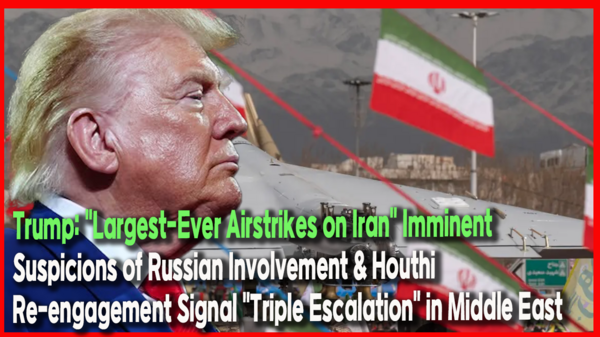
[Imminent ‘Record-Scale’ Strikes… Trump: “Iran Has Not Received Enough Pain”]
As U.S. President Donald Trump publicly stated that he is nearing a decision to launch the "largest-ever" airstrikes against Iran, the situation in the Middle East has entered another critical turning point. Simultaneously, U.S. intelligence agencies are investigating the possibility that Russia assisted Iran in its attacks against the U.S., while signs have emerged that Iran moved Islamic Revolutionary Guard Corps (IRGC) personnel and weapons systems to Yemen's Houthi rebels. As U.S. preparations for massive airstrikes, allegations of Russian involvement, and the resumption of Houthi attacks in the Red Sea converge, the Middle East war is rapidly shifting beyond the Strait of Hormuz into a new phase of escalation.
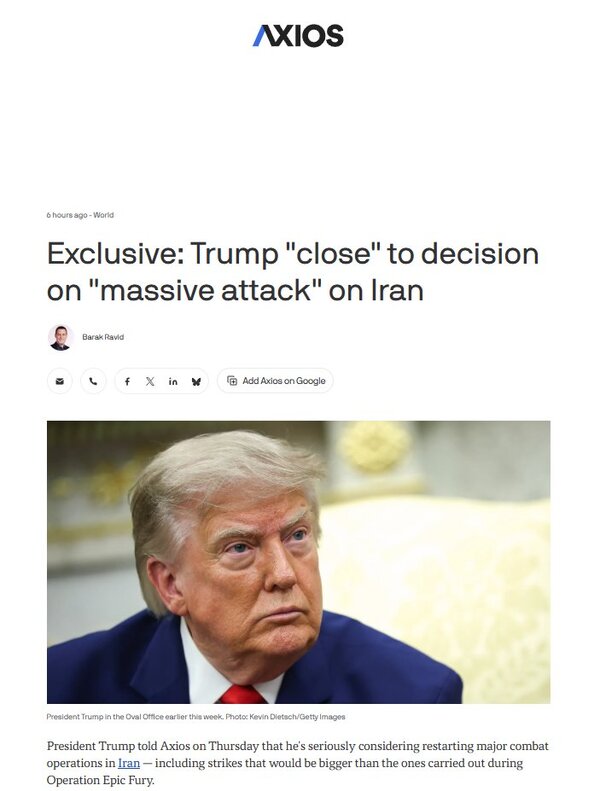
On July 24, U.S. internet news outlet reported: "President Trump said he is considering airstrikes on Iran larger in scale than 'Operation Epic Fury,' which began in late February with joint U.S.-Israeli strikes." He stated, "I am considering a massive attack. Bigger than ever before. I am close to making a decision," while clarifying that he has not yet made a final determination.
The news outlet conducted an exclusive interview with President Trump to deliver this report. It further noted that "two U.S. officials also confirmed that no new operational directives have been issued to the military so far."
According to the report, "President Trump emphasized that Israel could join 'in two minutes' if requested, but stressed that the U.S. 'does not need anybody's help'." He added that "if Israel joins the airstrikes, there would be consequences, such as Iranian retaliation."
Regarding the possibility of negotiations with Iran, President Trump expressed a negative outlook, stating, "They haven't received enough pain yet." On the same day, Secretary of State Marco Rubio reaffirmed the administration's hardline stance to reporters at the ASEAN Summit in Manila, stating that "President Trump's policy toward Iran is 'a head for an eye.'" Secretary Rubio's remarks appear to be a twist on the biblical phrase "an eye for an eye." It signifies that if Iran causes damage equivalent to an "eye" to the United States, the U.S. will respond with a far greater and overwhelming cost—a retaliation at the level of a "head."
In response, media outlets pointed out: "These remarks come as the U.S. and Iran have exchanged attacks for nearly 14 consecutive days after last month's Memorandum of Understanding (MOU) collapsed over disagreements regarding control of the Strait of Hormuz." It was further noted: "President Trump previously warned that each time Iran attacks a vessel in the Strait of Hormuz, the U.S. will bomb one of Iran's bridges or power plants." Reports added that "amid growing fears of escalation, global crude oil prices surged past $100 per barrel, and the U.S. House of Representatives once again passed a resolution introduced by Democratic Representative Pramila Jayapal demanding an end to unauthorized military force against Iran; however, the resolution remains symbolic and has failed to halt active combat."
[Did Russia Assist in Targeting CIA Facilities? U.S. Intelligence Launches Investigation]
However, the core of this crisis extends beyond American military preparations. Around the same time, U.S. intelligence agencies launched an investigation into whether Russia assisted Iran in its attacks against the U.S., illustrating how the war may be broadening beyond a bilateral conflict between the U.S. and Iran into a multilateral dynamic.
Media outlets reported that "U.S. intelligence is investigating whether Russia provided targeting information or advanced drone technology for Iranian drone attacks on CIA facilities in the Gulf region." Reports continued, "In March, at least two sites—a CIA station inside the U.S. Embassy in Riyadh, Saudi Arabia, and a separate facility in eastern Iraq—were hit, with some sources reporting damage to additional CIA facilities." The report added that "an internal memo from a Western intelligence agency reportedly concluded that Russia likely played a role in selecting CIA regional targets."
Two Western officials in the Gulf region stated: "Analysts believe two Russian-modified versions of Iranian 'Shahed' drones were used in the Riyadh attack." In connection with this, reports previously indicated in March that "Russia supplied Iran with the 'Kometa-M' satellite navigation system," though the Kremlin denied the report, calling it "fake news."
Further media reports noted: "In March, intelligence sources stated that Moscow was providing Iran with location data on U.S. military personnel and aircraft in the Gulf region, and recent reports once again highlight signs of Russian involvement." However, some experts analyze that Iran's own tactical adaptations are having a greater impact on the battlefield, regardless of Russian assistance.
[Iran Transfers IRGC Commanders and Missile Equipment to Houthis]
The underlying thread connecting these events is that the U.S. and Iran are expanding the war in fundamentally different ways. While the U.S. seeks to exert direct pressure through massive airstrikes, Iran appears to be opting for a strategy that disperses the burden on the U.S. by widening the conflict fronts rather than engaging in a direct confrontation. The first stage of this strategy is Yemen and the Red Sea.
It was exclusively reported that "Iran transferred IRGC commanders, military advisors, and missile/drone equipment to Yemen earlier this month." Citing four sources—including two Iranian sources, Yemen's Information Minister, and a regional security analyst—reports stated that "the personnel and equipment were transported from Tehran to Yemen via a Mahan Air flight on July 13, with IRGC personnel onboard estimated between 10 and 21, including high-ranking commanders."
Yemen's Information Minister, Muammar al-Eryani, representing the Saudi-backed government, confirmed the transfer of personnel and equipment, stating: "Their mission is to enhance the military capabilities of the (Houthi) militia and prepare them to threaten international maritime security in the Red Sea and the Bab al-Mandab Strait." Mjahem al-Saloum, a security analyst tracking Houthi movements, confirmed that "the flight cargo included short- and medium-range missile and drone components similar to those used in attacks on Saudi Arabia and the United Arab Emirates." A Houthi official acknowledged being on the flight but denied allegations that military experts were deployed.
[Houthis Attack Saudi Tankers… Red Sea Front Expands]
The chronological sequence is particularly noteworthy. Three days after the arrival of IRGC personnel in Yemen, the Houthis declared a blockade on Saudi-linked vessels and subsequently attacked two Saudi oil tankers in the Red Sea on July 23.
Regarding this, media outlets reported: "Just three days after the arrival of IRGC personnel in mid-month, Houthi rebels declared a blockade on Saudi-linked ships passing through the Bab al-Mandab Strait, and subsequently attacked two Saudi oil tankers in the Red Sea on the 23rd." The Houthis claimed that "ballistic missiles, cruise missiles, and drones were deployed in the operation, causing fires on two oil tankers that violated the blockade."
Reports also highlighted: "This attack marks the first resumption of maritime strikes since Red Sea vessel attacks—ongoing since the outbreak of the Gaza War in 2023—were halted following the October 2025 Gaza ceasefire declaration." It added that "behind the Houthis' re-engagement in the Red Sea front is the fact that Saudi Arabia's crude exports via the Red Sea's Yanbu terminal—used as an alternative route due to Iran's crude blockade through the Strait of Hormuz—surged from 240,000 barrels per day during the same period last year to 3.5 million barrels per day this past June." President Trump warned on the same day: "If the Houthis attack ships in the Red Sea again, we will hold Iran responsible."
[Why Times Insight]
These three developments must be viewed not as isolated events, but as a single interconnected trend. At the precise moment the Trump administration signals "record-scale airstrikes," signs of Russian intelligence and technical support, combined with Iran's bolstering of Houthi arms, suggest that Tehran is employing a strategy to distribute the costs of escalation through proxy and asymmetric warfare rather than direct head-on collision. Notably, confirmation that IRGC personnel arrived in Yemen three days prior to the Houthis' blockade declaration lends weight to the interpretation that the Red Sea attacks are not independent decisions by the Houthis, but rather a coordinated response orchestrated by Tehran.
To be sure, allegations of Russian support for strikes on CIA facilities remain under investigation by U.S. intelligence, and it remains unconfirmed whether President Trump's "largest-ever airstrikes" remark will translate into actual military execution. However, the broader trajectory is clear. The conflict that originated in the Strait of Hormuz is spreading into the Red Sea, and with the addition of the Russian variable, this war is no longer a simple duel between the U.S. and Iran. The Middle East war is entering a multilayered conflict involving multiple nation-states and proxy forces simultaneously—and the moment President Trump approves actual airstrikes, the pace of escalation is likely to accelerate far beyond what is being observed today.

-중국 푸단대학교 한국연구원 객좌교수
-전 EDUIN News 대표
-전 OUR NEWS 대표
-제17대 대통령직인수위원회 정책기획팀장
-전 대통령실 홍보기획비서관
-사단법인 한국가정상담연구소 이사장
-저서: 북한급변사태와 한반도통일, 2012 다시우파다, 선거마케팅, 한국의 정치광고, 국회의원 선거매뉴얼 등 50여권