Update2026.07.24 (금)

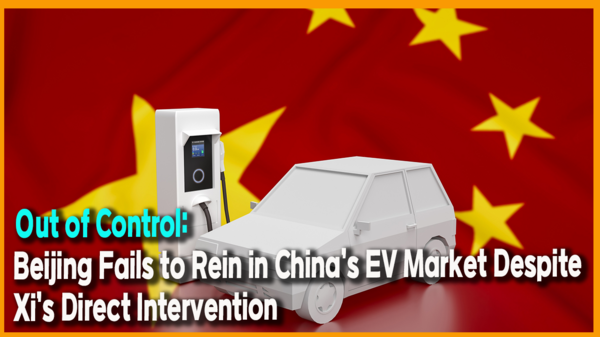
[Cracks Exposed in China’s State Capitalism via the EV Market]
The greatest crisis facing the Chinese electric vehicle (EV) industry is not price competition. Rather, it is the stark reality that no one halted their operations even after the nation’s top leader, President Xi Jinping, stepped in to deliver a direct warning to cease the expansion. In China, there has long been a strong perception that the central government can control any industry at will. However, the reality unfolding in the EV sector demonstrates the exact opposite. Analysts suggest that the interests of local governments are overriding central government policies, and that the state is entering a phase where it can no longer control the very strategic sectors it nurtured.
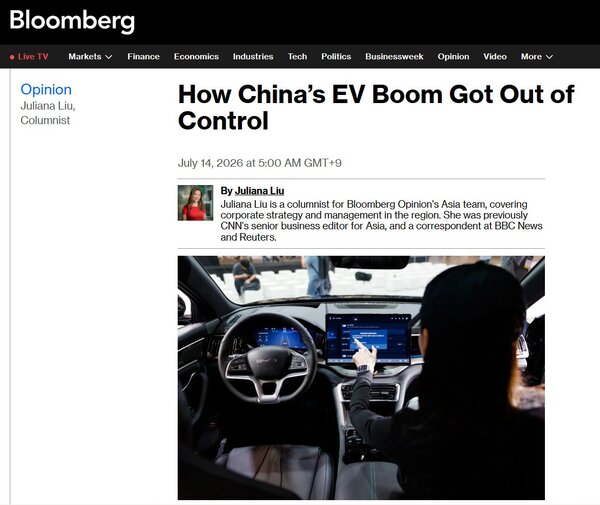
On the 15th, Bloomberg drew significant attention by publishing an analysis by opinion columnist Juliana Liu. The piece highlighted that "contrary to popular belief, China’s EV industry is not the byproduct of top-down design by the central government, but rather the result of fierce competition among local governments." It emphasized that "the core issue of the Chinese EV industry lies in its 'unresolvable overcapacity,' characterized by an abnormal market structure where over 140 brands flood the market and refuse to exit despite mounting losses—a situation that has shown zero improvement even after President Xi Jinping took the unusual step of personally ordering a crackdown."
Bloomberg further noted that "according to estimates by consulting firm AlixPartners, there are more than 140 Chinese new energy vehicle (NEV) brands, including battery EVs and hybrids," adding that "what is more alarming is that this market has completely derailed from the normal path of restructuring."
"Last year alone, 23 new brands entered the market, while only nine exited," Bloomberg pointed out. It diagnosed that "while a standard industrial trajectory dictates that intensifying competition naturally weeds out weaker firms, the Chinese EV market is presenting a paradox where the number of suppliers continues to increase despite deteriorating margins and profitability."
[Xi Jinping Issues Direct Warning, Yet None Halt Expansion]
This diagnosis carries immense weight because this period precisely coincides with President Xi's public criticism of local governments and his launch of the "anti-neijuan" (anti-internal-competition) campaign. In July last year, during a city work conference, Xi reportedly delivered an unprecedented, direct critique of local governments, stating: "Whatever the project is, as long as it involves investment, it is always the same: artificial intelligence, computing power, and new energy vehicles. Does this mean every single province in the country must develop its industries in this exact direction?"
During a meeting of the Central Financial and Economic Affairs Commission chaired by Xi that same month, the "management of disorderly low-price competition" was adopted as a core policy agenda. Furthermore, an article in Qiushi, the Communist Party’s flagship theoretical journal, went as far as using the phrase "cracking down on blind and bleeding price wars among enterprises." Prior to this, in May, the Ministry of Industry and Information Technology vowed to suppress "neijuan-style" competition in the automotive sector, and regulations were introduced to mandate payments to parts suppliers within 60 days. It is highly rare for China’s top leader to explicitly cite a specific industry to criticize the investment practices of local governments. The central government had essentially issued a full mobilization order.
Yet, the market remained unchanged. The count of 140 brands persisted, and new companies kept emerging. This signifies more than a mere policy failure; it demonstrates that the central government’s directives are failing to gain traction on the ground.
["The Real Reason Behind the Impasse: Local Governments as Direct Stakeholders"]
Regarding this issue, Bloomberg cited a recent study in The China Journal co-authored by Lu Fengming and Ma Xiao, noting that "the fundamental reason Beijing cannot control the situation despite its direct intervention is that local governments themselves are stakeholders in this industry." Bloomberg explained that "Chery Automobile, China's largest exporter, was established by the city of Wuhu in Anhui Province using funds from selling off a cement business, while Geely, which rivals BYD, grew through the full backing of the Zhejiang provincial government." It added that "local governments, facing a sharp decline in land sale revenues due to the real estate slump, now have an even greater incentive to cling to the EV industry as an alternative source of tax revenue and a marker of political achievement." Bloomberg also pointed out that "because the bankruptcy of a representative regional enterprise directly triggers a local employment crisis, local governments cannot easily liquidate brands despite accumulated losses." It further highlighted a policy contradiction: "The central government’s decision to resume EV subsidies in January sent mixed signals, simultaneously signaling an intent to fend off deflation while supposedly suppressing overcompetition."
Addressing this environment, He Xiaopeng, CEO of XPeng, a major Chinese EV manufacturer, remarked on a podcast last year that "the war of attrition in the Chinese auto industry will persist for at least another five years," adding that "no Chinese automaker is in a safe zone yet."
[Volume Unabsorbed by China Inevitably Shakes the Global Market]
The excess capacity that China failed to absorb domestically eventually spilled over into overseas markets, with Europe serving as the primary point of impact. Bloomberg noted that "in May, Chinese passenger car sales in Europe surpassed those of Japanese cars for the first time, and the EU's trade deficit with China widened to $1 billion per day, reaching approximately $410 billion annually as of 2025." As a consequence, "Mercedes-Benz announced on the 8th that its second-quarter sales in China plummeted by 30% year-on-year, BMW lowered its 2026 automotive operating profit margin forecast to 1–3% while announcing a 5% workforce reduction, and Mercedes-Benz halted employee bonus payments while offering voluntary retirement to thousands of workers." Domestic overproduction within China is now destabilizing the entire global automotive industry.
At a meeting in Brussels on the 30 of last month, Maroš Šefčovič, the EU Commissioner for Trade, stated, "While China’s exports to the EU continue to grow, our market share within China continues to shrink." The two sides established four workstreams covering export controls and the balance of trade and investment, scheduling follow-up negotiations for October. However, these are merely symptomatic treatments for the external eruption of China's unmanageable domestic overproduction, rather than solutions addressing the root cause.
[Why Times Insight]
This crisis extends far beyond the EV industry alone. More critically, it indicates that the control mechanism of Chinese-style state capitalism is fracturing.
For a long time, the Chinese economy has been evaluated as a system where local governments and state-owned enterprises move in perfect lockstep once the central government sets the direction. However, following the collapse of the real estate bubble and the local government debt crisis, the exact same phenomenon is repeating in the EV sector. While Beijing orders restructuring, local authorities are instead propping up failing enterprises to protect local economies, tax revenues, and employment. Ultimately, the central government's policy will is being neutralized by local interests.
What warrants even greater attention is that this structure is not confined to electric vehicles. As President Xi pointed out that "AI, data centers, and new energy vehicles are being rushed into uniformly across the nation," China is currently exhibiting identical signs of investment overheating in strategic sectors such as AI, semiconductors, and data centers. If the failure of control witnessed in the EV sector spreads to these industries, the next crisis facing the Chinese economy will likely not be a simple matter of overproduction, but a structural crisis where the state cannot control the very industries it generated.
South Korea must also avoid viewing this simply as a price offensive by Chinese firms. This is because China's domestic failure of control is spilling over into the global market, continuously disrupting the competitive order of major industries including automobiles, batteries, steel, and chemicals. What is occurring in China right now may not be a mere "EV crisis," but the gradual exposure of structural fissures within the Chinese economic system itself.
-중국 푸단대학교 한국연구원 객좌교수
-전 EDUIN News 대표
-전 OUR NEWS 대표
-제17대 대통령직인수위원회 정책기획팀장
-전 대통령실 홍보기획비서관
-사단법인 한국가정상담연구소 이사장
-저서: 북한급변사태와 한반도통일, 2012 다시우파다, 선거마케팅, 한국의 정치광고, 국회의원 선거매뉴얼 등 50여권