Update2026.07.24 (금)


[The US strategy has evolved from 'technology blockade' to 'capital blockade']
The mechanism of US pressure on China is shifting. While Washington previously focused on blocking exports of advanced semiconductors, AI chips, and chipmaking equipment, it has now gone a step further—targeting not just the technology itself, but the 'money' required to nurture it. As China faces the necessity of investing trillions of dollars into future industries like AI, semiconductors, and humanoid robotics, the US is zeroing in on this precise flow of capital. This marks a new phase in the US-China tech hegemony race; the battle has shifted from a competition over who secures advanced technology first to a struggle over who can maintain an ecosystem that sustains continuous innovation.
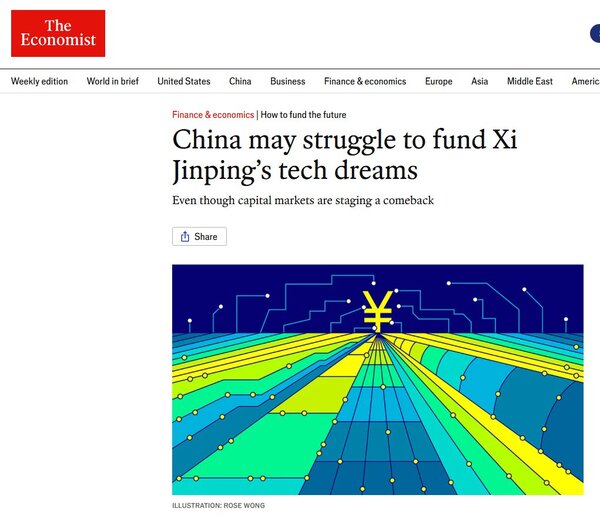
The British weekly The Economist delivered a sharp analysis of this transition in its latest issue. Its core warning highlights that "the biggest hurdle for China's AI and semiconductor ambitions is not a simple lack of funds, but a structure where the government excessively controls the flow of capital," adding that "the moment the state replaces the market in making investments, the speed and efficiency of innovation inevitably decline."
According to The Economist, just a few years ago, Washington's pressure on Beijing was strictly focused on preventing advanced technology from entering China. The US banned exports of cutting-edge AI chips, restricted the shipment of ASML’s EUV lithography equipment from the Netherlands, and cut off access to Electronic Design Automation (EDA) software and advanced manufacturing tools.
However, Washington began to realize that these measures alone were insufficient. Even if China could not secure cutting-edge chips immediately, it could eventually threaten America’s technological edge if it poured massive amounts of capital into developing its own proprietary technologies.
From the US perspective, high-tech industries do not grow on technology alone. R&D, data center construction, manufacturing expansion, and securing top-tier talent require astronomical funding. Ultimately, Washington calculated that controlling the flow of money would decelerate the very pace of technological advancement.
Consequently, the US elevated its strategy. The Outbound Investment Security Program (OISP), which took effect in 2025, prohibited or required notifications for US investments in Chinese semiconductors, AI, and quantum technology sectors. This was followed by the enactment of the COINS Act, which expanded these restrictions to high-performance computing and hypersonic systems.
This is not a simple financial regulation. It signals a strategic pivot from merely blocking tech transfers to cutting off the very capital that fosters technology. If past warfare meant bombing an enemy's factories, today’s US strategy is a war aimed at severing the financial lifelines needed to build those factories in the first place.
[The real problem facing China is not technology, but 'money']
This is precisely where China’s dilemma begins. Beijing has designated AI as a national strategic industry while simultaneously pushing for semiconductor self-reliance, humanoid robotics, and advanced manufacturing. However, these industries demand capital on an unimaginable scale.
The Economist estimates that "AI data centers alone will require approximately 2 trillion yuan in investment over the next five years." It further noted that "when factoring in robotics and advanced manufacturing, the funding required over the next decade will likely match or exceed that amount."
The problem lies in who will supply these massive sums. In the past, global venture capital, foreign institutional investors, and private capital shouldered a significant portion of this burden. Today, that reality has entirely changed. As US investment restrictions intensify, the flow of foreign capital into China's high-tech sectors is steadily drying up.
As a result, China's options are narrowing, forcing a rapid structural shift where the state must step in to fill the vacuum left by private capital.
[State-funded gaps, market-lost innovation]
This shift is already vividly reflected in China's capital markets. A prime example is ChangXin Memory Technologies (CXMT), China's largest memory chipmaker. CXMT is pursuing a listing on the Shanghai Stock Exchange’s STAR Market to raise approximately 29.5 billion yuan ($4.4 billion), marking the largest onshore IPO in China since 2022. Humanoid robotics company Unitree has also emerged as a poster child for China's tech push as it moves forward with its own listing.
The Chinese government promotes these developments as symbols of technological self-reliance. It was within this context that Premier Li Qiang explicitly mentioned Unitree alongside Huawei at the Davos Forum. However, The Economist focused not on the companies' performance, but on the source of their funding.
Today, China's startup ecosystem is rapidly becoming dependent on state-owned enterprises, local government funds, and policy-driven capital rather than private venture capital. An investment fund under the state-owned chipmaker SMIC has already invested in over 400 semiconductor firms, while Xiaomi has partnered with local governments to form joint funds investing in more than 100 companies. This implies that while these investments appear private on the surface, they frequently operate within a state-designed investment matrix.
[Why innovation is born in the market while the state merely follows]
This exposes the fundamental limitation of the Chinese innovation model. Innovation is born from market competition, not government planning. Nvidia, OpenAI, and Apple were not companies handpicked by governments at their inception. Instead, countless private investors took risks on their potential, and the market ultimately selected the winners.
Conversely, when a government dictates the direction of investment, the criteria change. Selection shifts away from the 'most innovative company' toward the 'company that best aligns with government policy.'
The Economist pointed out that "China's policy funds heavily favor companies that have already received government certification, while remaining relatively reluctant to invest in early-stage startups."
This is fatal to an innovation ecosystem. True breakthroughs often begin with the most uncertain enterprises. Yet, in China, it is precisely these companies that face the steepest hurdles in securing capital. Consequently, the market's price-discovery function weakens, and capital flows toward politically favored entities rather than the most competitive ones.
[The US targeted China's weakest link]
The latest US investment restrictions go beyond simple financial oversight. Washington is no longer just targeting Chinese semiconductor factories; it is taking aim at the very ecosystem where innovation is conceived.
The core of high-tech competition lies in the capital markets, not the research labs. New technology emerges when investors take risks, numerous firms compete, and the market filters out the survivors. However, as foreign capital flees and private investment shrinks, China is left with no choice but to have the state shoulder the bulk of the financial burden.
As the state's footprint expands, the market contracts—and as the market contracts, the diversity and dynamism of innovation are highly likely to erode. It is this structural vulnerability that the US is actively exploiting.
['Semiconductor War' yields to 'Capital War']
CXMT’s massive IPO is undoubtedly a meaningful milestone for China. However, the US is no longer preoccupied with halting the growth of individual firms. It has begun to disrupt the broader ecosystem that allows China to continuously generate innovative companies.
The US blocked advanced semiconductors, restricted manufacturing equipment, and cut off AI chips. Now, it has initiated the final phase: controlling the flow of investment and money. This is not a temporary tactic to delay China’s technological progress; it is a long-term strategy designed to undermine the foundational infrastructure of its innovation.
[Why Times Insight]
The Economist’s analysis goes far beyond the simple premise that "China is running out of money." The real takeaway is the evolution of the US strategy toward China from a 'technology blockade' to a 'capital blockade.' Washington has begun squeezing the financial flows that nurture technology, thereby choking the innovation ecosystem itself.
In response, Beijing is plugging the deficit with state capital. While this approach may yield short-term success stories like CXMT or Unitree, a structure where the government replaces the market is highly likely to degrade the autonomy and diversity of innovation over the long term.
Ultimately, the future of the US-China rivalry will not be decided by who fabricates a superior semiconductor chip, but by who sustains a healthier ecosystem for innovation. Rather than attacking China's factories, the US has begun shaking the very soil where innovation takes root. The moment that soil destabilizes, the future of China's AI ambitions will face its ultimate test.


-중국 푸단대학교 한국연구원 객좌교수
-전 EDUIN News 대표
-전 OUR NEWS 대표
-제17대 대통령직인수위원회 정책기획팀장
-전 대통령실 홍보기획비서관
-사단법인 한국가정상담연구소 이사장
-저서: 북한급변사태와 한반도통일, 2012 다시우파다, 선거마케팅, 한국의 정치광고, 국회의원 선거매뉴얼 등 50여권