Update2026.10.24 (토)

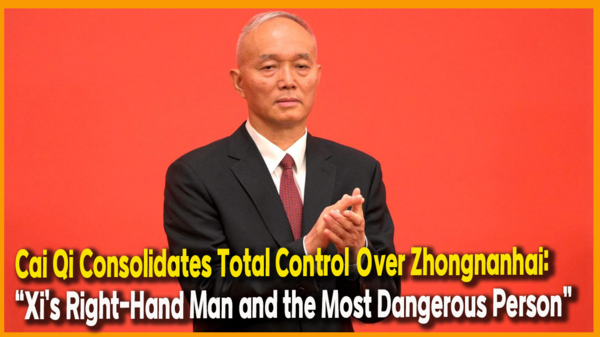
[Unprecedented Power Concentrated in a Single Figure: From the Party School and Propaganda to Cyber Affairs and Security]
A monumental shift is occurring within China's power matrix as Cai Qi, the fifth-ranked official in the Chinese Communist Party (CCP) hierarchy, has assumed the presidency of the Central Party School. The Central Party School is far more than a mere educational institution; it is the ultimate apparatus for vetting and selecting high-ranking cadres. Already in control of the Party's organizational operations, propaganda, internet censorship, and the personal security of the top leadership, Cai's latest appointment further underscores an unprecedented concentration of the CCP's core power under a single individual.
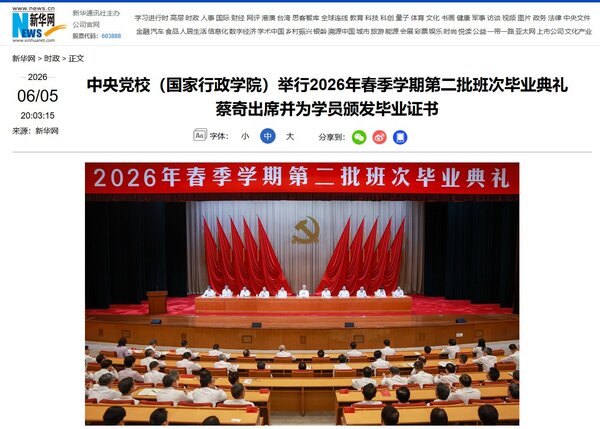
On June 5, China’s state-run Xinhua News Agency reported on the graduation ceremony for the Spring 2026 semester of the Central Party School (National Academy of Governance), noting that Cai Qi was listed as the school's president. Notably, there was no official announcement, press conference, or formal notice regarding his assumption of office. His predecessor, Chen Xi, had attended the opening ceremony as president as recently as May 15. Yet, by June 5, Xinhua's report casually introduced Cai in that role. This swift, low-profile transfer of power within less than three weeks serves as a major political signal in itself.
Conventionally, the presidency of the Central Party School has been held by a member of the Politburo Standing Committee (PSC). However, Xi Jinping broke this tradition in 2017 by appointing his close ally Chen Xi to the post. With Cai Qi taking the helm, the system where a Standing Committee member leads the school has been restored after nine years.
The Central Party School is an indispensable stepping stone through which high-ranking CCP cadres must pass before promotion. The training they receive and the evaluations they earn there dictate their future political trajectories. Controlling the Party School effectively means managing the pipeline of future leadership candidates.
Furthermore, the Central Party School is the ultimate body for researching and interpreting CCP ideology. It dictates the official Party line and determines what thoughts are deemed unacceptable. Because Cai Qi already oversees propaganda and cyber control, the production, dissemination, and enforcement of ideology have now effectively converged under one man.
The implications go deeper. China's two most recent paramount leaders, Xi Jinping and Hu Jintao, both served as presidents of the Party School before rising to the absolute pinnacle of power. Xi took the post in 2007 and became Vice President the following year, following a trajectory similar to Hu's. Consequently, some observers view Cai's concurrent appointment not merely as an expansion of duties, but as a development tied to the post-Xi Jinping succession matrix. Although analysts generally agree that Cai’s age (70) makes it unlikely for him to become the paramount leader, the symbolic weight of the appointment is undeniable.
[The Convergence of Core CCP Portfolios Under Cai Qi]
Commenting on the development, Vision Times, an overseas media outlet specializing in Chinese politics, noted, "The significance of this appointment goes far beyond adding another title to his resume. The sheer volume of the portfolios Cai currently wields illustrates the true gravity of his power."
According to the outlet, "As the Director of the Central General Office, Cai controls the daily flow of Xi Jinping's decision-making and commands the Central Security Bureau, which is responsible for protecting the lives of top leaders. Furthermore, as the first secretary of the Central Secretariat, he serves as the 'executive hub' translating Politburo decisions into daily party operations. He is also the czar of internet control, directly overseeing propaganda apparatuses and the Cyberspace Administration. On top of this, he serves as Deputy Chairman of the National Security Commission, Leader of the Central Business Inspection Work Leading Group, and Deputy Director of the Central Committee for Comprehensively Deepening Reform. The Central Party School presidency was the final piece of this puzzle."
Dr. Mitrelschneider, a China expert at the University of Zurich, remarked on the appointment: "The organizational, ideological, and administrative functions of the Communist Party have completely converged under a single member of the Politburo Standing Committee. Such a structure is entirely unprecedented."
In an in-depth analysis published last May, British economic weekly The Economist described Cai Qi as "the de facto number-two figure, rather than the official number five," pointing out that "Xi Jinping’s schedule management, filtering of accessible personnel and information, and the personal security of the entire top leadership all pass through Cai’s hands."
In essence, the presidency of the Central Party School is a position that simultaneously controls the people of the past (the personnel pipeline), the ideology of the present (the interpretation of orthodoxy), and the leaders of the future (the succession pathway). For Cai Qi, this role was the final piece in his consolidation of power.
[The Last Key Handed Over by Xi: Cyber Control]
Another critical pillar of Cai Qi’s expanding authority lies in internet governance. Xi Jinping has effectively handed over the operations of the Central Cyberspace Affairs Commission—a portfolio he previously managed directly—to Cai. This body is the core agency overseeing China’s internet censorship, data regulation, and platform management policies. The Hong Kong-based South China Morning Post (SCMP) reported that "Cai has virtually been handling these duties since the first half of last year, without any formal announcement."
A political scientist at Tsinghua University evaluated that "this series of delegations demonstrates that Cai Qi has secured the absolute trust of Xi Jinping." Deng Yuwen, a former editor of the Study Times (the official newspaper of the Central Party School), analyzed that "Xi Jinping is attempting to build a new power structure through the delegation of authority." However, external analysts look deeper, viewing this not simply as finding the right man for the job, but as a signal that Xi has handed over the final levers of power he once held exclusively to his closest confidant.
[Beyond Cai’s Rise: The Collapse of Collective Leadership]
The true significance of this reshuffle, however, does not lie in Cai Qi’s individual promotion. The more critical issue is the fundamental mutation of the CCP’s power structure. Deng Xiaoping established the collective leadership system specifically to prevent the abuse of power witnessed during the Mao Zedong era. It was engineered so that members of the Politburo Standing Committee would share power and check one another, ensuring absolute authority did not concentrate under a single individual.
However, the landscape has shifted drastically since the 20th Party Congress in 2022. Analysts evaluate that the power-dispersion function has withered away as the Politburo Standing Committee has been packed almost exclusively with Xi's loyalists. Term limits have vanished, and no successor has been designated. While the Standing Committee structure remains intact on paper, actual power is entirely centralized under Xi Jinping, with Cai Qi emerging as the linchpin supporting this architecture.
[The Precedent of Wang Dongxing: Is History Repeating Itself?]
Vision Times pointed out that "in the history of the CCP, only one other individual has concurrently held a seat on the Politburo Standing Committee and the directorship of the Central General Office: Wang Dongxing, who served for decades as Mao Zedong’s security chief and 'gatekeeper'." Mao trusted Wang implicitly. Yet, immediately after Mao’s death in 1976, Wang spearheaded the arrest of the 'Gang of Four'—including Mao’s widow, Jiang Qing—alongside Hua Guofeng and Marshal Ye Jianying. Crucially, Cai Qi’s current scope of power is far vaster than what Wang Dongxing ever possessed.
Given historical patterns and the ruthless nature of internal CCP power struggles, some analysts argue that frictions and contradictions between Cai Qi and Xi Jinping are inevitable and merely a matter of time. The criteria by which Xi draws the line between political rivals and trusted confidants remain highly unpredictable. As one analyst noted, "To fundamentally alter the political orbit of the Communist Party or shift the balance of power at the absolute top, one must control Xi Jinping’s personal safety—effectively his life and death. The only individual capable of doing that today is Cai Qi."
[The Structural Risk of One-Man Rule: The Dissolution of the 'Error-Correction Mechanism']
The core issue extends beyond Cai Qi’s personal status; it rests upon the inherent dangers this extreme centralization of power poses to the entire Chinese system. The regular, institutionalized turnover of leadership was a rare institutional achievement for a communist system and the primary source of China’s 'authoritarian resilience.' Under Xi, however, China is abandoning decades of institutionalized collective leadership to return to a personalized dictatorship (人治).
The conspicuous absence of a designated successor underscores Xi’s intent to rule indefinitely. Historically, authoritarian regimes maintained without succession planning face volatile power struggles when the leader dies, steps down, or is ousted. The lack of a designated heir-apparent raises the probability of internal factional warfare following Xi’s departure. Furthermore, continuous purges and anomalous reshuffles within the military leadership persist. While Xi's core loyalists are deeply entrenched within the institutional core of the Party, potential competitors or alternative successors have been stripped of any viable political base or organizational backing.
Willy Lam, a China expert at the Jamestown Foundation, previously warned that "under Xi Jinping, whatever the top leader says becomes law, and checks and balances no longer exist." Similarly, during the abolition of presidential term limits, Jonathan Sullivan, director of China Policy at the University of Nottingham, warned that "term limits were a key mechanism to institutionalize leadership transition, and removing them poses a real risk to long-term stability."
[A Regime Seemingly Stronger, Yet Increasingly Perilous]
Viewed through this prism, Cai Qi’s expanding authority signals that the CCP is entering a perilous new phase of hyper-centralization. The critical flaw is that as power becomes more concentrated, the mechanisms to rectify policy failures erode. Under the former collective leadership system, various leaders could deliberate, provide checks, and correct errant policies. Today, the paramount leader’s judgment instantly becomes absolute policy, leaving virtually no room for dissent or recalibration.
Ultimately, the reshuffle at the Central Party School is not a routine personnel change. It is an explicit signal that the CCP is reverting from institution-based governance back to personalized rule.
This structural dilemma has plagued CCP history repeatedly. Wang Dongxing, who rose to the peak of power post-Mao only to be purged by Deng Xiaoping, and the downfall of Lin Biao are textbook examples. The ground Cai Qi currently stands on is, as the University of Zurich’s Dr. Mitrelschneider puts it, "a position representing the highest stakes and the highest level of trust." He adds, "That is precisely what makes this position unprecedentedly powerful, yet unprecedentedly perilous." The ancient Chinese proverb, "Accompanying a sovereign is like living with a tiger" (伴君如伴虎), breathes with renewed relevance inside Zhongnanhai in 2026.
Cai Qi has undoubtedly become one of the most powerful figures in contemporary China. However, the more critical reality is that his rising power makes the entire Chinese political system acutely dependent on a single individual. Historically, such architectures appear formidable on the surface, but manifest catastrophic instability when a crisis hits. This is the true message encoded within the quiet transition at the Central Party School.
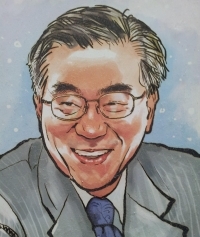
-중국 푸단대학교 한국연구원 객좌교수
-전 EDUIN News 대표
-전 OUR NEWS 대표
-제17대 대통령직인수위원회 정책기획팀장
-전 대통령실 홍보기획비서관
-사단법인 한국가정상담연구소 이사장
-저서: 북한급변사태와 한반도통일, 2012 다시우파다, 선거마케팅, 한국의 정치광고, 국회의원 선거매뉴얼 등 50여권