Update2026.10.24 (토)

['The End of 'Holding Out' for China: A Prelude to Supply Chain Collapse]
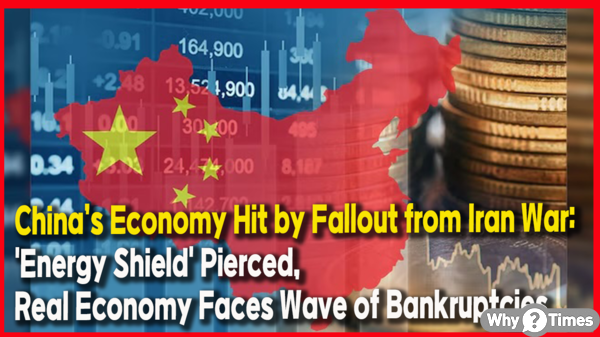
As the prices of oil and natural gas soar in the aftermath of the Iran War, the robust growth of the Chinese economy has been hit with a sudden brake. As the war drags into its ninth week, China, which had been holding out through its strategic petroleum reserves, is now unable to avoid the double blow of rising manufacturing costs and shrinking consumption. In particular, cracks in the overall economy are becoming clear: auto sales—a major consumption indicator for households—plunged in April, and factories in the southern manufacturing hubs are closing down one after another. Ultimately, it can be said that China's hegemonism, which staked energy security and public livelihoods, has returned as a massive economic boomerang.
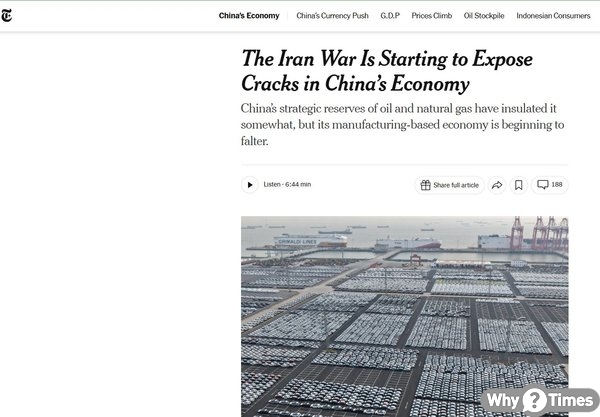
On the 28th, The New York Times (NYT) drew attention by reporting, "The Iran War has begun to expose cracks in the Chinese economy," and "While China has been somewhat protected from external shocks thanks to its strategic oil and natural gas reserves, its manufacturing-based economy is beginning to falter."
The NYT continued, "Rising oil and gas prices caused by the Iran War are beginning to strain the Chinese economy, further slowing already sluggish consumer spending and hitting key export sectors." It noted that "auto sales fell in March and plunged further in April; as households cut spending, customers at restaurants and hotels are also declining. In southern China, thousands of toy factory workers protested last week after factories went bankrupt due to rising plastic prices and persistent U.S. tariffs."
The NYT stated, "Recent signs of economic pressure show that even China, with its vast strategic oil reserves and massive investment in renewable energy, is not free from the factors squeezing the global economy." It added, "For weeks, China seemed to weather the war's aftermath well, supported by relatively solid economic indicators through March. However, as the war entered its ninth week with no end in sight, cracks began to emerge."
In fact, the first-quarter GDP growth rate reached 5.3% on an annualized basis, but this was the result of strength in January and February boosting the figures. Retail sales growth in March was only 1.7% year-on-year, and the China Federation of Logistics & Purchasing stated that inventory accumulation continues.
Beijing-based economist Michael Pettis warned, "Accumulating inventories could hold back future growth." Alicia García-Herrero, Chief Economist for Asia-Pacific at the French financial firm Natixis, added, "Economic growth is slowing down," and "China may find it difficult to achieve its growth target of over 4.5% this year."
[The Auto Market: A Leading Indicator of Economic Recession]
The clearest signal of the economic slowdown came from the automobile market. In China, cars are the second-largest household consumption item after housing and a key source of demand for material industries such as steel and glass. That auto market is collapsing. According to data from the China Passenger Car Association (CPCA), retail sales of passenger cars plummeted 26% year-on-year between April 1 and 19. While the expiration of EV tax benefits last December played a role, the drop for internal combustion engine vehicles was much steeper, decreasing by about 40%. The skyrocketing oil prices following the Iran War directly hit the demand for gasoline vehicles.
In the case of Mercedes-Benz, sales in the U.S. market increased by 20%, while sales in China plummeted by 27%, showing a stark contrast. The plunge in sales led to inventory backlogs, which immediately triggered production cuts. The fact that such drastic production adjustments are taking place despite increasing exports is evidence of how significant the impact of shrinking domestic demand truly is.
[Toy Factory Bankruptcies and Workers' Street Protests]
The industry hit more directly by energy price shocks than the automotive sector is the toy industry. Plastic, essential for toy manufacturing, is extracted from oil and natural gas, and prices spiked as raw material supplies were disrupted due to slowed navigation in the Strait of Hormuz. On the 20th, mainland Chinese factories of Wah Shing Toys, a toy company headquartered in Hong Kong, closed all at once. These factories are located in Yulin City, Guangxi Province, about 420 kilometers west of Hong Kong, an area known as a low-wage toy manufacturing hub.
The Yulin entity of Wah Shing Toys stated in a declaration distributed to employees, "The background of the bankruptcy filing and factory closures lies in the deepening trade friction between China and the U.S. in recent years and the worsening cash flow due to non-payment by overseas customers." Enraged by the sudden closure, thousands of workers protested in front of the factory for days, demanding wages and severance pay. Protesters hung banners at the factory gates that read, "Give me back my blood and sweat money." Videos of the protests spread rapidly through Chinese social media, and it was notable that authorities left them alone without deleting them—an unusual move—perhaps because they were peaceful rallies.
Shantou in Guangdong Province, about 270 km from Yulin, also could not escape the damage. The Shantou Chenghai Toy Association, an industrial group in the city that produces one-third of the world's toys, issued an emergency warning just ten days into the Iran War, stating, "Plastic prices are skyrocketing, and hoarding and panic buying are occurring."
[The Truth Hidden Behind March Industrial Profit Statistics: An "Illusion"]
Industrial profit statistics for March, announced in April, appeared favorable on the surface. This was thanks to chemical and energy companies—which had purchased large quantities of raw materials at low prices before the war—realizing one-time profits following the oil price surge. However, experts collectively diagnose that this "special demand" is difficult to sustain and is merely a temporary illusion masking the contraction of the real economy. Restaurants and hotels have seen a noticeable decrease in customers as households reduce spending. High energy-consuming industries such as steel, petrochemicals, and automobiles are facing a double whammy of cost pressures coupled with surging logistics costs.
Market research firm Bernstein warned in a report, "The greatest risk is a scenario where oil prices continue to rise due to a prolonged war and global consumer sentiment collapses, leading to a plunge in auto sales beyond the Gulf region." The same report pointed out that "17% of China's finished vehicle exports are headed to the Middle East." In particular, Iran is the largest auto market in the Middle East, where Chinese brands like Chery and Changan had essentially acted as major suppliers by taking advantage of Western sanctions before the war. A prolonged war could annihilate this export market itself.
[The Limits of Buffering Capacity: China’s Economy Can No Longer Endure!]
Of course, the defensive measures China possesses are not completely exhausted. Vast strategic oil reserves provide a buffer to absorb short-term shocks even if import disruptions occur. The policy of limiting the pass-through of oil price increases via state-run refiners also remains in place. However, all these buffers are bound to weaken as the war drags on. Strategic reserves will be consumed, price subsidies will increase the fiscal burden, and a vicious cycle may unfold where trading partners suffer the same energy shocks, reducing demand for Chinese exports.
Deloitte, the world's largest accounting and consulting firm, identified supply chain instability, surging energy prices, and geopolitical fragmentation as major potential risks in its 2026 global economic outlook. Those predictions are now accurately materializing in the reality faced by the Chinese economy. As a negotiated end to the war is delayed, China's shield of strategic reserves and price controls will grow increasingly thin.
In this way, the Iran War is moving beyond a local conflict in the Middle East to strike the heart of China, the world's factory. China appeared to be free from the war's aftermath by touting its vast strategic reserves and renewable energy investments, but it ultimately seems to be kneeling before the uncertainty of the global energy supply chain. This clearly demonstrates how powerless the bravado of the Xi Jinping regime—which has flaunted its control over resources—is in the face of an actual economic crisis.
The most painful part is the downfall of the auto industry. Automobiles are the core engine driving front-end industries such as steel and glass; the fact that this engine is stalling means that the fundamental strength of the Chinese economy has been depleted. The reality of accumulating inventories and a 27% drop in production is read not as a mere temporary recession, but as the prelude to a structural collapse.
In particular, the protests by toy factory workers in Yulin, near Guangdong Province in southern China, are even more symbolic. As the price of plastic, a petroleum compound, skyrocketed due to tensions in the Strait of Hormuz, factories that could not endure went bankrupt, and workers poured into the streets. The cry to "Give me back my blood and sweat money" vividly exposes the illusion of the "socialist paradise" that the Communist Party boasted of. The Chinese manufacturing model, which relied on cheap labor and a stable supply chain, is sinking after hitting the reef of an energy security crisis.
Furthermore, this situation is an extension of the U.S.-China conflict. The shuttered toy companies cited trade friction with the U.S. and the burden of tariffs as direct causes of bankruptcy. This proves that U.S. pressure on China is working effectively, and that as China relies on an unstable partner like Iran, that risk is transferred directly to the suffering of the Chinese people.
China's strategy of centering itself on an anti-U.S. front while squaring off against the liberal democratic camp has resulted in a boomerang that is now strangling its own economy. Although the state is trying to prevent public alienation by absorbing about half of the energy price increases, such makeshift measures that defy market principles have clear limits. The appearance of state-owned enterprises making temporary profits thanks to strategic reserves is nothing more than a statistical illusion; the actual private economy is already falling into a state of near-death.
Ultimately, the crisis of the Chinese economy is an inevitable result of the rigidity of the dictatorial system and outward expansionism. The external variable of the Iran War merely pulled the trigger; internally, time bombs such as the real estate slump and household debt were already active. Now is the time for China to stop obsessing over a 4.5% growth target and instead focus on restoring global market trust and revising its bellicose foreign policy.
However, it is doubtful whether the leadership in Beijing can face this reality. The more they try to cover up the crisis with statistical manipulation and censorship, the greater the market uncertainty will grow and the faster capital flight will accelerate. As Western nations speed up "de-risking" to lower their dependence on China, the Iran War is highly likely to become the decisive factor accelerating the collapse of the Chinese economy.
The turmoil China is currently experiencing is the high price a nation must pay for ignoring the principles of a free market economy and focusing only on hegemony. For the stability of the global economy, China must no longer persist on the path of dictatorship and expansion. The factories in China shaking from the energy shock are moving beyond simple economic indicators to signal the end of an era.


-중국 푸단대학교 한국연구원 객좌교수
-전 EDUIN News 대표
-전 OUR NEWS 대표
-제17대 대통령직인수위원회 정책기획팀장
-전 대통령실 홍보기획비서관
-사단법인 한국가정상담연구소 이사장
-저서: 북한급변사태와 한반도통일, 2012 다시우파다, 선거마케팅, 한국의 정치광고, 국회의원 선거매뉴얼 등 50여권