Update2026.11.23 (월)

[Satellite Imagery Reveals Expansion of 'Secret Prison']
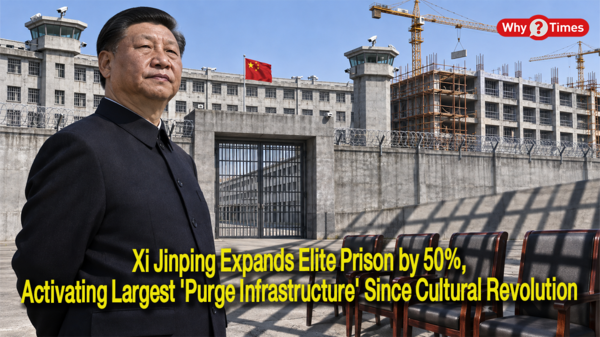
Beijing's Qincheng Prison, which detains the highest-ranking figures of the Chinese Communist Party (CCP), is undergoing its largest expansion since the Cultural Revolution. According to an analysis of satellite imagery by the U.K.'s The Economist, construction that began earlier this year will add at least 300 new cells, increasing the facility's capacity by roughly 50%. The timing of the expansion coincides precisely with the Xi Jinping regime's anti-corruption dragnet sweeping past ministerial-level officials to engulf Central Committee members and the military's top brass. Between January and September of this year alone, 105 cadres at or above the ministerial level were disciplined, and at last month's Fifth Plenum of the 20th Central Committee, the expulsion of 33 full and alternate Central Committee members was finalized all at once. The pace of the prison's expansion mirrors the pace of the purges, reflecting the magnitude of the warning Xi Jinping is sending to Party elites ahead of the 21st Party Congress in 2027. In short, it is nothing less than an admonition that anyone can be purged—a maximization of fear.
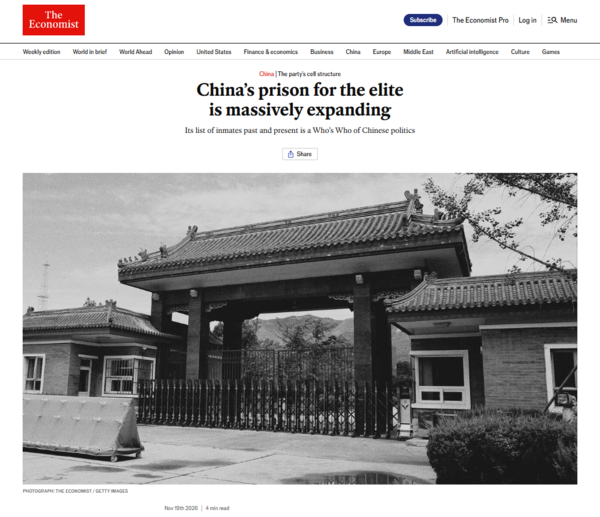
On the 20th, The Economist reported that "a detention facility for China's elites is undergoing a massive expansion," noting that "its roster of past and present inmates reads like a who's who of Chinese politics." The magazine further noted that "notorious Qincheng Prison sits at the foot of a mountain range on Beijing's northern outskirts and has housed China's most sensitive political prisoners, including numerous fallen officials, since it was built in the 1950s under Chairman Mao Zedong," adding that "student leaders of the 1989 Tiananmen Square protests were also locked in solitary confinement there and forced to sleep on wooden planks." One former inmate described Qincheng as "a place where you realize you are not a human being."
According to The Economist, Qincheng Prison was shrouded in secrecy from its inception. Built in 1958 with aid from the former Soviet Union, it was kept confidential while the other 156 Sino-Soviet aid projects were publicized—causing the joint initiative to be known externally as the "156 Projects." Located at the foot of the Yanshan Mountains in Beijing's northern Changping District, it is the only prison in China directly administered by the Ministry of Public Security rather than the Ministry of Justice. Initially, it consisted of just four three-story brick buildings labeled Jia, Yi, Bing, and Ding, each equipped with interrogation rooms and an independent courtyard. As high-ranking "criminals" surged during the Cultural Revolution, six additional blocks—from Wu to Gui—were added in 1967. That is why the current expansion is assessed as the largest since the Cultural Revolution.
The Economist published side-by-side satellite images of Qincheng Prison taken in 2016, 2021, 2023, and 2026. Until 2016, the area west of the prison was farmland. Major construction began there in 2021, erecting large barracks spanning roughly 7 hectares—the equivalent of 10 soccer fields—and by 2023, the outline of a new detention zone had emerged. In 2022, the northeastern cellblocks were renovated with an added exercise yard. Three new changes were captured in this year's imagery: additional cellblocks, an expanded administrative complex, and a new construction site on the eastern grounds. The centerpiece is a massive building up to six stories tall being erected on the site of two demolished cellblocks, estimated to house at least 300 cells alone. Staff quarters and administrative facilities are also expanding on the eastern side. Chinese authorities treat information regarding prison facilities as state secrets and have never officially announced the construction.
[A Prison Reflecting the Shadows of Chinese Power History]
The roster of Qincheng Prison's inmates serves as a direct chronicle of CCP power struggles. In 2009, Global People (Huanqiu Renwu), a magazine affiliated with the People's Daily, divided the prison's history into four eras. In the 1950s and 1960s, it primarily held high-ranking officials of the Qing Dynasty, Japanese war criminals, and Kuomintang (KMT) war criminals holding the rank of major general or higher. During the Cultural Revolution, it housed senior figures branded as "rightists" and alleged "counterrevolutionary ringleaders," while in the 1970s and 1980s, it held associates of the Lin Biao faction and the "Gang of Four." Since the 1990s, its primary inmates have shifted to corrupt provincial- and ministerial-level officials. Former Politburo Standing Committee member Zhou Yongkang and former Chongqing Party Secretary Bo Xilai, both sentenced to life imprisonment, are known to be incarcerated there. Participants in the 1989 Tiananmen pro-democracy movement also passed through its cells.
Citing a former Ministry of Justice official, The Economist reported that the criterion for imprisonment at Qincheng is not rank, but "what you know." The rationale is that individuals who have had access to state secrets cannot be placed in ordinary prisons. The custom of prison guards treating high-ranking inmates with courtesy is tied to the same logic: if the political landscape shifts, today's prisoner could be rehabilitated tomorrow and return to the center of power. Indeed, The Economist noted that in the past, whenever power shifted within the Party, the inmate population at Qincheng tended to decline. Conversely, the expansion of cellblocks signals that no such power shift will occur anytime soon—in other words, that Xi Jinping's one-man rule is set to be prolonged.
[The Acceleration of 'Tiger Hunting' by the Numbers]
Behind the expansion lies a statistically evident acceleration in disciplinary purges. According to official statistics from the Central Commission for Discipline Inspection and the National Supervisory Commission (CCDI), 181 "centrally managed cadres" (zhongguan ganbu—officials at or above the vice-ministerial level whose appointments and dismissals are controlled by the Party Center) were placed under investigation in 2025. The pace has quickened this year. In the first quarter alone, 30 provincial- and ministerial-level cadres were placed under investigation and 56 were disciplined; by the end of the first half, cumulative totals reached 50 investigated and 74 disciplined. For the January–September period, cumulative figures hit 73 investigated and 105 disciplined. The Economist analyzed that "the 105 senior ministerial-level officials subjected to imprisonment and other punishments so far this year already exceed 1.5 times last year's annual total." During the same period, disciplinary bodies nationwide opened 800,000 cases and disciplined 680,000 individuals.
The purges culminated at the Fifth Plenary Session of the 20th Central Committee (Fifth Plenum), held in Beijing from the 26th to the 29th of last month. The plenum finalized the expulsion of 33 members—24 full Central Committee members and 9 alternate members—and stripped alternate member Li Yunze of his intra-Party posts. Compared to 3 expulsions at the Third Plenum and 14 at the Fourth Plenum, the scale more than doubled, prompting Taiwan's World Journal to describe it as the largest purge since the Cultural Revolution. Sixteen of those expelled came from the military. They included former Central Military Commission (CMC) Vice Chairman Zhang Youxia, previously the highest-ranking uniformed officer in the Chinese military, and former Joint Staff Department Chief of Staff Liu Zhenli. On the civilian side, former Politburo member Ma Xingrui and former International Liaison Department Head Liu Jianchao were among those named.
[From Top Brass to Defense Moguls… Even 'Xi's Men' Are Not Spared]
The list also confirmed for the first time the fates of figures who had vanished from public view for months. The expulsions of former Eastern Theater Command Political Commissar Liu Qingsong, former Northern Theater Command Commander Huang Ming, and former Western Theater Command Commander Wang Haijiang only became known after the plenum communiqué was released. In effect, the theater command leadership overseeing the Taiwan Strait, the Korean Peninsula, and the Indian border collapsed simultaneously. The defense sector was not spared either: former China National Nuclear Corporation Chairman Yu Jianfeng, China Aerospace Science and Industry Corporation Chairman Yuan Jie, and China State Shipbuilding Corporation Chairman Wen Gang were all expelled.
The New York Times (NYT) assessed that "this announcement demonstrates how deep Xi Jinping's anti-corruption purge runs as he eyes a fourth term next year." Tsai Wen-hsuan, a research fellow at the Institute of Political Science at Taiwan's Academia Sinica, told the NYT that "this plenum signifies a sweeping purge of officials whom Xi Jinping personally promoted after taking power in 2012." Meanwhile, the enforcer of the purges saw his stock rise: CMC Vice Chairman Zhang Shengmin, who rose through the military's discipline inspection commission, was elevated to the Politburo at the plenum. Attendance at the plenum stood at 279, roughly 74% of the 376 members elected at the 20th Party Congress in 2022—the lowest attendance rate since the Reform and Opening-up era began. In the void left by the disappearance of a quarter of the Central Committee, 300 new prison cells are being built.
[Why Times Insight]
The expansion of Qincheng Prison is an effort to cast Xi Jinping-style rule by fear in concrete. The roughly 300 new cells are more than enough to incarcerate the entire 279-member Central Committee that attended the Fifth Plenum. That is why dissident Zhou Fengsuo quipped on X (formerly Twitter) that the facility is "large enough to lock up the entire Central Committee." The sheer number of cells is itself a message to the Party's upper echelons—a warning that the moment anyone deviates from the leadership's line, they could become the next inmate.
Even more noteworthy is that the blade of the purge is aimed not at political rivals, but at loyalists whom Xi Jinping personally handpicked. An inability to trust even one's own people is not proof of consolidated power; rather, it is evidence of how deep distrust runs within the system. Beijing touts this as an achievement of "comprehensive and strict Party governance" and anti-corruption efforts, yet the fact that investigations break records every year even after 13 years of anti-corruption campaigns is tantamount to a confession that the system itself has failed. Governance that binds elites together through fear rather than trust may extract loyalty in the short term, but it breeds information distortion, buck-passing, and rigid decision-making. The simultaneous vacuum across military theater commands and defense industry leadership also casts doubt on China's actual warfighting capabilities. The new cells at Qincheng are an architectural monument that most honestly reflects not the strength of Xi Jinping's regime, but its anxiety.
-중국 푸단대학교 한국연구원 객좌교수
-전 EDUIN News 대표
-전 OUR NEWS 대표
-제17대 대통령직인수위원회 정책기획팀장
-전 대통령실 홍보기획비서관
-사단법인 한국가정상담연구소 이사장
-저서: 북한급변사태와 한반도통일, 2012 다시우파다, 선거마케팅, 한국의 정치광고, 국회의원 선거매뉴얼 등 50여권