Update2026.11.09 (월)


[Xi Jinping Even Ousts Former Personal Secretary… Close Confidants Were Not Safe Either]
The purges under the Xi Jinping regime have extended beyond the military high command to the closest confidants handpicked and nurtured by Xi himself, turning the Central Committee of the Chinese Communist Party—now in the fourth year of its term—into a "regime of empty chairs" with a quarter of its seats vacated. Particularly noteworthy is that the CCP ratified the expulsion of 33 senior officials from party membership at the 5th Plenum. The ousted roster included not only the highest tier of the armed forces but also Zhong Shaojun, Xi's long-serving former personal secretary. While Zhang Shengmin, who spearheads the military purges, was elevated to the Politburo, no announcements were made to fill the vacancies on the Central Military Commission (CMC), hollowed out by massive purges. For Xi, who is widely expected to secure a fourth term next year, this plenum served as a showcase of his absolute personnel grip, while simultaneously laying bare the paradox of a rule in which he cannot even trust those he personally groomed.
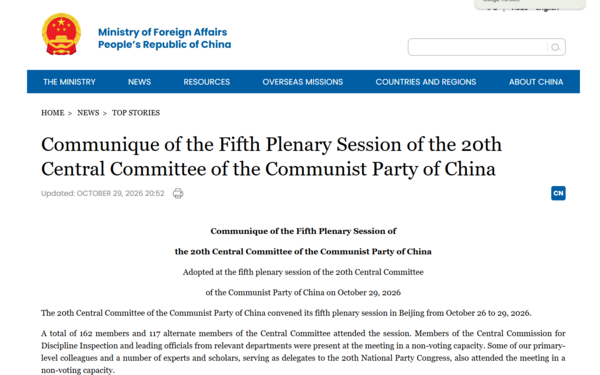
The official communique of the 5th Plenum released by the Chinese Foreign Ministry stated that "the Fifth Plenary Session of the 20th Central Committee of the Communist Party of China was held in Beijing from the 26th to the 29th, confirming the Politburo's prior decisions to expel 17 party and government officials and 16 military figures." It clarified that "33 individuals were not newly caught at once during this plenum; rather, the Central Committee formally endorsed disciplinary measures that had been handed down previously." The communique also officially announced the schedule that "the upcoming 21st Party Congress will be convened in Beijing in the second half of 2027."
The most symbolic figure among them is Zhong Shaojun, former director of the CMC General Office. Zhong served as Xi Jinping's personal secretary starting in Zhejiang Province, accompanying him to Shanghai and all the way to Beijing as an enduring confidant. After entering the military, he assisted Xi directly at the CMC. His expulsion demonstrates that not only peripheral power figures but even those who built decades of deep personal trust with the paramount leader are by no means safe from purges.
Diplomatic, financial, and regional provincial leadership were no exception. High-ranking cadres swept into the purge included Liu Jianchao, former head of the International Liaison Department of the CCP, once considered a leading candidate for Foreign Minister; Ma Xingrui, former Party Secretary of the Xinjiang Uyghur Autonomous Region; Jin Zhuanglong, former Minister of Industry and Information Technology; and Yi Huiman, former Chairman of the China Securities Regulatory Commission. The simultaneous removal of senior officials across disparate sectors indicates that this personnel action is a sweeping power shake-up far exceeding a routine cleanup of sector-specific graft.
[Military Command Hollowed Out, While Chief Inspector Rises]
The military roster effectively guts the upper echelon of the People's Liberation Army (PLA) command architecture. It includes Zhang Youxia, former Vice Chairman of the CMC; Liu Zhenli, former Chief of the Joint Staff Department; Wang Renhua, Secretary of the CMC Political and Legal Affairs Commission; Liu Qingsong, former Political Commissar of the Eastern Theater Command; Huang Ming, former Commander of the Northern Theater Command; and Li Qiaoming, former Commander of the PLA Ground Force. Investigations into Zhang Youxia and Liu Zhenli were first announced on January 24 of this year. Later, at a Politburo meeting on September 21, both were stripped of their party and military affiliations on charges of "faction building" and "disloyalty," actions that the Central Committee formally ratified at this plenum.
As a result, of the seven-member Central Military Commission formed at the 20th Party Congress in 2022, five members—He Weidong, Li Shangfu, Miao Hua, Zhang Youxia, and Liu Zhenli—have been purged. Only two remain: Chairman Xi Jinping and Vice Chairman Zhang Shengmin. The vacant seats were once again left unfilled.
Assistant Professor Wu Se-chih of the Taipei University of Marine Technology analyzed on Voice of America (VOA) that "the concept of collective leadership is increasingly tilting toward the CMC Chairman Responsibility System—a dynamic where absolute authority is concentrated entirely in one individual." He also noted that "successive purges have depleted the pool of qualified senior generals," citing this as another key reason for the delay in appointments.
The purges spread deep into the defense industry as well. The communique roster named Yuan Jie, former Chairman of China Aerospace Science and Industry Corporation (CASIC); Wen Gang, former Chairman of China State Shipbuilding Corporation (CSSC); and Yu Jianfeng, former Chairman of China National Nuclear Corporation (CNNC). Ma Xingrui, former Party Secretary of Xinjiang, and Jin Zhuanglong, former Minister of Industry and Information Technology—both former aerospace engineers—were also included. Analysts at the Asia Society Policy Institute (ASPI) pointed out that "while China continues to unveil advanced, formidable military hardware, these purges raise critical questions about operational leadership and combat readiness."
[Diplomatic and Regional Elites Crumbled]
On the party and government side, Liu Jianchao, former head of the International Liaison Department and once viewed as a leading contender for Foreign Minister, stands out. After rumors of an investigation circulated last summer, he vanished from public view, but authorities only now formally confirmed "serious violations of discipline." In addition, Lan Tianli, former Chairman of the Guangxi Zhuang Autonomous Region; Wang Lixia, former Chairwoman of the Inner Mongolia Autonomous Region; and Yi Huiman, former Chairman of the China Securities Regulatory Commission, were named. Technocrats promoted during the Xi Jinping era across diplomacy, finance, ethnic minority frontier provinces, and high-tech industries have been hit across the board.
[97 Empty Chairs… Lowest Attendance Rate 'Since Mao']
The scale of the purge was illustrated even more visibly by the sea of empty seats in the assembly hall. Total attendance at this plenum stood at 279 (162 Central Committee members and 117 alternate members), representing just 74.2% of the 376 members elected in 2022. This marks a decrease of 36 delegates compared to last year's 4th Plenum (315 attendees, approximately 83.8%) and is lower than the pre-meeting estimate of 291 delegates (77%) projected by the Asia Society Policy Institute (ASPI). Neil Thomas, Senior Fellow at ASPI, characterized this as a "new post-Mao low." Reuters reported that "a substantial number were unable to attend due to purges." An analysis by the Wall Street Journal (WSJ) showed that, among plenums with disclosed attendance rates, this was the lowest figure since meetings during the Cultural Revolution in 1968.
Personnel adjustments were equally irregular. Although the party promoted 10 alternate members to full Central Committee status, it did not refill the full 205-seat quota that had been customary under Xi's rule. According to the WSJ, the statutory size of the Central Committee shrank to 191 members. While alternate members are conventionally promoted in order of vote count at the Party Congress, five higher-ranked alternates were skipped over. Among those elevated, Shanxi Governor Lu Dongliang and Zhejiang Governor Liu Jie are seen as rising contenders for the seventh-generation leadership.
[Purge Commander Zhang Shengmin Enters the Politburo]
The sole major promotion at this plenum was the elevation of Zhang Shengmin to the Politburo. Born in Shaanxi Province in 1958, Zhang directed anti-graft investigations across the military as Secretary of the CMC Commission for Discipline Inspection, becoming CMC Vice Chairman at the 4th Plenum last year. According to the Financial Times (FT), he is currently the only military officer on the Politburo. Senior Fellow Thomas noted on X (formerly Twitter) that Zhang is "the first person to be elevated to the Politburo outside a full Party Congress since 1994." Analyst Tsai Wen-hsuan observed that "this signals an even further tightening of the military disciplinary inspection apparatus," forecasting that "more senior flag officers could be purged moving forward."
[Decision to 'Strictly Govern the Party with Full Rigor'… Anti-Corruption Cemented as a Statecraft Mechanism]
The plenum also adopted a Central Committee decision on "Continuously Advancing Full and Strict Governance over the Party." The communique explicitly stated the need to "maintain a high-pressure stance in punishing corruption and strengthen checks and supervision over the exercise of power," demanding the study and implementation of "Xi Jinping Thought on Party Building." However, The New York Times (NYT) pointed out that similar pledges were issued at a plenary session on the exact same theme a decade ago. Statistical records reflect this posture: disciplinary agencies penalized a record 983,000 individuals last year, and disciplined approximately 680,000 personnel between January and September this year, including over 100 officials at the provincial-ministerial level or higher. Those penalized for inadequate policy execution and dereliction of duty reached 131,000, an 18.6% increase compared to the same period last year.
Professor Chong Ja Ian of the National University of Singapore, a non-resident scholar at Carnegie China, told the BBC that "anti-corruption has already become an established instrument for consolidating and preserving power." He projected that "going forward, the scale of anti-corruption campaigns will depend less on the actual severity of graft and more on how Xi Jinping perceives the security and stability of his own authority."
[Why Times Insight | People Can Be Replaced, but Trust Cannot Be Commanded]
What this 5th Plenum revealed is that the strength and the fragility of Xi Jinping's power are two sides of the same coin. The fact that he can simultaneously purge his personal secretary and the military's second-in-command proves that no rival faction remains within the party capable of checking him. A fourth term in 2027 is virtually an established reality. Yet, the reality that Xi himself had to purge a quarter of the Central Committee members he personally vetted and elevated amounts to a tacit admission that his own personnel screening system has failed.
The most critical concern lies within the military. The contraction of the seven-member CMC collegial body into a two-man setup consisting solely of the "Chairman and his Chief Inspector" sharply magnifies the risk of command rigidity and distorted intelligence flow in the event of a crisis in the Taiwan Strait. In an organization where loyalty screenings thoroughly eclipse evaluations of operational competence, reporting invariably gets filtered upward to tell leaders only what they wish to hear. As researchers at the Brookings Institution pointed out, Xi Jinping can replace people, but he cannot manufacture genuine trust. A system bound together by fear reacts latest and relies on the most distorted intelligence during an acute crisis. This is why South Korea and the United States must monitor not only China's raw military hardware, but also its core decision-making apparatus.
Heading into next year's Party Congress, what warrants scrutiny is not merely the tally of further purges. Observers must watch who fills the vacant posts, how much operational combat experience and policy competence are valued, and whether the new leadership cadre can carry out its mandate with stability. Xi can switch out personnel at will, but he cannot command trust by decree. South Korea and the United States must appraise both China’s weaponry and troop strength as well as the judgment structures of the leadership wielding that power, for compliance gained through fear can never guarantee accurate reporting or competent execution.

-중국 푸단대학교 한국연구원 객좌교수
-전 EDUIN News 대표
-전 OUR NEWS 대표
-제17대 대통령직인수위원회 정책기획팀장
-전 대통령실 홍보기획비서관
-사단법인 한국가정상담연구소 이사장
-저서: 북한급변사태와 한반도통일, 2012 다시우파다, 선거마케팅, 한국의 정치광고, 국회의원 선거매뉴얼 등 50여권