Update2026.11.09 (월)


[Growing vacancies in the Central Committee… A crisis of trust left in the wake of purges]
The sword of purges that Chinese President Xi Jinping has wielded to consolidate power is now straining the very foundation of his rule. Compounded by vacancies across the central leadership and frequent turnover among provincial chiefs, the Chinese Communist Party (CCP) faces a formidable dilemma in forming its next leadership slate ahead of the 21st Party Congress in 2027. Having ousted even his handpicked confidants, a pointed question arises: whom can he trust to steer state affairs in the next term? It is a stark paradox where purges aimed at securing personal power are progressively undermining China's capacity to prepare for the future.
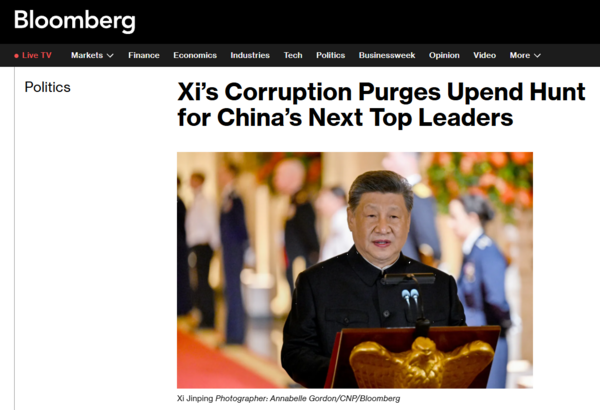
On the 28th, Bloomberg reported that “a shadow of personnel instability hangs over the 5th Plenary Session of the 20th CCP Central Committee, held from the 26th to the 29th,” highlighting an analysis by the Asia Society Policy Institute which projected that “only about 291 of the 376 full and alternate members elected in 2022 are expected to attend, representing just 77.4% of the original roster.”
Bloomberg further observed, “The downward trend in attendance had already become apparent, with total attendance of full and alternate members declining from 373 at the Second Plenum in 2023, to 364 at the Third Plenum in 2024, and down to 315 at last year's Fourth Plenum.” The outlet noted, “If the current projection holds, attendance will shrink even further—a combined consequence of investigations, expulsions, and prolonged absences that shows the leadership slate Xi formed at the start of his third term is destabilizing significantly before completing its tenure.”
The shockwaves are most acute within the military. According to the Brookings Institution, the Central Military Commission (CMC), which started Xi’s third term with seven members, has dwindled to just two: Xi Jinping and Zhang Shengmin. Out of 44 military-backed Central Committee members elected in 2022, only 17 remain on paper, and Brookings observes that the only figures with visibly confirmed recent public activities are Dong Jun and Zhang Shengmin. While this cannot definitively be labeled as “42 purged,” the level of uncertainty paralyzing the military leadership is profound.
Three members have also been ousted from the Politburo during this term. Yet, the pace of filling vacancies remains sluggish compared to the speed at which seats are emptied. Brookings pointed out that “the promotion of military alternate members to full members was not carried out at the previous plenary session,” adding, “If successors cannot be readily selected even after problematic figures are removed through purges, the core of the personnel crisis goes beyond mere vacancies to the question of whom the leader can actually trust.”
[Provincial leadership turned into a revolving door… Prioritizing immediate survival over long-term policy]
Personnel turbulence is by no means confined to Beijing. According to a Bloomberg analysis of local leadership appointments over the past 20 years, the average tenure of provincial party secretaries through September dropped from 43 months during Xi’s first five years in office to 26.5 months—a sharp decline of about 38%. Eight new provincial party secretaries have been appointed this year alone, signaling accelerated turnover in key posts responsible for local economies and administration.
According to Bloomberg, Anhui Province, a hub for the electric vehicle industry, and Qinghai Province, a clean-energy center, have each seen three party secretaries rotate through since the 20th Party Congress in 2022. To be sure, not all departures stem from purges; promotions, reassignments, and retirements play a role. However, when relentless turnover coincides with investigations and dismissals, local officials inevitably run out of time to implement policies, rectify mistakes, and validate results on the ground.
This disruption severely burdens areas demanding sustained, long-term commitment, such as industrial investments and local fiscal management. Each time a new leadership arrives and reassesses previous project priorities while scrutinizing accountability, administrative continuity unravels. In cases where a predecessor faces an active investigation, even the decision to carry forward their flagship initiatives carries immense political risk. This is the exact transmission path through which personnel instability spills over into policy paralysis.
Professor Victor Shih of the University of California, San Diego, similarly warned that frequent turnover among senior officials tends to shorten bureaucratic horizons. Officials “end up focusing on responding to the latest directives from the center rather than prioritizing long-term reforms or economic growth.” Commenting on this, Bloomberg noted, “If avoiding immediate political peril takes precedence over driving policies through to fruition, the judgment and executive drive needed to navigate a difficult economy will inevitably wither.”
Hence, the core issue is not simply the shrinking tenure of provincial leaders; it lies in what behaviors officials deem necessary for self-preservation. When standards for purges are opaque and reassignments occur at breakneck speed, deciphering signals from superiors becomes far more critical than delivering long-term performance. At a juncture where the Chinese economy urgently requires consistent structural reforms and accountable execution, the personnel apparatus risks engineering perverse incentives in the opposite direction.
[The massive 2027 reshuffle… Whom to trust and elevate?]
Bloomberg notes that Xi is widely expected to secure a fourth term at the 21st Party Congress next year. Yet, engineering his own tenure extension and assembling an effective team to govern alongside him remain two distinct challenges. If traditional retirement norms are observed, massive turnover is anticipated across the Politburo Standing Committee as well. Compounded by lingering vacancies within the CMC and the wider Politburo, the leadership cannot dodge the imperative of selecting new personnel to run state affairs, even as Xi maintains his position at the apex of power.
Senior Chinese officials traditionally hone their competencies and build track records by rotating through key regional and central posts. Rotations are meant to broaden executive breadth. However, when career pipelines are disrupted by repeated purges and abrupt dismissals, predictability in cultivating and vetting the next echelon of leaders collapses. It is not that China lacks bureaucrats; rather, it has become difficult to maintain a stable pipeline of qualified candidates who possess both administrative competence and the absolute personal trust of the top leader.
While recent personnel adjustments have brought prospective Politburo contenders to the fore, technical credentials and political reliability remain very different matters. With Xi’s handpicked loyalists having fallen victim to purges, what metrics can newcomers leverage to prove their loyalty? Amplifying performative loyalty provides no guarantee of integrity or policy efficacy. This dynamic exposes deep systemic vulnerabilities within an appointment process that cannot be resolved merely by swapping out personnel.
Professor Joseph Torigian of American University assessed that “Xi has lost confidence in many Central Committee members since the last party congress and will be determined to avoid repeating those missteps in upcoming appointments.” Consequently, he projected that “vetting and punitive enforcement will likely intensify further.” Conversely, if leadership resists elevating fresh faces and opts to retain incumbents, generational renewal will stall. Regardless of the choice made, Beijing must confront the profound deficit of institutional trust forged in the wake of relentless purges.
[Why Times Insight ; The more power is guarded, the harder governance becomes]
The Structure of a Self-Reinforcing Trap: Xi Jinping’s dilemma condenses into a vicious cycle: purges unmask corruption among inner-circle confidants; unmasked corruption fuels suspicion; suspicion breeds harsher vetting and punishment; and heightened scrutiny further shrinks the pool of viable candidates. As Professor Torigian envisions, if vetting sharpens ahead of the 2027 appointments, this feedback loop will spin even faster. The purges once wielded as instruments of power consolidation have converted into a mechanism that actively cannibalizes administrative governance capacity.
The Trade-off Between 'Loyalty' and 'Competence': The collapse of provincial party secretary tenures to 26.5 months is not merely a statistical artifact; it indicates regional chiefs are shuffled out before they can even pilot an initiative and gauge its efficacy. As Professor Victor Shih pointed out, when bureaucrats direct their energies toward reacting to real-time central directives rather than structural overhauls, pressing challenges like local government debt crises and sluggish capital investment are relegated to the sidelines. Just when China's economy most critically demands long-range stewardship, the cadre management system creates incentives running entirely counter to that need.
The Perils of Gerontocracy and Succession Voids: For a supreme leader unable to trust newcomers, the safest tactical maneuver is clinging to familiar faces. Should the scenario of overriding customary retirement conventions to freeze the current lineup materialize, a gerontocracy of aging loyalists will encircle a 73-year-old leader. While this might simulate surface stability in the immediate term, anchoring the system ever more completely to a single individual without proven successors dramatically elevates systemic fragility over the horizon.
A Void in the Military Command Chain: A CMC stripped down to two figures and an Central Committee military contingent hollowed out of active presence unavoidably casts doubts on the command continuity and operational readiness of the People's Liberation Army (PLA). Coupled with flashpoints like Taiwan, this security trajectory demands heightened vigilance from neighboring states.
Exposing corruption and enforcing accountability are unquestionably imperative. Yet, when recurring removals of close associates occur without building a sustainable framework to identify, vet, and supervise reliable cadres, perpetual instability ensues. Misconduct among confidants heightens paranoia, which triggers stricter vetting and harsher crackdowns, prompting officials to retreat further into political self-preservation. Escalating punitive severity is by no means synonymous with improving the quality of governance.
To navigate headwinds in its economy and groom its next cohort of leaders, China requires an accumulation of experience, policy continuity, and courageous execution. If the specter of purges and rapid reshuffling erodes this foundation, China’s present and future will shoulder the cost together. The trap Xi Jinping has dug for himself does not point to an immediate loss of power; rather, it lies in how the very methods employed to guard his authority systematically hollow out his ability to effectively govern the nation and prepare for tomorrow.

-중국 푸단대학교 한국연구원 객좌교수
-전 EDUIN News 대표
-전 OUR NEWS 대표
-제17대 대통령직인수위원회 정책기획팀장
-전 대통령실 홍보기획비서관
-사단법인 한국가정상담연구소 이사장
-저서: 북한급변사태와 한반도통일, 2012 다시우파다, 선거마케팅, 한국의 정치광고, 국회의원 선거매뉴얼 등 50여권