
Update2026.11.09 (월)


[Shanghai Composite Hits a 14-Month Low… STAR 50 Plummets 4.8% in a Single Day]
While the Chinese Communist Party convenes the 5th Plenary Session of the 20th Central Committee—emphasizing party discipline and loyalty—the Chinese stock market suffered a shocking market crash, with more than 4,900 stocks tumbling. The market, once groomed to serve as the financial pipeline for technological rise led by artificial intelligence (AI) and semiconductor firms, has instead fallen into a deep correction as investors lose confidence due to Chinese politics. While overvalued tech stocks and an economic slowdown triggered the sell-off, one cannot overlook the reality that the market is struggling to find answers for growth at a time when the Party is underscoring political control. Notably, what the Chinese stock market is losing is not merely a few hundred index points, but the hope that the future will improve.
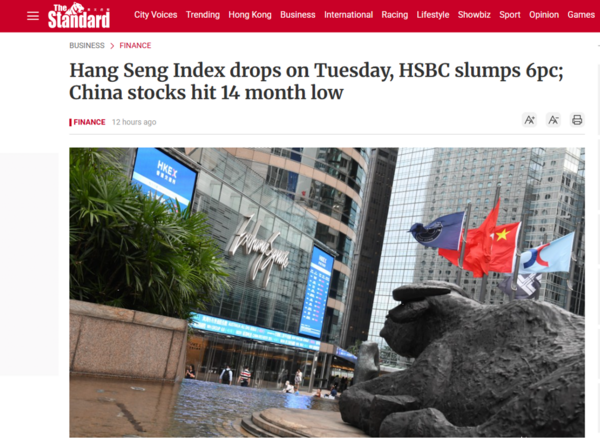
Hong Kong's English-language daily The Standard reported on the 27th that "Chinese stocks attempted a rebound early in the session on the 27th, but surrendered their gains as selling pressure intensified in the afternoon." It noted, "The Shanghai Composite Index closed down 1.3% from the previous day at around the 3,648 level, marking its lowest level in about 14 months since August 2025; the Shenzhen Component Index also dropped 2.5% to finish near 11,245, while the growth-oriented ChiNext Index shed 3.41% to close at 2,548.15."
The Standard further highlighted, "In particular, the STAR 50 Index—the benchmark index of Shanghai's Science and Technology Innovation Board—plunged 4.81% in a single day," adding, "More than 4,900 stocks declined across the Shanghai and Shenzhen bourses, demonstrating that the shock of the downturn spread throughout the broader market rather than being confined to weakness in a few large-cap shares."
According to the Financial Times (FT), the divergence of the Chinese market was even more pronounced when compared to neighboring economies. Following a rebound in US tech stocks the previous day, stock markets in South Korea and Japan traded strongly on the 27th, whereas mainland China and Hong Kong markets slumped. While global expectations for the AI industry remain robust, doubts over profitability and stretched valuations of Chinese tech firms weighed heavily on investor sentiment.
The day's decline was not an isolated shock. According to Reuters, the blue-chip benchmark CSI 300 Index has fallen about 20% from its June peak. Given that a 20% drop from a peak is conventionally classified as a technical "bear market," China's equity market has moved beyond a simple temporary correction into a phase of prolonged dampening in investor sentiment.
Bloomberg also reported on the 27th that "roughly $2.4 trillion (around 3,187 trillion won) in market capitalization has been wiped out from Chinese equities since their May peak." A slump in stock prices does not end merely as paper losses. Households that feel their asset values shrinking grow more cautious regarding spending and investment, which can further weigh on already fragile domestic demand. However, the actual impact on consumer spending varies depending on portfolio size and individual household circumstances.
[AI and Semiconductor Stocks, Once the Beacon of Hope, Have Crashed]
Addressing this, Reuters reported, "The most painful aspect of this downturn is that the tech companies championed by the Chinese government as the core of future growth are at the very epicenter of the sell-off," noting that "as the STAR 50 Index—packed with Chinese AI and semiconductor firms—slumped roughly 40% in less than four months, about $480 billion (around 637 trillion won) in market capitalization evaporated from related companies." Reuters diagnosed that China's AI bubble has already burst.
According to Reuters, the AI boom in China had previously been fierce. As US export controls on advanced semiconductors intensified, China was pushed to develop domestic AI and chip technologies, leading investors to anticipate new growth opportunities for Chinese enterprises. Slogans of state policy support and technological self-reliance fueled the rally in related share prices.
However, anxiety mounted as stock prices surged far ahead of actual corporate earnings. According to Reuters, concerns over whether AI demand will sustain expectations and whether Chinese firms can expand business while navigating US technological restrictions fueled the sell-off. Investors began recalibrating their assessments of heavily inflated share prices.
The core issue lies in the massive weight the AI investment craze held within China's stock market. Citing estimates from Goldman Sachs, The Guardian noted that "AI-related stocks account for more than 40% of the total market capitalization of mainland China and Hong Kong equity markets." Consequently, when expectations concentrated on tech stocks collapse, the shock inevitably spreads across the entire market.
The Xi Jinping leadership sought to channel household savings into the stock market to help high-tech firms raise capital, leveraging them in the technological competition with the United States. Reuters pointed out that "the sharp plunge in tech stocks could deal a blow to Beijing's vision of tapping savings through the capital markets to fund its AI industry."
Naturally, falling share prices do not automatically mean immediate financing failure for all tech companies. However, sustained lower corporate valuations could complicate capital raising via new share issuance or initial public offerings. Having weathered steep losses, investors are also bound to turn far more cautious about deploying capital into the next generation of tech firms. A paradox has emerged: the very capital markets needed to fuel China's technological drive are now faltering as outsized expectations for that technological ambition unravel.
[The Real Economy Is Also Fragile… Absence of Domestic Demand to Support Equities]
Instability in the stock market is not limited to tech shares. Real economic indicators observed by investors fail to inspire confidence in a domestic demand recovery. Furthermore, when households lack confidence in future earnings and asset values, increasing consumer spending proves difficult. Businesses likewise hesitate to expand new capital expenditures and hiring amid uncertain consumption prospects. Weakened corporate profit outlooks further deflate expectations for equity investments. Real estate, consumption, corporate investment, and the stock market are mutually reinforcing one another, constructing a vicious cycle that complicates any restoration of confidence.
In particular, if the Chinese leadership intends to use equity markets as a funding channel for tech industries, households must believe in the long-term economic outlook well beyond short-term stock gains. However, when instability across major assets like real estate and equities persists simultaneously, demanding that investors take on greater risk is a tall order.
[Market Defense by the 'National Team'… Confidence Fails to Return Even After Rebounds]
Chinese authorities have not stood idly by watching the sharp market drop. Whenever markets face severe turbulence, state-backed institutional investors—the so-called "National Team"—have intervened. According to Reuters, during the process where Chinese equities erased intraday losses to rebound on the 23rd, trading volumes in several exchange-traded funds (ETFs) favored by state-backed investors surged. This prompted market speculation that state capital had stepped in to prop up share prices.
The Shanghai Composite briefly slipped below the 3,600 mark that day before closing up 0.89% at 3,690.48. The subsequent decline on the 27th demonstrates that such rebounds have yet to translate into sustained restoration of confidence. Buying shares through state funds does not automatically improve corporate profitability, nor does it enhance household income outlooks or private enterprise investment environments. State capital may buy time for the market, but converting that borrowed time into confidence in durable growth is an entirely separate challenge.
[The Party Debates Discipline, While the Market Searches for Growth Solutions]
Against this backdrop, the Chinese Communist Party is holding the 5th Plenary Session of its 20th Central Committee in Beijing from October 26 to 29. According to Xinhua News Agency, the official agenda of this meeting is strengthening "full and rigorous Party self-governance." The leadership is placing weight on enforcing party discipline and ensuring central directives are executed properly on the ground.
The FT reported that "the meeting will serve as a venue showcasing President Xi Jinping's dissatisfaction with the discipline and performance of officials heading key local and central institutions." Attention is also focused on the event as a critical political milestone leading up to the 21st Party Congress next year. The plenum convened amid an ongoing series of investigations and purges targeting senior military and party figures. Citing experts, the Associated Press reported that "attendance at this plenary session may be lower than in the past."
Tightening party discipline is not inherently detrimental to the economy; curbing corruption and enhancing the execution of government policy can indeed support economic health. However, the questions posed by the market today are far more concrete: Will the outcomes of this 5th Plenum revive consumption? Can corporations increase long-term investments? Will lofty growth expectations for tech firms translate into tangible profits?
To be sure, there is no definitive basis to conclude that the 5th Plenum is the direct cause of the stock market slide. The decline predated the meeting, and economic factors such as tech overvaluation and economic slowdown are evident. Yet, the fact that the market remains unconvinced about the future of growth and profitability at a moment when the Party is emphasizing control and discipline underscores the core challenge facing China's leadership.
[Why Times Insight | What the Market Has Lost Is Confidence in the Future]
The decline on the 27th cannot be attributed solely to the 5th Plenum. The immediate trigger was the collapse of overheated AI and semiconductor valuations, corroborated by analyses from Reuters, Goldman Sachs, and Morgan Stanley. However, the interpretation that this downturn is inherently "political" holds compelling weight for other reasons: China alone collapsed while global equities maintained their AI rally, and interventions by the National Team failed to hold up even for a single day in the very midst of a major political conclave. As the Party emphasizes discipline and loyalty while the market asks for growth and earnings prospects, the overlap of this 5th Plenum with the market rout is profoundly symbolic. In short, the stock market reflects that politics is offering zero economic hope.
The Xi Jinping administration has pushed a vision of steering household savings into equities to serve as the financial pipeline for technological self-reliance. The stock market was not merely a trading venue, but an engine of state-engineered "technological rise." The fact that this engine sputtered out precisely against the backdrop of the 5th Plenum's purge stage carries weighty implications. For the Xi administration, this is an immense shock.
In this regard, the message delivered by the market is clear: within a system where political loyalty overrides economic rationality, investors will no longer wager on the assumption that "the government will hold up the floor." What the Chinese stock market has lost is not a few hundred index points, but that very expectation—namely, hope.


-중국 푸단대학교 한국연구원 객좌교수
-전 EDUIN News 대표
-전 OUR NEWS 대표
-제17대 대통령직인수위원회 정책기획팀장
-전 대통령실 홍보기획비서관
-사단법인 한국가정상담연구소 이사장
-저서: 북한급변사태와 한반도통일, 2012 다시우파다, 선거마케팅, 한국의 정치광고, 국회의원 선거매뉴얼 등 50여권