
Update2026.11.09 (월)


[The World’s Factory Has Expanded, but Domestic Consumption Lags Behind]
China's economy is overflowing with factories, goods, and manufacturing capacity, yet domestic household consumption fails to adequately support it. The Diplomat and the Center for Strategic and International Studies (CSIS) have consecutively warned that China’s sluggish consumption is leading to slowing growth, mounting debt, and intensifying foreign trade disputes, with systemic financial fragilities compounding the situation. The very credit and investment machinery that once fueled China’s hyper-growth has turned into an impediment. While prescriptions emphasizing boosted consumption and debt restructuring are well known, implementing them requires altering the flow of capital concentrated among the central government, state enterprises, and local governments—a structural pivot that Xi Jinping and the Chinese Communist Party (CCP) have utterly failed to initiate.
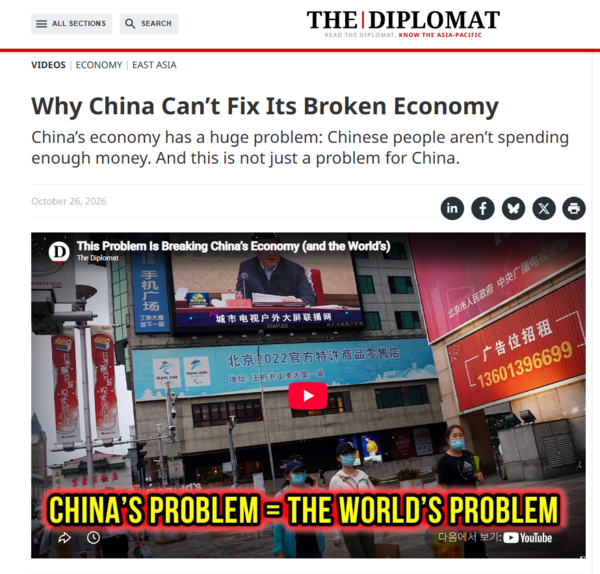 The Diplomat reported on the 26th (local time) that "while China boasts immense manufacturing prowess, domestic consumption as a share of its overall economy remains low compared to major economies," pointing out that "with domestic demand unable to sufficiently absorb production, China has relied on investment and exports to sustain growth rates and employment." The Diplomat added that "consumption accounts for roughly 56% of China’s GDP," though separate empirical datasets indicate that Chinese household final consumption expenditure stood at approximately 40% of GDP in 2024.
Recent data likewise captures this profound disconnect between output and domestic absorption. China’s official third-quarter GDP grew 4.5% year-on-year. Reuters analyzed that "while exports and industrial production supported growth, consumer spending remained relatively sluggish." Retail sales of consumer goods grew by a modest 1.1% in September.
This consumption slump cannot be attributed merely to cultural frugality. Rather, it stems from job and income insecurity, plunging property values, and the heavy burdens of out-of-pocket healthcare and retirement provisions. When declining real estate prices erode household net worth and employment prospects turn precarious, families prioritize boosting precautionary savings or paying down debt over discretionary spending. While this defensive posture is rational for individual households, it stifles aggregate demand and deepens the broader consumption deficit.
[The Investments That Built China’s Miracle Now Turn into a Debt Trap]
China’s investment-driven model served as a formidable growth engine in past decades. When roads, rail links, housing, and industrial facilities were severely lacking, the government and state-run banking institutions poured immense capital into infrastructure and manufacturing. Output expanded, rural labor shifted to productive urban hubs, and the economy surged.
However, continuing to ramp up capital expenditures once basic infrastructure is largely saturated inevitable misallocates funding into low-return endeavors. Even when housing units sit vacant, industrial parks operate below capacity, and toll receipts fail to service underlying debt obligations, the financial liabilities persist. Investment—once the primary catalyst of expansion—inevitably returns as an acute fiscal and banking burden.
At a forum titled "Is China’s Economy Broken?" hosted last month by CSIS, Logan Wright, a China economy specialist at Rhodium Group, examined the financial dimensions behind these dynamics. Drawing from his work Broken China, Wright addressed how decelerating Chinese growth is intimately tied to the structural mechanics of its financial system and how this narrows Beijing’s policy runway.
In a separate interview, Wright noted that "surging credit following the 2008 global financial crisis was heavily channeled into real estate and local government infrastructure." He argued that "the financial architecture that historically powered growth is now constraining it, and reforming fiscal and financial frameworks will require accepting lower economic growth rates in the short term." This assessment underscores the severe structural policy burdens confronting Beijing.
Local fiscal strains reflect this compounding squeeze. According to Reuters, China’s land-sale revenues from January to September fell 27.9% year-on-year. The collapse of land concessions, long the fiscal lifeblood of municipal administrations, has severely curtailed local authorities' capacity to service legacy debts while sustaining social services and basic welfare transfers.
[Propped Up by Exports: But Global Markets Have Their Limits]
Exports have served as China’s primary conduit to offset domestic demand shortfalls. According to Reuters, China’s merchandise trade surplus reached an all-time high of $1.189 trillion (approx. 1,578 trillion KRW) last year. Even as shipments bound for the United States moderated, Chinese manufacturers pivoted outward to alternative international destinations to keep production and headline growth intact.
Trade surpluses continue to accumulate at a rapid pace this year. Reuters noted that China’s goods trade surplus hit $938.1 billion (approx. 1,245 trillion KRW) across the first nine months. While export expansion offers Beijing a release valve for domestic overcapacity, it is triggering profound alarms among key trading partners that inflows of low-priced Chinese goods threaten domestic manufacturing bases and local labor markets.
Europe represents the primary friction point. Reuters reported that "the EU is weighing trade defense measures and industrial protections alongside formal negotiations to counteract industrial disruptions driven by rising Chinese imports." Last year, the EU’s bilateral merchandise trade deficit with China eclipsed €370 billion. The more Beijing relies on external demand to absorb domestic output, the sharper European regulatory pushback becomes. In examining these below-cost outbound shipments, The Diplomat emphasized that "China is engaging in 'dumping' exports."
[The Solutions Are Known: Beijing Must Decide Who Pays the Cost]
Sustaining a transition toward consumer-led expansion requires putting more discretionary income into household pockets and reducing future uncertainties. Elevating wages, bolstering household incomes, and expanding medical coverage, public pensions, and unemployment safety nets naturally empowers households to consume. The International Monetary Fund (IMF) has similarly advised Beijing to pivot toward private consumption-oriented rebalancing and structural social safety net expansions. The foundational premise of such policy is straightforward: a prosperous, economically secure citizenry forms the true basis of national strength.
The fundamental complication lies in the mindset of the CCP leadership, which fears that an economically independent citizenry with rising prosperity inevitably erodes the authoritarian grip of Party rule. In short, there is a deep-seated conviction that widespread personal wealth fosters demands for civic autonomy, something the Party apparatus seeks to prevent at all costs. Rather than allowing broad-based private affluence, the objective of Xi Jinping and the Party establishment remains focused on ensuring subsistence-level welfare while reinforcing the Party’s pervasive, direct dominance over the political and economic landscape.
The challenge now is that even engineering baseline subsistence prosperity has become extraordinarily difficult. Within an economic structure subordinated entirely to Party primacy, engineering sustainable upward mobility for 1.3 billion non-Party citizens demands immense capital reallocations that Beijing refuses to make.
Herein lies the central dilemma facing the Xi administration. The CCP long derived its governing legitimacy from an implicit social contract promising continued economic delivery and rising living standards. However, under Xi’s rigid Party-first governance, systemic breakdowns have emerged. Growth dividends were not balanced across society, but rather concentrated within state channels to preserve and finance the regime’s apparatus—the hallmark of Xi's economic playbook.
This governance model has thoroughly undermined the health of China’s economy. To validate its governing mandate, the leadership staked everything on headline growth metrics, treating a minimum 5% annual GDP target as an existential red line for regime stability and expending immense resources to hit that benchmark.
Yet throughout Xi’s tenure, an obsessive emphasis on "the state advances, the private sector retreats" (Guojin Mintui), deep ideological hostility toward the real estate market, and rigid regulatory crackdowns on sectors like private education have crippled the private economy. Although realization of these policy missteps has belatedly set in, reviving a withered economic ecosystem remains beyond the capability of the current administration—and in practical terms, has become a problem Beijing can no longer untangle.
[Why Times Insight | Only a Fundamental Shift in CCP Ideology Can Save China]
While reports from The Diplomat and CSIS approach the issue from distinct empirical vantage points, they converge on a single fundamental question: Can China continue defending headline growth through credit-fueled investment while successfully rebalancing its economy around household consumption?
The consumption deficit highlighted by The Diplomat raises structural questions about how much of China’s economic output actually accrues to its people. The financial bottlenecks discussed at the CSIS panel question whether the debt-driven financing model that supported past capital accumulation remains viable. The two dilemmas are fundamentally intertwined: when household demand remains weak, authorities face the immediate temptation to double down on exports and debt-fueled construction, yet unprofitable investments only compound the debt load and further constrain the spending capacity of governments and households alike.
It is premature to declare the imminent collapse of the Chinese economy. However, unless the CCP abandons a governance framework centered entirely on Party supremacy over citizen welfare, reversing China’s deep structural malaise will remain impossible. In other words, without relinquishing Xi’s Party-first state management model, China's economy faces an unviable future. The central obstacle remains "Xi Jinping’s ideology of infallibility," which preempts any meaningful policy pivot. While China possesses capable economic technocrats, they remain silenced: criticizing Xi’s economic doctrine risks immediate career termination or outright detention. Even the late Premier Li Keqiang, who periodically voiced realistic critiques of the prevailing economic trajectory, was thoroughly marginalized. The inescapable conclusion is clear: until the Party-centric monopoly over the economy is broken, China’s economic revitalization will remain out of reach.


-중국 푸단대학교 한국연구원 객좌교수
-전 EDUIN News 대표
-전 OUR NEWS 대표
-제17대 대통령직인수위원회 정책기획팀장
-전 대통령실 홍보기획비서관
-사단법인 한국가정상담연구소 이사장
-저서: 북한급변사태와 한반도통일, 2012 다시우파다, 선거마케팅, 한국의 정치광고, 국회의원 선거매뉴얼 등 50여권