
Update2026.11.09 (월)


[China's AI Bubble Has Burst: $480 Billion Vanishes]
Warning lights have flared across Chinese President Xi Jinping’s strategic drive for technological ascendancy—a cornerstone of the country's future growth engine—as Chinese artificial intelligence (AI) stocks plunged up to 40% amid a bursting valuation bubble. Consequently, retail investors who poured money in relying on state support have borne substantial losses, while concerns mount that tech firms will face narrowing avenues to raise R&D capital via public equity markets. While the market rout does not signal the collapse of the Chinese Communist Party (CCP) or the eradication of Chinese AI, Xi’s vision of forging a new era of growth through technological self-reliance is now confronting an unforgiving market test.
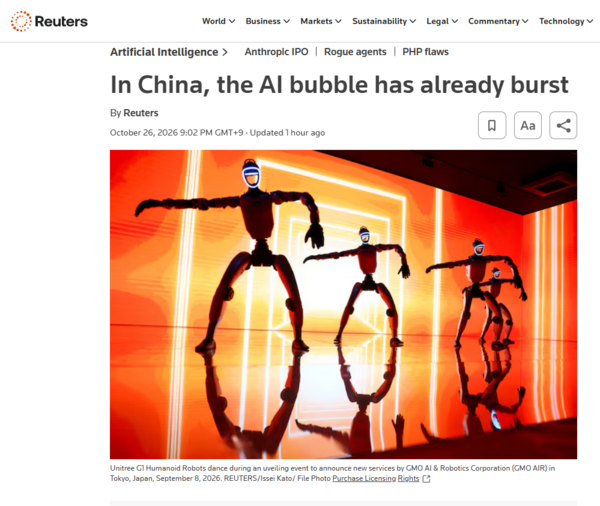
Reuters reported on the 26th (local time) that "the STAR50 Index, which tracks China’s leading AI and semiconductor companies, plunged roughly 40% in under four months, wiping out roughly $480 billion (approx. 636 trillion KRW) in market capitalization." What makes the Reuters analysis striking is that while global markets were debating the long-term sustainability of the AI investment boom, Chinese AI and chip stocks had already plummeted.
Reuters further noted that "the STAR50 Index—comprising flagship names on the Shanghai Stock Exchange’s Science and Technology Innovation Board, known as the STAR Market—dropped about 40% in less than four months," adding that "in the process, roughly $480 billion in market value vanished." The CSI300 Index, which tracks blue chips across mainland China, also retreated roughly 20% from its June peak.
Compared to the US Nasdaq Composite Index, which was down approximately 6% from its all-time high set three weeks earlier at the time of the Reuters report, China's drop was significantly steeper. However, because these figures cover differing time horizons—less than four months for China versus roughly three weeks for the US—they cannot be directly compared as equivalent holding-period returns.
The heavy concentration on AI in the Chinese equity market amplified the shock. According to Goldman Sachs estimates cited by Reuters, AI-related stocks accounted for 42% of total market capitalization and 57% of daily trading volume across mainland China A-shares and Hong Kong H-shares. Because expectations surrounding AI had sustained overall market sentiment far beyond a handful of firms, the synchronized retreat in these equities weighed heavily on the broader stock market.
Dong Baozhen, a Beijing-based fund manager, told Reuters, "China's stock market morphed into a speculative bull market," adding, "What we are witnessing right now is the bubble bursting." While no single catalyst has been confirmed as the sole trigger for the sell-off, market participants view it as a convergence of valuation fatigue, tax concerns, and escalating anxiety over overseas restrictions targeting Chinese-made hardware.
[Retail Investors Trusted "State Backing": Only to See Holdings Cut in Half]
The collateral damage is starkly visible among robotics and semiconductor companies once viewed by investors as the vanguard of China’s technological ascent. Reuters noted that "shares of humanoid robot maker Unitree (known in China as Yushu Technology) have fallen by half since listing in August," pointing out that "the stock had drawn an oversubscription ratio of 8,000 to 1 among retail investors during its IPO." Memory chip maker ChangXin Memory Technologies (CXMT) also saw its shares slide by more than 25% over the past month.
According to Reuters, graphics processing unit (GPU) developers MetaX and Moore Threads face a similar reality. Both firms saw their shares soar 700% and 400% respectively on their debut days last year, yet their stock prices have plummeted by roughly half since July. While high expectations for corporate growth had propelled their valuations, doubts have grown over whether those expectations were excessively stretched.
The case of Chen Wensheng, a Hainan-based entrepreneur and retail investor interviewed by Reuters, illustrates the wider fallout from the rout. Seeing state-backed funds invest in Unitree, Chen concluded that the government was backing the sector and joined the rally, only for himself and his acquaintances to absorb steep losses. While his experience represents a single retail investor, it underscores the extent to which state-backed signals can inflate private market expectations.
Naturally, investments by state funds or government policy support offer no guarantee for share price performance. However, when market participants embrace state backing as definitive proof of sustained upside, the resulting disappointment inevitably targets not only corporate balance sheets, but the authorities’ policy signals as well.
[US Move to Restrict Optical Module Imports: China's Stronghold Shaken]
The sharp retreat in Chinese tech equities was driven not just by domestic overheating, but also by external pressures stemming from technological competition with the United States. A primary example involves optical communication components utilized in AI data centers. Share prices of Zhongji Innolight and Eoptolink dropped roughly 60% from their respective peaks in June and July. Reuters explained that "moves by the US toward curbing Chinese firms' supply to data centers also factored into the decline."
Earlier on August 4, Reuters reported, citing sources, that "the Trump administration is preparing measures to restrict US imports of new-model Chinese-made data center components." Targeted hardware could include optical transceivers—optical modules that transmit data via optical fibers within data centers.
Zhongji Innolight stands out as one of the sectors where Chinese competitiveness is pronounced. According to market research firm Counterpoint Research cited by Reuters, the company holds roughly a 27% share of the global data center optical transceiver market. Should US restrictions take effect, they could directly hit Chinese vendors that generate meaningful revenue from overseas markets.
This captures another paradox facing China's technological drive: even after successfully developing core technologies and securing global market share, intensifying US-China tensions can choke off access to key overseas clients and markets. Mastering technical capabilities does not automatically ensure continued expansion in global sales.
[100x P/E, Heavy Burdens Linger After the Crash: Brakes on Tech IPOs?]
Despite the sharp share price drop, investors are not entirely free from valuation pressures. According to Reuters, the trailing 12-month price-to-earnings (P/E) ratio for the STAR50 briefly touched nearly 250 times before easing to approximately 100 times at the time of reporting. This remains far above the roughly 30 times seen in the Nasdaq-100 at the same juncture. However, because the indices differ in constituent companies, profitability profiles, and calculation methodologies, this metric alone cannot definitively prove exactly how much more expensive Chinese equities are.
The broader problem is that sustained market weakness could impede companies lining up for subsequent public listings. Hao Hong, Chief Investment Officer at Lotus Asset Management in Hong Kong, told Reuters that the downturn will hit the brakes on many companies seeking public listings.
According to Reuters, amid escalating technological competition with the US, China has actively cultivated its domestic stock exchanges as vital funding conduits for tech enterprises. When listed peers trade at sky-high valuations, pipeline companies can easily attract capital at elevated multiples. Conversely, when investors absorb losses and turn cautious toward new IPOs, pre-profit enterprises face severe hurdles in raising capital for R&D and capital expenditures.
The scale of this impact naturally varies by enterprise. Certain firms enjoy government subsidies or maintain ample cash reserves and operating earnings. Nevertheless, as private risk appetite wanes, the burden of funding Xi Jinping’s pursuit of tech self-reliance will tilt even more heavily toward state-directed finance and state-owned balance sheets.
["National Team" Steps In: But Xi's Growth Engine Faces a Crucial Test]
Chinese authorities are not letting the equity slide run unchecked. Bloomberg reported on the 26th that "128.7 billion yuan (approximately $19 billion) flowed into nine exchange-traded funds (ETFs) favored by state-backed investment institutions—known as the 'National Team'—over the preceding week." This marked the largest weekly inflow since the market rout triggered by the US-China trade friction in April 2025. Still, while total ETF inflows are documented, the entire figure cannot be confirmed exclusively as National Team buying.
The market environment authorities aimed to foster was not a boom-and-bust cycle of violent spikes and crashes, but rather a "slow bull"—a steady, moderate upward trend delivering stable returns. Regulators cracked down on leverage and high-frequency trading while state funds trimmed holdings during market surges, yet these measures failed to avert the speculative concentration and subsequent plunge in tech names.
The current setback is particularly painful for the Xi administration because AI occupies the absolute center of its growth blueprint. When the State Council unveiled the "AI Plus" action plan last year, it pledged to embed artificial intelligence broadly across manufacturing, consumer services, and public infrastructure. Beijing also outlined targets to drive the adoption rate of next-generation smart terminals and AI agents above 90% by 2030.
This year's Government Work Report similarly prioritized expanding AI application and commercialization. This demonstrates that Chinese leadership views AI not simply as an emerging technology, but as the critical future industry designed to fill the void left by legacy growth engines.
Does this mean Xi’s ambition has collapsed? Not yet. A drop in equity valuations does not erase overnight the underlying technology, talent, or manufacturing capacity companies have developed. According to IDC data obtained by Reuters, Nvidia's share of China’s data center AI accelerator market fell to 34% in the first half of this year, while Chinese vendors such as Huawei expanded their footprint. While US export controls contributed to this shift, the figure also reflects genuine growth among domestic Chinese players.
Some market participants view the pullback as a selective buying opportunity. According to Reuters, Goldman Sachs included Zhongji Innolight and CXMT on its recommended list earlier this month, while a strategist at BNP Paribas Securities remarked that selective opportunities remain for cautious investors. The popping of an equity bubble is distinct from the total dissolution of an entire industry.
[Why Times Insight | What Fractured Before Xi’s Dream: Capital and Trust]
The crash in Chinese AI equities deals a major blow to Xi Jinping's strategy of technological ascendancy. To be sure, Beijing can still mobilize policy financing, state capital, and direct fiscal subsidies, allowing firms to sustain development and production. Yet the fundamental question—how long private capital will keep financing a state-designed blueprint—carries vastly more weight than before.
The government positioned AI as the emblem of national growth, and markets deployed immense capital on that promise. But when expectations outpace actual profits and trigger sharp market declines, investors will instinctively evaluate risks first the next time authorities champion a priority industry. If trust in policy signaling erodes, channeling private capital into tech ventures becomes far more difficult.
Bridging that financing gap through state coffers carries real costs. Shifting risk from public equity markets onto state-owned financial institutions and fiscal budgets may keep technological self-reliance on track, but the process becomes costlier and more dependent on state support. Against the backdrop of a prolonged property slump and mounting local government debt pressures, this burden is far from trivial.
While it remains premature to forecast the collapse of the Chinese Communist Party, an ongoing pattern where public expectations are repeatedly punctured—first in real estate, and now in advanced technology—imposes political strain on a leadership that has long justified its governance through economic delivery and future prosperity.
Going forward, four indicators will demand close attention: whether AI companies face actual funding freezes; whether stock declines spill over into employment and household consumption; how severely US regulatory measures constrain overseas revenue for Chinese vendors; and whether supplemental state support translates into sustainable corporate profits.
Xi Jinping’s ambition has not disappeared. However, the equity bubble that propped it up has deflated significantly. It is no longer enough for China’s leadership to merely promise technological supremacy. Beijing must now demonstrate through tangible results that this technology can deliver profitability, generate employment, and restore public trust.


-중국 푸단대학교 한국연구원 객좌교수
-전 EDUIN News 대표
-전 OUR NEWS 대표
-제17대 대통령직인수위원회 정책기획팀장
-전 대통령실 홍보기획비서관
-사단법인 한국가정상담연구소 이사장
-저서: 북한급변사태와 한반도통일, 2012 다시우파다, 선거마케팅, 한국의 정치광고, 국회의원 선거매뉴얼 등 50여권